
LMS Buyer’s Guide · India
Best LMS Platforms in India (2026): An Honest Comparison
A straight-talking guide to the learning platforms Indian teams actually shortlist, scored on what matters here: Hindi and regional-language delivery, honest INR pricing, GST-ready billing, mobile-first learners, and compliance you can prove.
Book a free demoThe Indian LMS market is not short of options. It is short of options that price in rupees, speak your team’s languages, and still feel modern. A platform built for a US buyer often lands in India priced in dollars, English-only, and far heavier than a growing company needs.
This guide compares the best LMS platforms in India that businesses shortlist most, and scores each on the criteria that actually decide the deal here, not a generic global checklist. We are honest about the trade-offs, including where our own platform, Nialtus, fits and where it does not. Short on time? Skim the comparison table, then read the review for the platform that matches your situation.
At a glance: the best LMS platforms in India
| Platform | Best for | Hindi + regional languages | Starting point | Our rating |
|---|---|---|---|---|
| Nialtus Top pick | Indian teams that want vernacular reach, INR pricing, and GST-ready billing | Yes, unlimited languages | Affordable, INR + GST | 4.8 / 5 |
| Disprz | Large enterprises running skills programs at scale | Yes | Custom (enterprise) | 4.3 / 5 |
| Zoho Learn | Businesses already inside the Zoho ecosystem | Partial | Low, INR available | 4.1 / 5 |
| TalentLMS | Small teams that want fast English-first setup | Partial | From ~$69/mo (USD) | 4.1 / 5 |
| Docebo | Global enterprises with a large budget | Supported | Enterprise ($$$$, USD) | 4.2 / 5 |
| Moodle | Institutions and teams with developers | Yes, you configure it | Free + hosting/support | 3.9 / 5 |
What Indian businesses actually need from an LMS
Before the feature comparison, get clear on the four things that decide whether a platform works in India or just demos well.
- Vernacular reach, not just English. To train beyond the head office, into Tier 2 and Tier 3 cities, frontline staff, and field teams, you need courses in Hindi and regional languages like Tamil, Telugu, Bengali, and Marathi. Consumption of vernacular content is rising fast, and it is how you reach the majority of your workforce.
- Pricing that respects the rupee. A tool billed in US dollars is punishing at Indian scale. Look for genuine INR pricing and GST-ready invoicing, so finance can process it cleanly and claim input credit.
- Mobile-first delivery. Most Indian learners are on a phone, often on patchy networks. The learner experience has to work on mobile first, not as an afterthought.
- Compliance you can certify. Mandatory training such as POSH (prevention of sexual harassment), plus safety and sector rules in BFSI, IT, and manufacturing, needs completion tracking and certificates that stand up to an audit.
The two forces driving LMS demand in India
First, skilling at national scale. Government platforms like iGOT Karmayogi already run thousands of courses across more than twenty languages for millions of users, and Skill India has normalized digital learning as the default. That expectation flows into the private sector.
Second, compliance that carries legal weight. POSH training is mandatory, and the new Digital Personal Data Protection (DPDP) Act raises the bar on how employee and learner data must be handled. An LMS that certifies mandatory training and treats data responsibly is now part of staying compliant, not just a training convenience.
The platforms, reviewed
Nialtus
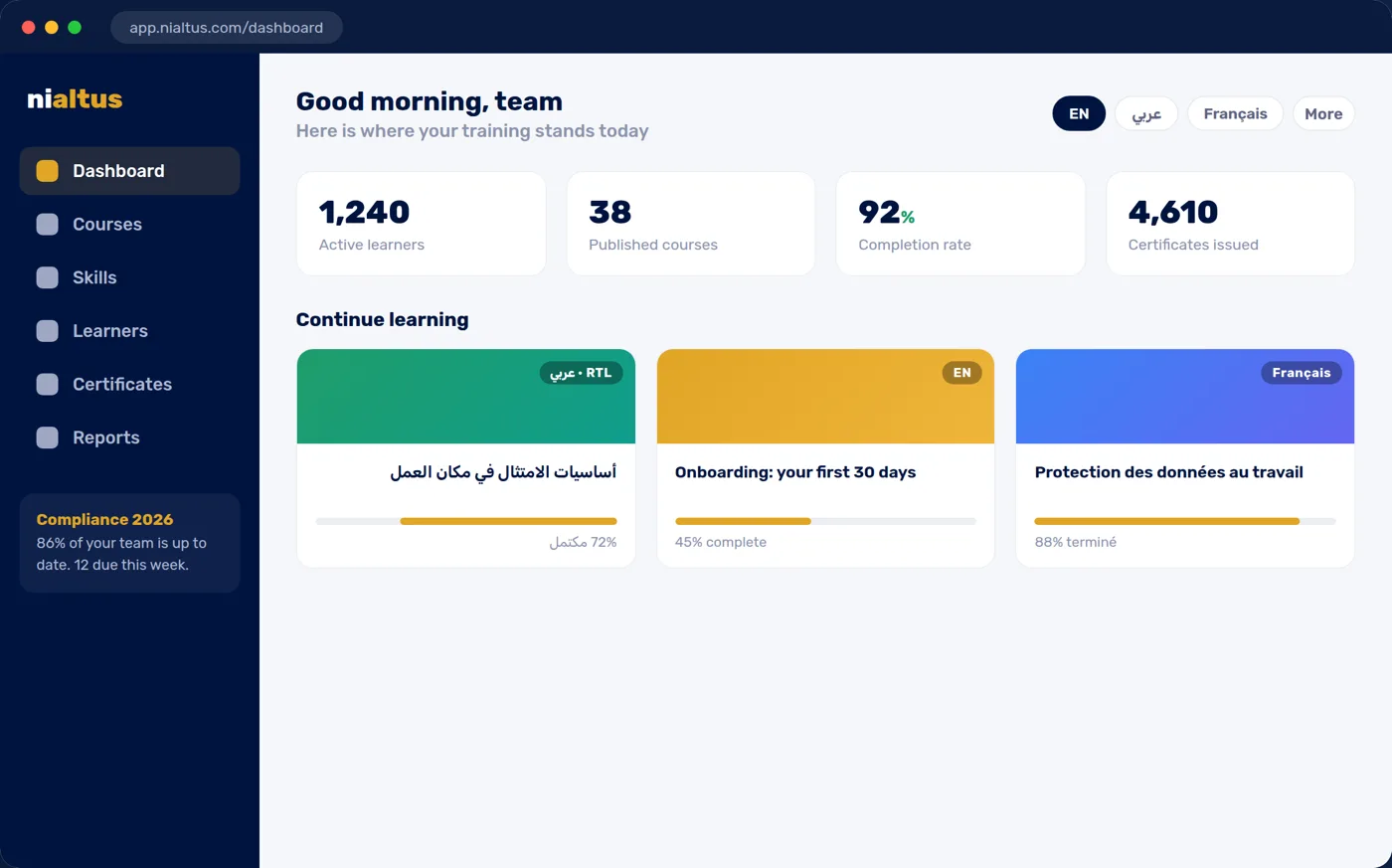
Best for IndiaNialtus is a modern, multi-tenant LMS built for teams that need real localization at a price that makes sense in India. Its strongest cards here are language and money. It supports unlimited languages, so one course reaches your Hindi, Tamil, Telugu, Bengali, and English speakers from a single setup, and it bills in INR with GST-ready invoicing and local tax support. On top of that you get AI course authoring, a skills and competency framework, white-label with your own domain, mobile-friendly delivery, SCORM and xAPI support, and audit-ready certificates for programs like POSH. For a growing Indian company or a training provider, it hits the vernacular, price, and compliance needs together.
Strengths
- Unlimited languages, strong for Hindi and regional delivery
- Honest INR pricing with GST-ready billing
- AI authoring speeds up course creation
- Compliance tracking and certificates for POSH and safety
- White-label and custom domain
- Mobile-first learner experience
Watch-outs
- A newer name than Moodle or the global brands
- Not built for the very largest global enterprises needing hundreds of prebuilt integrations
- If you want a huge prebuilt Indian course marketplace out of the box, confirm content options
Disprz
Disprz is an India-built, skills-first platform with a strong enterprise footprint, especially in IT services and BFSI. If your goal is measurable capability building across a large workforce, it is one of the best local choices and understands the market well. The trade-offs are the usual enterprise ones: pricing is custom and quote-based, and the platform carries more process and weight than a small or mid-size company setting up its first LMS usually wants.
Strengths
- India-built, strong local understanding
- Excellent skills and capability focus
- Proven at enterprise scale
Watch-outs
- Custom, quote-only pricing
- Enterprise-oriented, heavier to adopt
- More than a first-time SMB buyer needs
Zoho Learn
Zoho Learn is an India-born, affordable option that is a natural pick if you already live inside the Zoho ecosystem, and it offers INR pricing. For knowledge management plus lightweight training, it is good value. Where it can fall short for a training-led company is depth: advanced course authoring, a full competency framework, and rich vernacular delivery are not its core focus, so training-heavy teams often outgrow it.
Strengths
- Affordable, INR pricing
- Seamless for existing Zoho users
- Good for knowledge plus light training
Watch-outs
- Best value only inside the Zoho ecosystem
- Lighter on advanced training features
- Partial vernacular depth
TalentLMS
TalentLMS is easy and quick to set up, with a low entry price, which makes it popular with small English-first teams. If your training is simple and in English, it delivers fast. The friction for an Indian buyer is that pricing is in US dollars, which stings at scale, and vernacular support is partial, so it does not reach much beyond an English-comfortable head office.
Strengths
- Fast, simple setup
- Low entry price
- Good for small English teams
Watch-outs
- USD pricing, costly at Indian scale
- Partial vernacular support
- Thins out on multilingual and white-label
Docebo
Docebo is a powerful enterprise platform with deep AI features and a big integration ecosystem. For a large Indian enterprise with global operations and a matching budget, it is a credible choice. But it is priced and sold for exactly that buyer: quote-only enterprise pricing in dollars, and enough complexity that you need trained admins to run it. For most Indian companies it is more platform, and more cost, than the situation calls for.
Strengths
- Enterprise depth and mature AI
- Large integration ecosystem
- Suited to global operations
Watch-outs
- Premium USD, quote-only pricing
- Complex, needs trained admins
- Overkill for most Indian teams
Moodle
Moodle is deeply established in India, especially in education, and for good reason: no license fee, total control, and support for Indian languages if you configure it. If you have developers and want to own the stack, it is powerful. The real cost is effort. You host, secure, update, and configure everything yourself, and a modern, mobile-first learner experience takes serious work. For a company without a technical team, running it well often costs more in time than a paid platform costs in fees.
Strengths
- No license fee, open source
- Total control and customization
- Widely used and understood in India
Watch-outs
- You host, secure, and maintain it
- Needs developers to run well
- Modern experience requires heavy setup
What separates the best LMS platforms in India in 2026
The bar has moved. A few years ago, an English course library at a low price was enough to win an Indian deal. In 2026, buyers expect more, and the platforms that win reflect it.
AI that saves real time. The strongest platforms now use AI to draft courses, build quizzes, and speed up translation into Hindi and regional languages, turning weeks of authoring into days. For a lean Indian team, that is the difference between launching this month and next quarter.
Skills, not just courses. With a huge share of the workforce due for reskilling, buyers increasingly want to see capability, not just completion. A competency framework that maps training to real skills is becoming a baseline expectation, not a premium extra.
Proof and price that finance trusts. Audit-ready reporting for POSH and safety, plus clean INR billing with GST, is now a first-order requirement, not an afterthought.
Weigh any shortlist against these shifts. The best LMS platforms in India are the ones already built for where the market is going, not where it was.
How to shortlist the best LMS platforms in India
Use this checklist when you compare vendors, so a slick demo does not hide a gap you only find after you sign. Tick each item off as you test it.
Your India LMS shortlist
Whatever you shortlist, weigh it against these six points rather than a long feature grid. The best LMS platforms in India are the ones that pass all six in a real test, not the ones with the biggest brochure.
Why affordable and vernacular is the real India gap
Read the shortlist together and the gap is obvious. The most powerful platforms are priced in dollars for global enterprises. The easiest ones are English-first and thin on Indian languages. The free one costs you a technical team. And the strongest local enterprise player is built for big, complex programs, not a growing company setting up its first serious LMS.
What is missing is the platform that is genuinely multilingual for Indian teams, honestly priced in rupees with GST-ready billing, modern in its features, and light enough to launch without a project. That is the shape of the problem Nialtus is built for, which is why it lands first in this guide for India, not because it wins every single line, but because it fits the Indian buyer’s real constraints better than the alternatives.
There is a quieter cost to getting this wrong. When a course only exists in English, the learners in your regional offices and on the factory floor quietly disengage, completion drops, and your compliance reporting suffers, which is the opposite of what you bought the platform for. A tool that treats Hindi and regional languages as first-class, and prices honestly in rupees, protects both the reach and the budget that make training worth doing. That is why we weight vernacular depth and clean INR billing so heavily when we rank the best LMS platforms in India.
Five questions that reveal the best LMS platforms in India
Vendors always demo their strengths. These five questions surface the weaknesses that matter here, and they are worth asking before any contract is signed.
- Can you show me the same course in Hindi and a regional language? A live yes proves vernacular delivery is real, not a roadmap promise.
- Is the price in rupees, with a proper GST invoice? A dollar-denominated quote will hurt at Indian scale and slow your finance team down.
- How does a course run on a budget phone and a weak network? Most of your learners are mobile-first, and a heavy platform loses the field team.
- How do you track and certify mandatory training like POSH? The answer shows whether compliance evidence is built in or bolted on.
- How long until we are live, and do we need a technical team? This separates a platform you can launch this month from a project that drags for a quarter.
Ask these of every vendor on your shortlist. The best LMS platforms in India answer all five plainly, while the weaker options change the subject or promise to send details later.
Frequently asked questions
Which LMS is best for Hindi and regional-language training?
Look for a platform that delivers the same course in many languages from one setup. Nialtus supports unlimited languages and is built for Hindi and regional delivery, and Moodle can do it if you configure it. Global platforms like TalentLMS and Zoho Learn offer only partial vernacular support, which limits how far past an English-speaking head office you can train.
Does the LMS bill in INR and provide GST invoices?
This is where many global tools fall down, since they bill in US dollars. Nialtus prices in INR with GST-ready invoicing and local tax support, and Zoho Learn offers INR pricing too. Docebo and TalentLMS are typically priced in dollars, which is costlier at Indian scale and adds friction for finance.
Can it handle POSH and other mandatory compliance training?
Yes. The right platform tracks completion of mandatory training like POSH, stores audit-ready records, and issues certificates. You provide the training content, and the LMS gives you the proof you need for compliance.
Is it mobile-friendly for field and frontline teams?
It should be. Most Indian learners are on phones, often on slower networks, so mobile-first delivery is essential to reach frontline and field staff. Nialtus is built mobile-first, and any platform you shortlist should be tested on a real phone before you buy.
What is the best LMS for a small or mid-size Indian company?
For a growing team that needs vernacular reach, INR pricing, and compliance tracking without enterprise weight, Nialtus is our top pick. If you are already deep in Zoho, Zoho Learn is convenient. If you run large, complex skills programs, Disprz is worth evaluating.
How quickly can we go live in India?
A modern, self-serve platform gets you live in days, not a quarter-long project. Most of the effort is preparing your courses and vernacular content, not configuring software or waiting on a services team. If a vendor needs a long implementation before you can run a single course, factor that into your timeline and budget.
Will it work for teams spread across many Indian cities?
Yes. Distributed teams across Tier 1, Tier 2, and Tier 3 cities are the norm in India, so the platform has to deliver reliably on mobile and on slower networks, and in the languages people actually speak. That mix of mobile-first delivery and vernacular reach is what lets you train the whole workforce, not just the head office.
See vernacular training and INR pricing in one place
The quickest way to judge an LMS for India is to see it deliver a course in Hindi and a regional language, then check the price is in rupees with a clean GST invoice. Book a short walkthrough and we will show you all of it.
Book your India demo