

Two minutes a day, and the training stops fading
People forget most of a course within a month. Drills bring the questions back on a spacing that follows each person’s own memory, out of the course you already built, without anyone writing a thing.
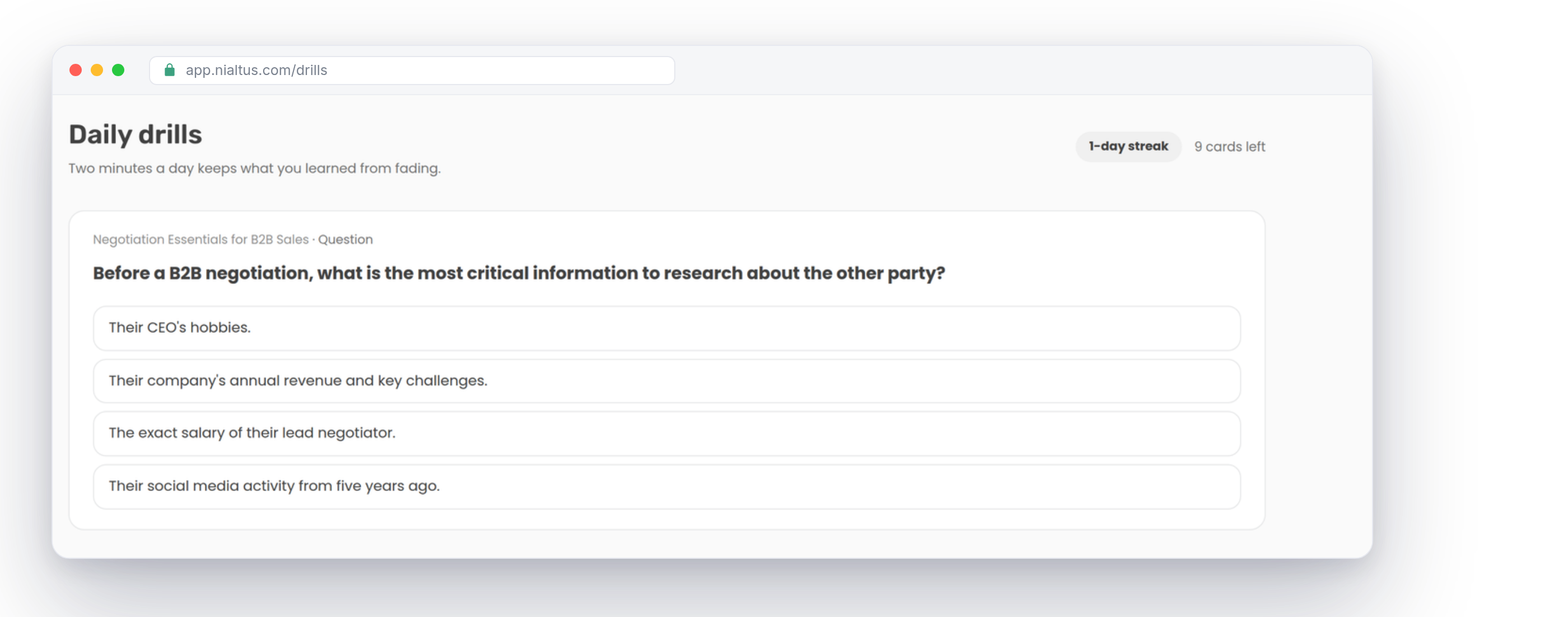
The course ends. The forgetting starts.
Completion is measured on the day. Retention is what the job runs on, and nothing in a normal LMS touches it: the course closes, the score is filed, and a month later most of it is gone.
How memory is actually kept
Spaced repetition, the thing language apps proved works, applied to the training you already run.
It builds itself
Every quiz and assessment question in a course becomes a card, and you can write your own or let AI draft them from the course content. Nothing new to author, nothing to maintain separately.
It follows each person
Five boxes. A right answer moves a card up and pushes the next review further away; a wrong answer sends it back to the start. Two people who took the same course end up with two different schedules, because they remember different things.
It stays small
A daily cap, hardest cards first, and a reminder only when enough have piled up. Two minutes a day is the whole commitment, and a streak is there for the people who like one.
It tells you who is struggling
Miss the same card three times running, or fail an assessment twice, and that person is flagged for retraining, with their manager told. You reopen the course for them in one click.
Five boxes, and the gap grows as they remember
Every card sits in a box. Get it right and it moves up a box, and the next time you see it is further away: tomorrow, then two days, then four, then a week, then a fortnight. Get it wrong and it drops straight back to box one and comes round again tomorrow.
That is the whole mechanism, and it is why ten minutes of drills a week beats an hour of re-reading. The things a person already knows quietly stop appearing. The things they do not keep coming back until they stick.
The cards are already written
Turn drills on and the questions inside your courses become the practice: quiz questions, assessment questions, and any drill items you write yourself. AI can draft more from what the course actually says, and nothing reaches a learner until somebody approves it.
Cards start a couple of days after somebody finishes the course, which you can change. There is no second course to build and nothing to keep in step: edit the quiz and the practice follows.
Two minutes, not a second course
A learner opens Drills and sees only what is due today, hardest first, capped so it never becomes a queue to dread. Answer, see whether you were right, move on. A streak counts the days, and a reminder goes out only when enough cards have piled up to be worth the interruption.
The cap and the reminder threshold are both yours to set. So is whether reminders go out at all.
about two minutes12-day streak
Set the pace to the work
Three paces ship with the platform, and the workspace picks one. Intensive brings a card back after one day, then one, two, four, seven. Standard, the default, runs one, two, four, seven, fourteen. Relaxed stretches to two, four, eight, fifteen, thirty.
Safety-critical work wants intensive. An annual compliance refresher wants relaxed. The same course can be drilled at either pace by different workspaces.
The people who are quietly struggling become visible
Somebody who misses the same card three times running is not having a bad day. Somebody who fails the same assessment twice is not going to pass it on the third try unaided. Both are flagged for retraining, and their manager is told unless you turn that off.
From the flag you can reopen the course for that person with a deadline, keeping their certificates and past scores, or mark it handled if you have dealt with it another way. Both thresholds are settings, and either can be switched off.
“Which tolerance applies to a slip gauge?” · wrong 38%
And the questions nobody gets right are a course problem
Per course you see how many cards are in circulation, how many people practised in the last thirty days, what share of cards are mastered, and the items the cohort finds hardest to remember.
A question the whole room keeps missing is rarely a room full of people who are not trying. It is usually a part of the course that did not land, which is exactly what the effectiveness report will tell you from the other direction.
Drafted by AI, approved by a human
For courses with few questions of their own, drills can be drafted from the course content: recall questions and short scenarios, generated from what the material actually says rather than invented.
They arrive as drafts. Somebody reviews them, edits what is clumsy, approves what is right, and only then do they reach anybody. The draft queue and the approved set are both on the course’s Drills page.
How it works
Switch it on once; it runs itself after that.
One switch in settings, with the sources: quiz questions, assessment questions, your own items, or all three.
Open a course’s Drills page, look at what was generated or drafted, and approve what should be practised.
Intensive, standard or relaxed, a daily cap, and how many due cards should trigger a reminder.
Cards appear at /drills a couple of days after they finish. Two minutes, hardest first, with a streak.
Mastery per course, the hardest items, and a list of people flagged for retraining.
What it changes
The difference between training delivered and training retained.
What drills include
All of it configurable, none of it compulsory.
Learning Everest builds training for plants, hospitals and retail floors where forgetting has a cost. Drills exist because the question after every rollout was the same one: will they still know this in March?
Questions about drills
How it behaves, and what you control.
Send us a course and we will show you the cards it would generate and what a week of practice looks like.

The LMS that builds courses with you, wraps them in your brand, and keeps every team coming back.
© 2026 Nialtus · Part of Learning Everest Private Limited · Privacy · Cookies · Terms