
Close the skill gaps you can finally see
Define the skills each role needs, map training to them, and watch a live competency matrix show exactly where your people stand and where to invest.
Course completions tell you people showed up, not that they can do the job
Most platforms track that a course was finished. They cannot tell you whether the person can actually do the job, or how their capability compares to what their role needs. Nialtus measures capability, not just activity.
Skills you can measure, not guess
Move from a pile of course completions to a real map of who can do what.
Define the target
Build a skills taxonomy, set proficiency levels, and say which skills, at which level, each job role needs to hold. Now capability has a definition, not a vibe.
See the gap
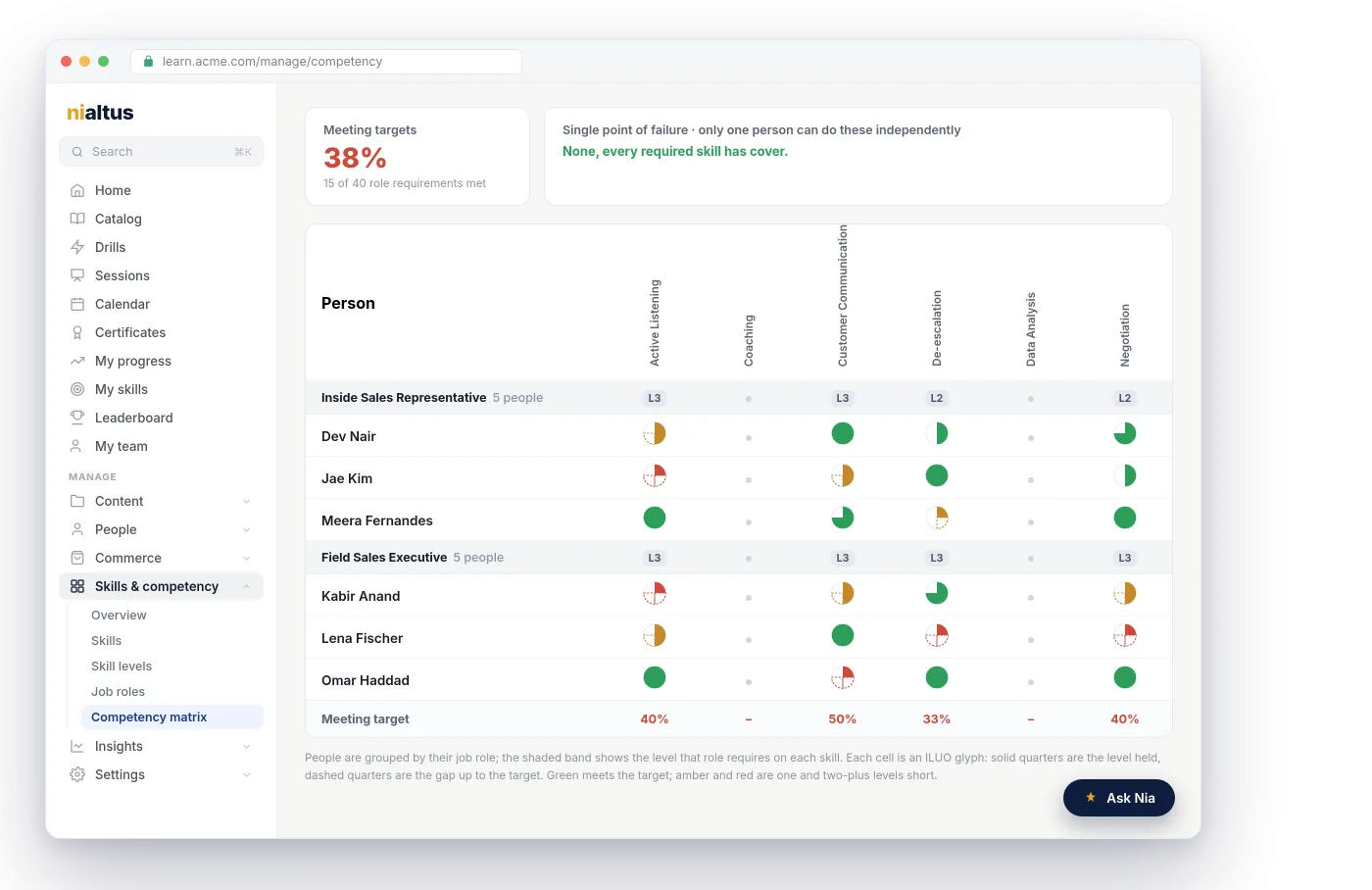
A live competency matrix shows every person against their role’s target, so gaps stop being a hunch and become a specific, actionable plan.
Close it with the right training
Map courses to skills, so assigning the right learning to close a specific gap is one obvious step rather than a guessing game.
A living map of your workforce’s skills
A skills survey is out of date the day it is finished, which is why so many organizations do not really know what their people can do. Nialtus keeps the picture alive. As people complete training and are assessed, the competency matrix updates, so leadership sees the real state of capability whenever they look. Each person is plotted against the skills and levels their role needs, grouped by team or job role, so you can read a whole group at a glance or drill into one person.
Define what good actually looks like
Skills are meaningless unless everyone agrees what each level means. Nialtus lets you define proficiency levels, so beginner, capable, and expert have a concrete definition for each skill rather than being a matter of opinion. That shared language is what makes the whole system trustworthy: a manager assessing one team and a manager assessing another are measuring against the same bar. Without it, a skills matrix is just colored squares. With it, it is a fair, comparable picture of real capability.
Tie every course to the skill it builds
The link between learning and capability is where most platforms go silent. Nialtus makes it explicit: map each course to the skills it develops, so completing the right training visibly moves a person toward the level their role needs. When a gap appears in the matrix, the training that closes it is right there, one step away. Learning stops being a catalog people browse and becomes a targeted response to a specific, measured need.
Invest where it actually moves the needle
When you can see which skills are thin across a team, you stop spreading budget thinly and start targeting the gaps that matter. Reskilling becomes a decision you can defend with data rather than a hopeful initiative. You can see that a whole team is weak on a skill that is about to become critical, and act before it hurts, or notice that an area everyone assumed was a gap is actually fine, and redirect the money. That is the difference between spending on training and investing in capability.
Grow people into the roles you need next
A skills matrix is not only a snapshot of today. It is a map of where people can go. Because you have defined what each role requires, an employee can see exactly what stands between them and their next role, and you can grow your own bench deliberately instead of always hiring from outside. Internal mobility, succession, and career development all run on the same foundation: a clear, current picture of who has which skills, at which level.
Report on capability, not just activity
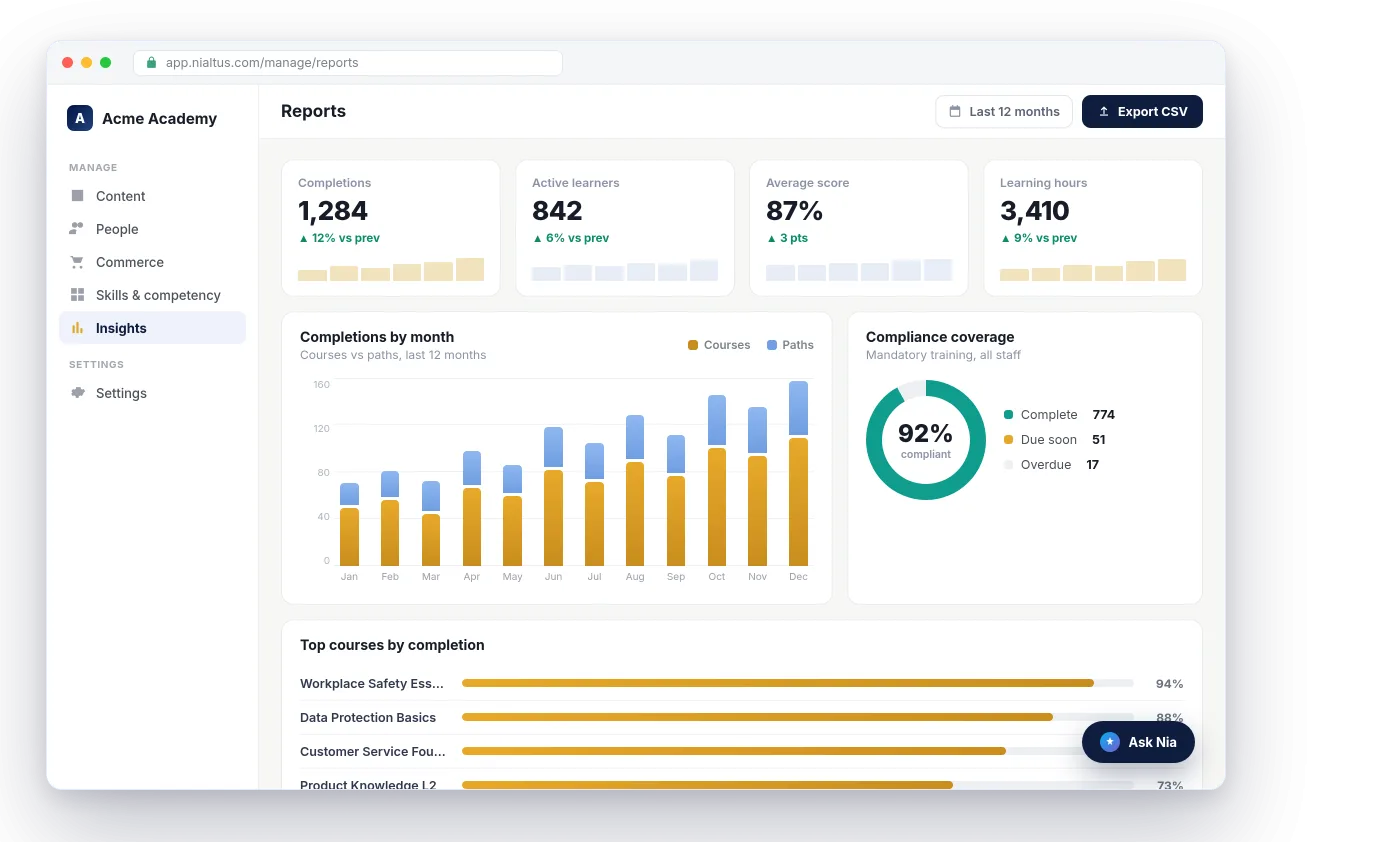
When leadership asks whether the workforce is ready, you need more than a completion percentage. Nialtus lets you export where capability is thin and where it is growing, by team, role, or skill, so you can answer the real question with real evidence. Over time you can show that a targeted program actually lifted a skill across a group, which is the kind of proof that keeps a learning budget funded. Activity reports show effort. Capability reports show results.
How upskilling works in Nialtus
From defining skills to closing real gaps.
Define the skills that matter to your organization and organize them in a way that fits how you actually work.
Say what each level means and which skills, at which level, each job role needs to hold, so capability has a clear definition.
Link your courses to the skills they build, so closing a specific gap is one obvious step rather than a search.
See every person against their role’s target, grouped by team or role, and spot exactly where capability is thin.
Assign the right training at the real gaps, and export the growth over time to show leadership the investment is working.
What a skills-based approach gives you
The payoff of measuring capability, not activity.
What powers real upskilling
The building blocks of a skills-based program.
Learning Everest has helped organizations build capability, not just deliver courses. Nialtus makes that visible: a live picture of the skills your workforce holds, and the ones you still need.
Skills and upskilling questions
Straight answers on how Nialtus turns training into measurable capability.
Bring a role and we will map its skills and show the competency view.