

Turn training into skills you can measure
Build a skills framework, define what good looks like at each level, and map every course to the skills it grows. A live competency matrix then shows you exactly where your team meets the mark and where the gaps are, role by role.
Three ways training becomes measurable skill
Not a skills spreadsheet you update by hand, but a living picture that moves as your people learn.
Speak one language about skills
Define your own skills and describe each level, from aware to expert, so a rating means the same to a manager, a learner, and HR. No more everyone inventing their own scale.
See capability, not just completions
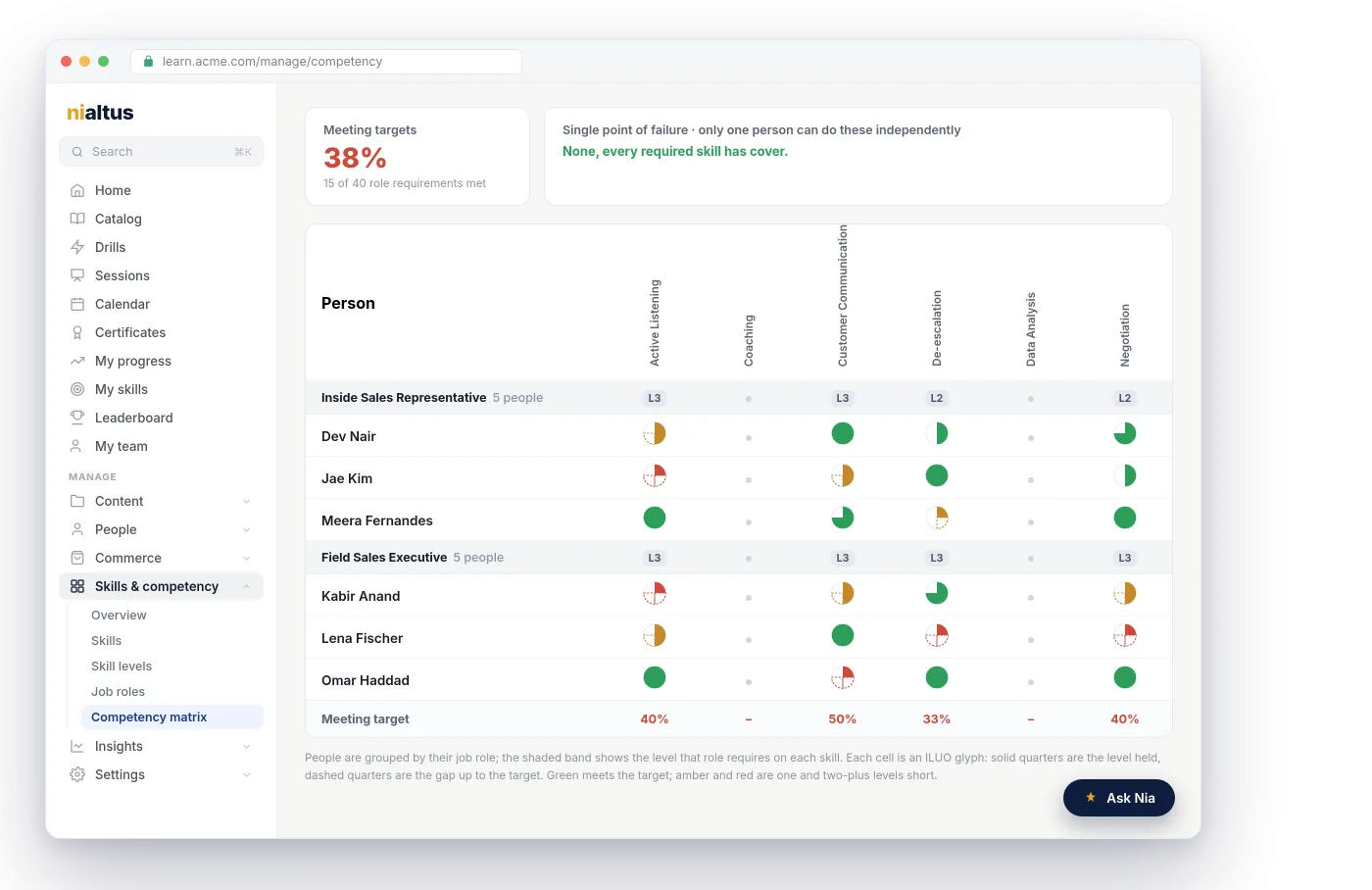
The competency matrix turns training into a live picture of what your team can actually do, grouped by role, with gaps in amber and red and cover you can trust.
Grow the skills the role needs
Map courses to skills and each person gets a plan from where they are to their target. Training stops being a checkbox and starts moving real capability.
Define what good looks like, level by level
Set up your own skills and describe each proficiency level, from just aware to expert. Nialtus uses a clear four-step scale so a rating means the same thing across every team, and a manager and a learner finally speak the same language about a skill.
See the gap, then close it with a course
Map each course to the skills it builds, and the matrix turns into a plan. A learner sees where they stand against their role and the exact course that moves them up a level. You see cover across the team, and where a skill rests on a single person.
From a skill list to a living picture of capability
Everything you need to define, measure, and grow the skills your roles depend on.
Built by Learning Everest, a company that has mapped skills and closed capability gaps for enterprise teams for years. This is the competency model we always wished our own tools had.
Questions we hear a lot
Straight answers, so you know what you are getting before you switch it on.
Ask us on a quick call and we will walk you through it in your own setup.