
LMS Buyer’s Guide · Kingdom of Saudi Arabia
Best LMS Platforms in Saudi Arabia (2026): An Honest Comparison
A practical, no-fluff look at the learning platforms Saudi teams actually shortlist, judged on the things that matter in the Kingdom: genuine Arabic and right-to-left support, Saudization and compliance tracking you can prove, SAR pricing with local tax billing, and data handling that stands up to the PDPL.
Book a free demoChoosing a learning management system in Saudi Arabia is a different problem from choosing one in London or Dubai. Your workforce mixes Saudi nationals and a large expatriate population. A growing share of your training is tied to national policy rather than nice-to-have. And many platforms that shine in an English demo quietly break the moment you switch the interface to Arabic and expect the whole screen to mirror.
This guide compares the best LMS platforms in Saudi Arabia that organizations shortlist most often, and scores each one on the criteria that truly decide the purchase in the Kingdom. We name the trade-offs plainly, including where our own platform, Nialtus, is and is not the right fit.
At a glance: the best LMS platforms in Saudi Arabia
| Platform | Best for | Native Arabic + full RTL | Starting point | Our rating |
|---|---|---|---|---|
| Nialtus Top pick | Saudi teams that want Arabic done right, Saudization-ready reporting, and honest SAR pricing | Yes, full RTL by design | Affordable, transparent | 4.8 / 5 |
| Ensaan Technologies | HR-led buyers who want learning bundled with regional talent and labor-policy tooling | Supported, HR-suite led | Quote-based | 4.2 / 5 |
| Disprz | Skills-first upskilling programs across the GCC | Supported | Mid-market ($$$) | 4.2 / 5 |
| Docebo | Large enterprises with a big budget | Supported, add-on feel | Enterprise ($$$$) | 4.3 / 5 |
| TalentLMS | Smaller teams running mostly English training | Partial, English-first | Low-cost tiers | 4.0 / 5 |
| Moodle | Institutions with in-house technical teams | Community add-ons | Open source (self-hosted) | 3.9 / 5 |
What Saudi businesses actually need from an LMS
Before you compare features, get clear on the four things that separate a platform that works in the Kingdom from one that only works in the demo.
- Arabic that is more than translated text. Real right-to-left mirrors the whole interface, not just the labels. Menus, progress bars, tables, certificates, and quiz layouts all have to flow from the right. Many global tools bolt Arabic on as a language pack and leave the layout stuck in a left-to-right frame, which looks wrong to any native reader.
- Many languages in one platform. A Saudi employer typically trains Saudi nationals in Arabic alongside expatriate staff who work in English, Urdu, Hindi, Tagalog, and more. You want one course library that serves every group, not a separate system per language.
- Compliance you can prove. Saudization targets under Nitaqat, health and safety rules, and sector regulators all expect records. You need completion tracking, certificates, and exportable reports that hold up when an auditor or a ministry asks for evidence.
- Pricing and billing that fit the Kingdom. Budgets are set in Saudi riyals, invoices need correct VAT, and finance teams do not want to reconcile a foreign-currency subscription every month. Local billing removes real friction.
Why training just became non-optional in Saudi Arabia
Saudization, administered through the Nitaqat system, ties a company’s ability to hire and operate to how many Saudi nationals it employs and develops. Falling out of your band brings real consequences for work permits and government services, so building the skills of Saudi staff is now a business requirement, not a goodwill exercise.
The practical effect: employers are formalizing training. The Human Resources Development Fund (HRDF, known as Hadaf) co-funds many training and upskilling programs, which makes structured, trackable learning even more valuable, because subsidized programs still need clean records of who completed what.
The platforms, reviewed
Nialtus
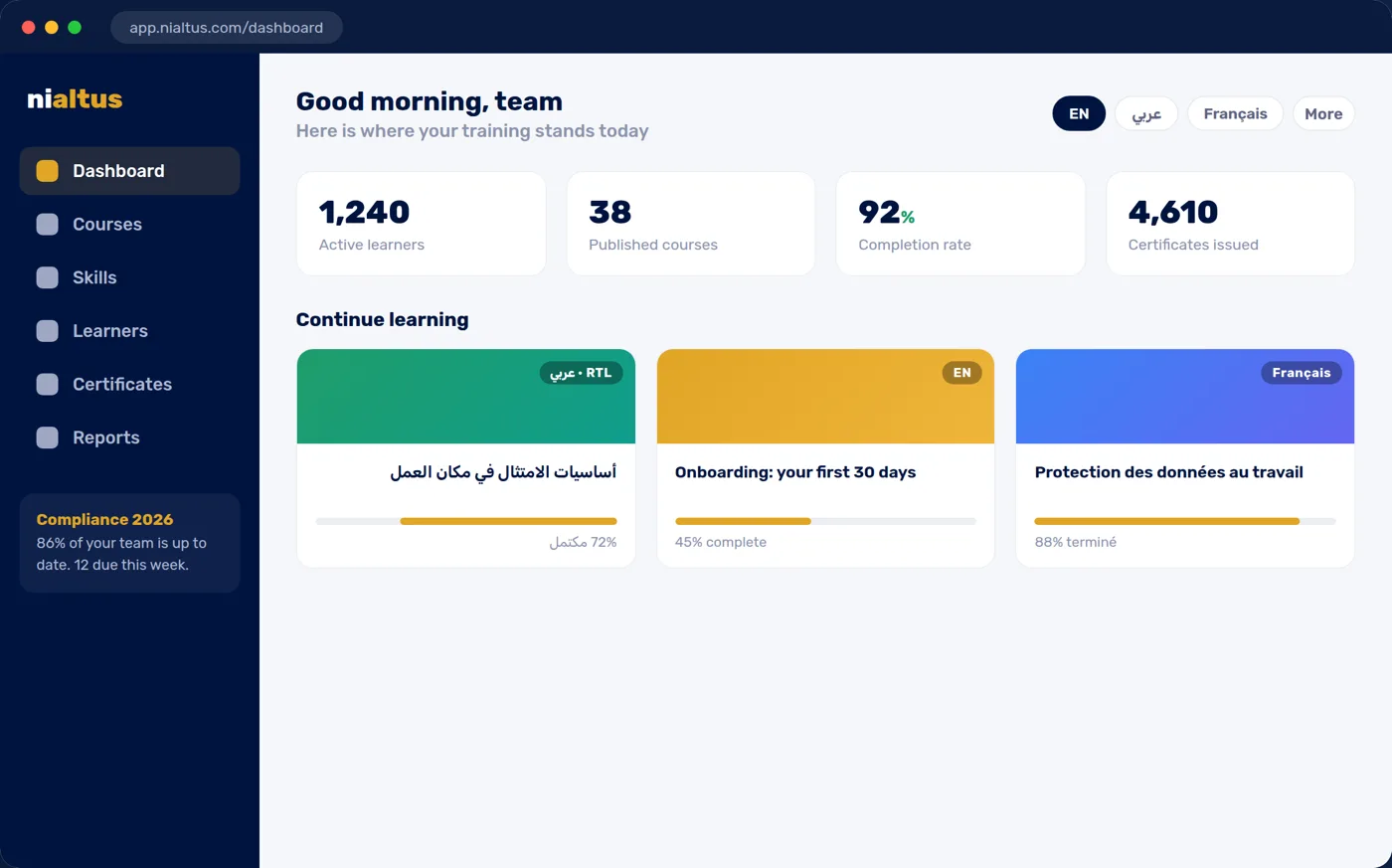
Best for Saudi ArabiaNialtus is a modern, multi-tenant LMS built for teams that need genuine localization without an enterprise price tag. Arabic is a first-class citizen: the entire interface mirrors to right-to-left, and you can verify it live in a demo rather than taking it on faith. It carries unlimited languages in one platform, AI course authoring to speed up content creation, a skills and competency framework, white-label branding with a custom domain, SCORM and xAPI support, and compliance tracking with certificates. Billing runs in SAR with local VAT handling, which matters to Saudi finance teams.
Strengths
- Arabic-first, full RTL you can verify in a live demo
- Unlimited languages in one platform for mixed Saudi and expatriate teams
- SAR pricing with correct VAT on invoices
- Saudization-friendly completion tracking, certificates, and exportable reports
- AI authoring, skills framework, SCORM and xAPI without enterprise pricing
Watch-outs
- Newer name than the global incumbents
- Very large government tenders may still require an in-Kingdom hosting arrangement to confirm
Ensaan Technologies
Ensaan is a regional HR and talent management provider with deep roots in the Saudi and wider GCC market. Learning tends to arrive bundled inside a broader HR suite, which appeals to buyers who want performance, talent, and training under one roof and who value a partner that understands Saudi labor policy and reporting needs. If you are HR-led and want the whole employee lifecycle in one place, it is worth a look.
Strengths
- Strong regional presence and Saudi labor-policy familiarity
- Learning packaged with wider HR and talent tooling
Watch-outs
- Learning depth can trail a dedicated LMS
- Quote-based pricing and suite bundling can raise the entry cost
Disprz
Disprz is a skills-first learning and upskilling platform with a visible presence across the GCC. Its strength is mapping learning to skills and career pathways, which suits organizations running structured development programs rather than one-off course catalogs. Arabic is supported, though buyers who need flawless full-screen RTL should test it against real Arabic content before committing.
Strengths
- Strong skills and capability-building focus
- Established in the regional market
Watch-outs
- Skills-heavy model can be more than smaller teams need
- Confirm full RTL fidelity with your own Arabic content
Docebo
Docebo is a powerful enterprise platform with mature AI features and deep configurability, and it is a common shortlist name for large Saudi organizations with the budget to match. Arabic is supported, but the localization can feel like an add-on rather than a native design, and pricing is premium and quote-only, which puts it out of reach for many mid-market buyers.
Strengths
- Enterprise depth and mature AI features
- Highly configurable for complex organizations
Watch-outs
- Premium, quote-only pricing in foreign currency
- Arabic and RTL can feel bolted on rather than native
TalentLMS
TalentLMS is a clean, approachable platform that smaller teams like for its low cost and quick setup. It works well when your training is mostly in English and your compliance needs are light. For a Saudi employer that has to serve Arabic-speaking staff and produce Saudization-grade records, the English-first design and thinner RTL support become real limits.
Strengths
- Low cost and fast to launch
- Simple, friendly interface for small teams
Watch-outs
- English-first with only partial RTL
- Lighter on deep compliance reporting
Moodle
Moodle is the best-known open-source LMS and is widely used across Saudi universities and institutions. It is flexible and has no license fee, but that freedom comes with a cost: you need in-house technical people to host, secure, update, and localize it. Arabic and RTL are achievable through community plugins and configuration, though the polish and support depend entirely on the team you put behind it.
Strengths
- No license fee and fully customizable
- Large global community and plugin ecosystem
Watch-outs
- Needs real technical resources to run well
- Arabic polish and support depend on your own team
What separates the best LMS platforms in Saudi Arabia in 2026
The bar has moved. A platform that only stores courses is no longer competitive here, because the pressures on Saudi employers now reward speed, skills, and evidence.
AI that saves real time. With Vision 2030 pushing digital learning across the Kingdom, teams are producing far more training than before. AI authoring that drafts courses and assessments, including in Arabic, turns weeks of content work into days.
Skills, not just courses. Nitaqat rewards developing Saudi nationals, and HRDF co-funding favors structured programs. A skills and competency framework lets you show capability growth, not just seat time.
Proof on demand. Regulators, auditors, and government tenders want records. The platforms that win are the ones that turn training into clean, exportable evidence with certificates attached.
Weigh any shortlist against these shifts. The best LMS platforms in Saudi Arabia are the ones already built for where the market is going.
How to shortlist the best LMS platforms in Saudi Arabia
Use this checklist when you compare vendors. It keeps the conversation on the criteria that actually decide the purchase in the Kingdom, rather than the features that only look good in a slide.
Your Saudi Arabia LMS shortlist
Whatever you shortlist, weigh it against these six points. A vendor that clears all six is rare, and it usually tells you who has genuinely built for the Saudi market rather than adapted for it late.
Why affordable and Arabic-first is the real Saudi gap
Look closely at the shortlist and a pattern appears. The platforms with the deepest features tend to be enterprise-priced and English-first, with Arabic added later. The affordable platforms tend to be light on true RTL and on the compliance reporting Saudi employers now depend on. Buyers are asked to choose between price, features, and a properly localized experience.
That leaves a clear opening for the platform that is genuinely Arabic-first, priced in SAR, and still carries AI authoring, a skills framework, and audit-ready compliance tracking. Saudi employers should not have to overpay for enterprise software just to get Arabic that reads the way their staff expect.
There is a quieter cost to getting this wrong. When the interface only half-mirrors, Arabic-speaking staff quietly disengage, completion drops, and the very Saudization and audit reports you depend on lose their value. A platform that treats Arabic as a first-class language, and prices honestly in riyals, protects both the reach and the evidence that make training worth doing. That is why we weight Arabic depth and SAR billing so heavily when we rank the best LMS platforms in Saudi Arabia.
There is a quieter cost to getting this wrong. When Arabic is only half-mirrored, native readers disengage, completion rates slip, and the very Saudization evidence you need becomes harder to produce. A platform that treats Arabic as a first-class language, and prices honestly in riyals, protects both the reach and the budget that make training worth doing. That is why we weight Arabic depth and SAR billing so heavily when we rank the best LMS platforms in Saudi Arabia.
Five questions that reveal the best LMS platforms in Saudi Arabia
Vendors always demo their strengths. These questions surface the weaknesses, and the answers separate the platforms built for the Kingdom from the ones adapted for it.
- Can you show me the platform in Arabic, right now? Watch whether the whole screen mirrors to RTL, or just the words change while the layout stays left-to-right.
- How do you handle Saudization and audit reporting? Ask to see the actual completion report and certificate you would hand to an auditor or a ministry.
- Is pricing in SAR with correct VAT? Foreign-currency subscriptions create monthly reconciliation work and hide the true cost.
- Where is our data stored, and how do you meet the PDPL? For larger and government-facing buyers, ask whether in-Kingdom hosting is available.
- Will our existing and HRDF-funded content run? Confirm SCORM and xAPI so you are not rebuilding courses you already own.
Ask these of every vendor on your shortlist. The confident, specific answers come from the teams that have actually done the work for Saudi Arabia.
Frequently asked questions
Which LMS has the best Arabic and RTL support in Saudi Arabia?
The platforms that mirror the entire interface to right-to-left, rather than only translating the labels, give the best Arabic experience. Nialtus is built Arabic-first with full RTL by design, and you can confirm this in a live demo. The most reliable test is to ask any vendor to switch to Arabic in front of you and watch whether menus, tables, progress bars, and certificates all flow from the right.
How does an LMS help with Saudization and Nitaqat compliance?
An LMS does not change your Nitaqat band, but it produces the evidence that structured development of Saudi nationals is happening. Completion tracking, certificates, and exportable reports let you show who trained on what and when. That record is useful for internal governance, for HRDF-funded programs, and whenever an auditor or authority asks for proof.
Does the LMS need to be hosted inside Saudi Arabia?
It depends on the buyer. The PDPL, enforced by SDAIA, sets rules on how personal data is processed and, for sensitive data, favors keeping it in the Kingdom unless conditions are met. Many private companies operate with compliant cloud arrangements, while larger organizations and government tenders often require in-Kingdom hosting. Ask each vendor directly about data location and PDPL alignment.
Can one platform train both Saudi nationals and expatriate staff?
Yes, and it should. A single platform that carries unlimited languages lets you deliver Arabic courses to Saudi staff and English, Urdu, Hindi, Tagalog, or other content to expatriate teams from one library. This avoids running separate systems and keeps all your reporting in one place.
Is training in Saudi Arabia eligible for HRDF support?
The Human Resources Development Fund, known as Hadaf, co-funds a range of training and upskilling initiatives for Saudi nationals. Eligibility and terms vary by program, so confirm current details with HRDF. Whatever the funding route, a platform that keeps clean completion records makes any subsidized program easier to run and report on.
How much should a good LMS cost in Saudi Arabia?
Costs range widely, from open-source Moodle with no license fee but real technical overhead, to enterprise platforms quoted in the tens of thousands. The value question is whether you get true Arabic support, compliance reporting, and SAR billing at a price that fits your budget. Affordable, Arabic-first options now deliver capabilities that once required enterprise contracts.
What is Vision 2030’s connection to e-learning in Saudi Arabia?
Vision 2030 places heavy emphasis on digital transformation and skills, and the government has invested significantly in e-learning infrastructure and platforms. For employers, the practical takeaway is that digital learning is now central to national policy, which raises the expectation that companies develop their people through structured, trackable programs.
See the Arabic-first difference for yourself
The fastest way to judge an LMS for Saudi Arabia is to watch it run in Arabic, in full right-to-left, with the reports and certificates you would actually hand to an auditor. Book a demo and see whether the platform was built for the Kingdom or merely adapted for it.
Book your Saudi Arabia demo