
LMS Buyer’s Guide 2026
The Best LMS Platforms in Singapore (2026)
A practical, honest comparison of the best LMS platforms in Singapore for finance, technology, logistics, healthcare, and professional services teams. Built for SkillsFuture-aware training, a genuinely multilingual workforce, and PDPA-grade data protection, without enterprise-tier pricing.
Book a free demoChoosing between the best LMS platforms in Singapore is less about feature checklists and more about local fit. A Singapore learning platform has to serve an English-first but deeply multilingual workforce, respect the Personal Data Protection Act (PDPA), and support the kind of structured, trackable training that funding-conscious employers expect. That is a different brief from a generic global rollout.
This guide ranks the best LMS platforms in Singapore for 2026 on the things that actually decide the shortlist: multilingual delivery for a diverse and regional workforce, clean tracking and reporting for claimable training, honest SGD pricing, and modern AI-assisted course building. Nialtus comes first for local fit, and we name five real competitors fairly, with their strengths and their watch-outs.
The best LMS platforms in Singapore at a glance
| Platform | Best for | Multilingual + SE Asia ready | Starting point | Our rating |
|---|---|---|---|---|
| Nialtus Top pick | SMEs and mid-market teams that want local fit without enterprise pricing | Yes, unlimited languages incl. Mandarin, Malay, Tamil, Bahasa | Transparent SGD monthly plans | 4.8 / 5 |
| Docebo | Large enterprises with dedicated L&D teams | Yes, strong localization | Enterprise quote only, high entry cost | 4.4 / 5 |
| TalentLMS | Small teams wanting a simple, quick start | Partial | Per-user tiers, free small plan | 4.3 / 5 |
| 360Learning | Collaborative, peer-authored learning | Partial | Per-user, mid-market pricing | 4.2 / 5 |
| Gnowbe | Mobile-first frontline microlearning (Singapore-built) | Yes, mobile and regional focus | Per-user, SME-friendly | 4.1 / 5 |
| Moodle | Institutions wanting open-source control | Yes, community language packs | Free software, hosting and admin cost extra | 3.9 / 5 |
What Singapore businesses actually need from an LMS
Singapore’s economy is compact, competitive, and export-facing. A learning platform here has to do more than host videos. It has to hold up across languages, regulators, and regional expansion. Four needs come up in almost every shortlist we see.
- Genuine multilingual delivery. Singapore’s workforce spans English, Mandarin, Malay, and Tamil, and teams that expand into Malaysia, Indonesia, or Vietnam need Bahasa and more. Translation cannot be an afterthought bolted onto an English course.
- PDPA-grade data protection. Learner records are personal data. Under the PDPA an organisation must protect that data, limit how it is used, and be able to notify the regulator of a notifiable breach within three calendar days. Your LMS has to make that straightforward, not risky.
- Trackable, claimable-ready training. Employers who want to make the most of SkillsFuture funding need clean attendance, completion, and assessment records. Even where a course is not directly subsidised, structured tracking is what turns training spend into something you can report on.
- Honest, predictable pricing. Enterprise LMS quotes in Singapore can run into five figures a year before a single learner logs in. Growing teams want transparent SGD pricing they can budget against without a procurement cycle.
The SkillsFuture and SDL reality, stated honestly
Every employer in Singapore already pays the Skills Development Levy (SDL), a mandatory levy of 0.25 percent of each employee’s monthly wages, subject to a minimum of 11.25 dollars, on the first 4,500 dollars of pay. That money funds the Skills Development Fund and the SkillsFuture Singapore (SSG) subsidies that can cover up to 70 percent of course fees for individuals, and up to 90 percent for SMEs under Enhanced Training Support.
Be clear on one thing: an LMS does not make your courses SkillsFuture-claimable on its own. To offer subsidised, claimable training you must become an SSG-approved training provider with approved courses. What the right platform does is make that path realistic, with the tracking, assessment records, and reporting that approval and audits demand. Nialtus is built for that discipline without pretending to be a shortcut around SSG approval.
The best LMS platforms in Singapore, reviewed
Nialtus
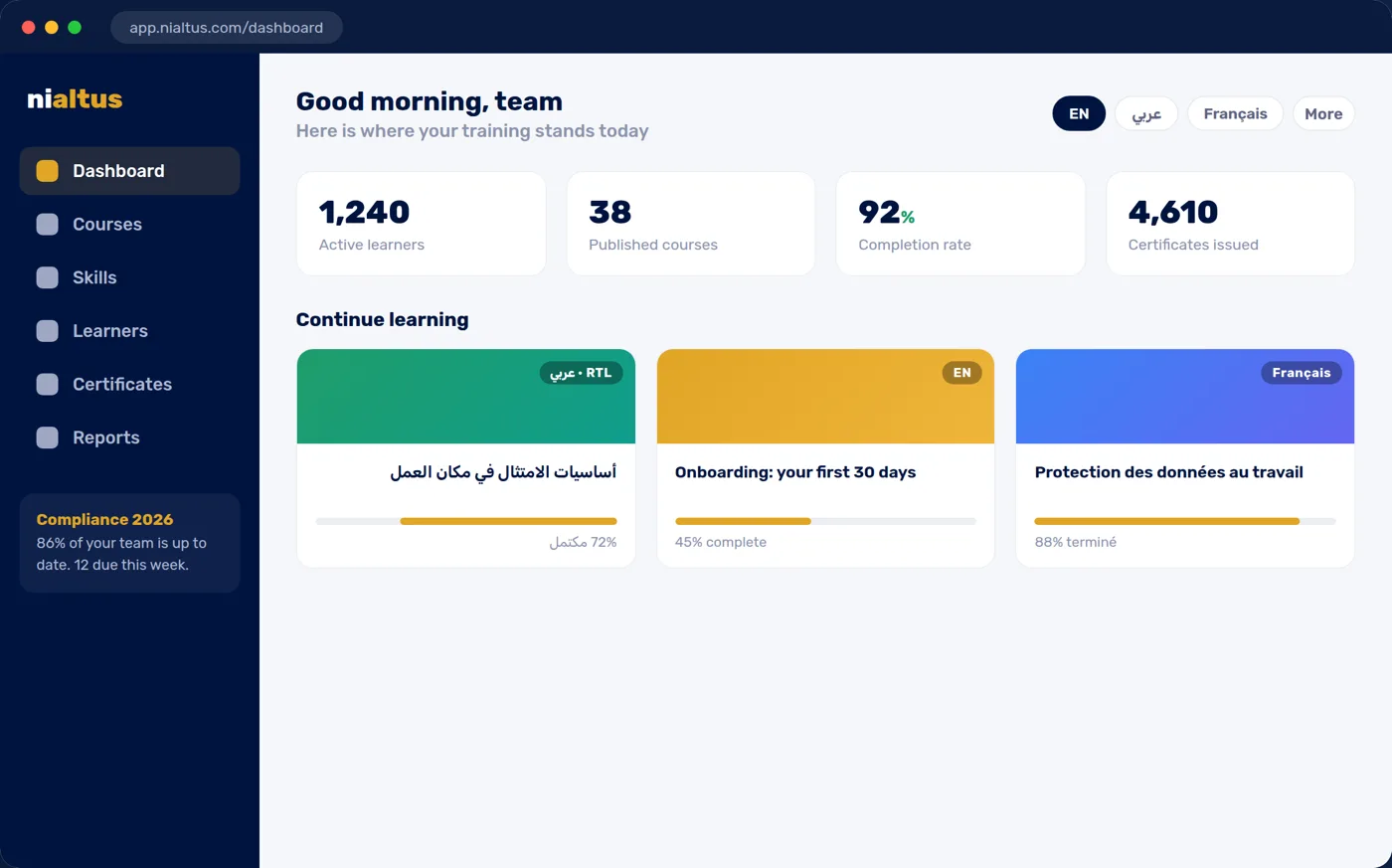
Best for SingaporeNialtus is a modern, multi-tenant LMS built for exactly the constraints Singapore teams work under. It delivers unlimited languages, so a single course can run in English, Mandarin, Malay, Tamil, and Bahasa without maintaining separate copies. Its AI course authoring turns existing material into structured lessons quickly, and its skills and competency framework maps training to real job roles. White-label branding, custom domains, multi-currency and local-tax billing, SCORM and xAPI support, compliance tracking, and certificates all come standard, at transparent SGD pricing rather than an enterprise quote.
Strengths
- Unlimited languages, ideal for a diverse local workforce and SE Asia rollouts
- AI authoring and a skills framework that reduce course-build time
- Clean compliance tracking and certificates that suit claimable, audit-ready training
- Transparent SGD pricing with white-label and custom domain included
Watch-outs
- Newer name than the global incumbents, so brand recognition is still growing
- SkillsFuture claim eligibility still depends on your own SSG provider approval, not the platform
Docebo
Docebo is a mature, AI-enabled enterprise LMS with strong localization and deep configurability. For large Singapore organisations in finance or technology that have a dedicated L&D function and budget, it is a serious contender with an extensive feature set and a large partner ecosystem.
Strengths
- Enterprise-grade features, analytics, and integrations
- Strong multilingual and localization support
- Established brand with a broad implementation network
Watch-outs
- Enterprise pricing that is out of reach for many SMEs
- Quote-based, so no transparent SGD entry price
- Can be heavier to configure than smaller teams need
TalentLMS
TalentLMS, from Epignosis, is a well-regarded, easy-to-use platform aimed at small and mid-sized teams. It is quick to launch and reasonably priced, which makes it popular with Singapore SMEs that want to get training online without a long project.
Strengths
- Simple, fast to set up and administer
- Free tier for very small teams and predictable per-user pricing
- Solid core LMS features and clean interface
Watch-outs
- Multilingual delivery is workable but not as deep as regional teams need
- Per-user pricing rises as headcount grows
- Less suited to complex competency or compliance programmes
360Learning
360Learning, founded in France, is built around collaborative, peer-authored learning. It works well for technology and professional-services firms that want subject-matter experts to create and maintain courses rather than relying on a central team.
Strengths
- Strong collaborative authoring and social learning
- Good for capturing internal expertise quickly
- Modern interface with useful analytics
Watch-outs
- The collaborative model is a shift some teams take time to adopt
- Multilingual and regional depth is partial for SE Asia rollouts
- Mid-market pricing that can climb with scale
Gnowbe
Gnowbe is a Singapore-founded, mobile-first microlearning platform launched in 2015. It shines for frontline and deskless teams in logistics, retail, and hospitality where short, mobile lessons and behaviour change matter more than long courses. Being locally built, it understands the regional context well.
Strengths
- Excellent mobile-first microlearning and engagement
- Singapore roots and regional understanding
- Good for frontline and distributed teams
Watch-outs
- Microlearning focus is less suited to full compliance curricula
- Lighter on deep enterprise LMS administration
- Best as a complement to, not a replacement for, a full LMS in some cases
Moodle
Moodle is the long-standing open-source LMS, widely used by universities and institutions. For Singapore organisations with technical capacity that want full control and no per-seat licence, it is flexible and mature, with community language packs covering local languages.
Strengths
- Open source with no licence fee and full control
- Huge plugin ecosystem and community language support
- Proven at scale in education
Watch-outs
- You carry hosting, security, PDPA safeguards, and maintenance yourself
- Interface feels dated without customisation work
- Total cost of ownership can exceed a hosted SaaS once staffing is counted
What separates the best LMS platforms in Singapore in 2026
The gap between platforms has narrowed on basic features. Almost every serious LMS now does courses, quizzes, certificates, and reporting. What separates the leaders in Singapore is how well they fit local reality.
Language is the real dividing line. A platform that treats Mandarin, Malay, Tamil, or Bahasa as first-class rather than an add-on lets you run one course for a mixed team and expand across Southeast Asia without rebuilding content each time.
Data protection has become a buying criterion. With the PDPC’s 2026 guidance extending to generative AI and a three-day breach notification window, buyers now ask hard questions about where learner data lives and how it is protected before they sign.
Pricing transparency separates the confident from the cautious. Vendors that publish clear SGD pricing tend to be the ones you can deploy quickly, while quote-only enterprise tools add procurement time and cost.
Finally, AI authoring has moved from novelty to genuine time-saver. The platforms that use it to turn existing material into structured, multilingual courses give lean L&D teams real leverage.
How to shortlist the best LMS platforms in Singapore
Before you book demos, score each platform against the criteria that actually matter in Singapore. Use this checklist to keep the comparison honest and local.
Your Singapore LMS shortlist
If a platform cannot tick most of these, it is not a fit for Singapore, however strong its global reputation. The best LMS platforms in Singapore earn their place by clearing every line, not just the feature list.
Why multilingual, funding-aware delivery is the real Singapore gap
Most global LMS vendors were designed for a single dominant language and a single market. They translate, but grudgingly, and their pricing assumes large enterprise budgets. In Singapore that leaves a gap: teams that are multilingual by default, that want to make training count against real funding and reporting needs, and that cannot justify enterprise-tier spend.
That gap is exactly where the best LMS platforms in Singapore win. A platform that delivers unlimited languages, supports PDPA-grade data handling, keeps records clean enough for claimable training, and does it all at transparent SGD pricing is solving the local problem rather than a generic one. That is the case for putting Nialtus at the top of this list.
Five questions that reveal the best LMS platforms in Singapore
The right questions cut through demo polish faster than any feature grid. Ask each vendor these five, and listen for honest answers rather than confident ones.
- Can one course run in five languages without me maintaining five copies? This exposes whether multilingual is real or cosmetic.
- Where is learner data stored, and how do you support PDPA obligations? If the answer is vague, the risk is yours to carry.
- What does it cost in SGD for my headcount, all in? A clear number signals a platform you can deploy without a procurement marathon.
- Can your records support claimable or audited training? The honest vendor will explain that SSG approval is on you, but their tracking makes it feasible.
- How long from signature to first live course? Weeks is a good answer; many months signals hidden complexity.
The platforms that answer these plainly are the ones that belong on your shortlist.
Frequently asked questions
What are the best LMS platforms in Singapore in 2026?
Our top pick is Nialtus for its unlimited languages, AI authoring, PDPA-friendly data handling, and transparent SGD pricing. Strong alternatives include Docebo for large enterprises, TalentLMS for simple SME setups, 360Learning for collaborative authoring, Gnowbe for Singapore-built mobile microlearning, and Moodle for open-source control.
Can an LMS make my training SkillsFuture-claimable?
No platform makes training claimable on its own. To offer SkillsFuture-subsidised courses you must become an SSG-approved training provider with approved courses. A good LMS makes that path realistic by keeping clean attendance, assessment, and completion records that approval and audits require.
How does the Skills Development Levy relate to training?
Every Singapore employer pays the SDL, 0.25 percent of each employee’s monthly wages, with a minimum of 11.25 dollars, on the first 4,500 dollars of pay. It funds the Skills Development Fund and the SSG subsidies that can cover up to 70 percent of course fees, and up to 90 percent for SMEs under Enhanced Training Support.
What does PDPA mean for choosing an LMS?
Learner records are personal data under the PDPA. Your LMS should help you protect that data, limit its use to informed purposes, manage retention, and support notifying the PDPC of a notifiable breach within three calendar days. In 2026 the PDPC also issued guidance on personal data used in generative AI, which matters if your LMS uses AI features.
Which LMS is best for a multilingual Singapore workforce?
Nialtus leads here because it supports unlimited languages, so a single course can run in English, Mandarin, Malay, and Tamil, and add Bahasa and others for Southeast Asia expansion, without maintaining separate copies. Moodle and Gnowbe also handle multiple languages well.
Are there Singapore-built LMS options?
Yes. Gnowbe is a Singapore-founded, mobile-first microlearning platform launched in 2015, well suited to frontline and deskless teams. It is a strong regional option, though its microlearning focus makes it lighter for full compliance curricula than a complete LMS.
How much should a Singapore LMS cost?
It varies widely. Enterprise platforms like Docebo are quote-based and can run into five figures a year. SME-friendly tools such as TalentLMS and Nialtus offer transparent, predictable pricing. Nialtus publishes SGD plans that include white-label branding and a custom domain, so you can budget without a long procurement cycle.
See why Nialtus tops the best LMS platforms in Singapore
Unlimited languages, AI authoring, PDPA-friendly data protection, audit-ready tracking, and transparent SGD pricing, built for how Singapore and Southeast Asia teams actually learn. Book a walkthrough tailored to your sector and see the fit for yourself.
Book your Singapore demo