
LMS Buyer’s Guide · Egypt
The Best LMS Platforms in Egypt for 2026
A practical, independent guide to choosing a learning platform for Egypt’s fast-growing, young workforce, where affordability, true Arabic delivery, and scale matter more than a long feature list.
Book a free demoChoosing among the best LMS platforms in Egypt in 2026 is really a question about scale and cost. Egypt has one of the largest and youngest workforces in the region, and reskilling it is a national priority under Egypt Vision 2030 and the wider Digital Egypt strategy. That combination of size and ambition means the platform you pick has to train thousands of people affordably, in fluent Arabic, without falling apart under load.
This guide compares the best LMS platforms in Egypt on the things that actually decide success here: honest local pricing in a market where every Egyptian pound and every dollar of foreign-currency cost is scrutinized, genuine right-to-left Arabic that reads naturally to a native speaker, and the flexibility to serve both Arabic-first employees and the English-speaking outsourcing teams that serve multinational clients. We rank six platforms, explain who each one suits, and name competitors fairly so you can shortlist with confidence.
At a glance: the best LMS platforms in Egypt
| Platform | Best for | Native Arabic + full RTL | Starting point | Our rating |
|---|---|---|---|---|
| Nialtus Top pick | Affordable, Arabic-first training at national scale | Yes, full RTL | Affordable monthly plans, EGP-friendly billing | 4.8 / 5 |
| Almentor | Ready-made Arabic learning content in Egypt | Yes, Arabic-native | Content subscription | 4.2 / 5 |
| Disprz | Frontline and skilling-led enterprises | Partial | Custom quote | 4.1 / 5 |
| Docebo | Large multinationals with big budgets | Partial | Custom quote, premium tier | 4.3 / 5 |
| TalentLMS | Small teams wanting a quick start | Partial | Free tier, then paid plans | 4.0 / 5 |
| Moodle | Institutions with in-house IT | Partial, needs setup | Free, self-hosted | 3.9 / 5 |
What Egyptian businesses actually need from an LMS
Egypt is not a small, high-budget Gulf market. It is a large economy with tight cost discipline, a huge population of young workers entering the labor force, and employers who train at volume across banking, telecom, tourism, manufacturing, and a sizable business-process-outsourcing sector. The best LMS platforms in Egypt succeed by matching that reality rather than importing pricing and assumptions built for smaller, wealthier markets.
- Affordability at scale. When you are onboarding and reskilling thousands of people, per-user cost is not a detail, it is the deciding factor. A platform priced for a few hundred premium seats simply does not work for an Egyptian rollout.
- Real Arabic, not a translated skin. Menus, learner screens, quizzes, and certificates all need to read right-to-left and feel native to an Arabic speaker, while still supporting English for teams that serve international clients.
- Local, low-friction billing. Cost sensitivity and foreign-currency friction make EGP-aware pricing and clean local tax handling far more than a convenience.
- Compliance you can prove. Egypt’s Personal Data Protection Law No. 151 of 2020 raised the bar on how employee data is handled, so records, consent, and completion tracking need to be defensible.
The Egypt wedge is affordability plus Arabic, not quotas
Guides written for the Gulf lead with nationalization targets and Emiratization-style quotas. That framing does not fit Egypt.
Here the pressure is scale and cost. The winning platform trains a very large young workforce cheaply, in fluent Arabic and English, and holds up under Egypt’s Digital Egypt push. Keep that lens as you read the reviews below.
The platforms, reviewed
Nialtus
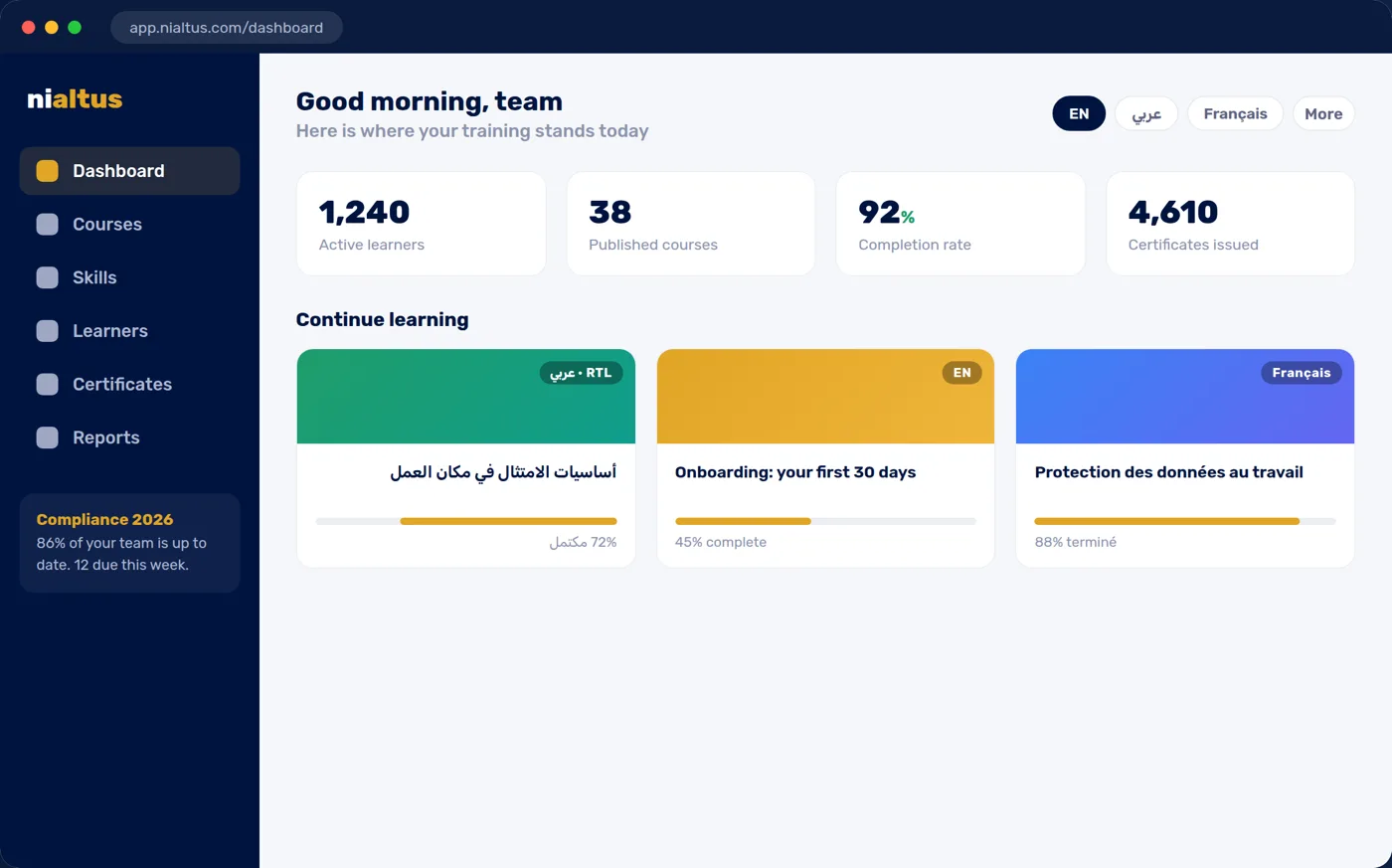
Best for EgyptNialtus is a modern, affordable, multi-tenant LMS built for exactly the pressures Egyptian employers face. It delivers unlimited languages with full right-to-left Arabic, AI-assisted course authoring so lean teams can produce training fast, a skills and competency framework, white-label branding with your own custom domain, and multi-currency billing with local tax handling. Add SCORM and xAPI support, compliance tracking, and certificates, and you have a platform that scales to a national workforce without a premium-market price tag.
Strengths
- Affordable pricing that works for training thousands, with EGP-friendly, multi-currency billing and local tax handling
- Genuinely native Arabic and full RTL, plus English side by side for outsourcing and multinational teams
- AI authoring lets small learning teams build courses quickly across a big catalog
- White-label and custom domain make it feel like your own platform, not a rented tool
- Skills framework, compliance tracking, SCORM and xAPI, and certificates in one place
Watch-outs
- Newer name than the global incumbents, so it wins on fit and value rather than brand recognition
- Very large enterprises may want a guided onboarding to map existing content and roles
Almentor
Almentor is an Egyptian-born learning company with one of the largest libraries of professional Arabic video content in the region, and a business arm that sells that content to employers. If your priority is ready-made, high-quality Arabic learning material rather than a fully brandable delivery platform, it is a strong local option.
Strengths
- Deep, native Arabic content produced for the Egyptian and wider Arab audience
- Local roots and brand recognition inside Egypt
- Good fit for soft-skills and professional development at scale
Watch-outs
- Primarily a content library, not a full white-label LMS for your own courses and compliance
- Less suited to SCORM, xAPI, and custom competency frameworks
- Limited control over branding and your own domain
Disprz
Disprz is a skilling-led platform popular with enterprises that train large frontline and field teams. It has real strengths in skills mapping and mobile learning, which suits parts of Egypt’s telecom, retail, and manufacturing sectors.
Strengths
- Strong skilling and competency features for frontline workforces
- Mobile-first delivery that suits distributed teams
- Enterprise reporting and analytics
Watch-outs
- Arabic and RTL support is partial and varies by module
- Enterprise pricing by quote, which can strain cost-sensitive budgets
- Heavier to roll out than lighter platforms
Docebo
Docebo is a capable, well-known enterprise LMS with a broad feature set and strong AI positioning. It is a reasonable fit for large multinationals operating in Egypt that already have the budget and internal team to run a premium platform.
Strengths
- Mature, feature-rich enterprise platform with strong integrations
- Established brand trusted by large global organizations
- Solid analytics and administration
Watch-outs
- Premium pricing that is hard to justify at Egyptian scale
- Arabic and RTL are supported but not the product’s center of gravity
- Complexity can slow down smaller learning teams
TalentLMS
TalentLMS is a lightweight, easy-to-start platform that suits small Egyptian teams testing structured training for the first time. It gets you live quickly, though it is less suited to national-scale, Arabic-first rollouts.
Strengths
- Simple, quick to launch, with a free tier to start
- Clean interface that non-technical admins can manage
- Predictable published pricing for small teams
Watch-outs
- Arabic and RTL support is partial and basic
- Costs climb as learner numbers grow to Egyptian scale
- Limited white-label and competency depth
Moodle
Moodle is the open-source standard, free to license and widely used by universities and institutions in Egypt. It is flexible and low-cost on paper, but the real cost is the in-house IT effort needed to host, secure, and maintain it.
Strengths
- Free and open-source, with a huge plugin ecosystem
- Fully customizable for teams with technical resources
- Well established in Egyptian education
Watch-outs
- Arabic and RTL work, but need configuration and upkeep
- Real total cost sits in hosting, security, and maintenance
- Compliance and modern authoring need extra plugins and effort
What separates the best LMS platforms in Egypt in 2026
The gap between platforms this year is less about raw features and more about whether the tool was designed for Egypt’s specific pressures. Everyone lists Arabic support and reporting; far fewer deliver them in a way that survives a rollout to thousands of cost-conscious learners.
Scale changes the math. A price that looks fine for 200 seats becomes impossible at 20,000. The strongest platforms hold a low, predictable per-user cost as numbers grow, which is why affordability moves to the top of the checklist in Egypt rather than the bottom.
Arabic has to be native, not bolted on. A translated menu is not the same as a properly right-to-left interface where quizzes, dashboards, and certificates all read naturally. Learners notice the difference immediately, and it directly affects completion rates.
Bilingual delivery is a real requirement. Egypt’s outsourcing and contact-center industry serves multinational clients in both Arabic and English, so the platform needs to switch cleanly between the two without maintaining two separate systems.
Digital Egypt and the Personal Data Protection Law No. 151 of 2020 have also raised expectations around how employee learning data is stored and proven. A platform with clear compliance tracking and defensible records is now a baseline, not a bonus, and it separates the serious options from the rest.
How to shortlist the best LMS platforms in Egypt
Use this short checklist to keep your evaluation focused on what actually matters in the Egyptian market. Tick each item off as a platform proves it, not just claims it.
Your Egypt LMS shortlist
If a platform cannot demonstrate the first three items convincingly, it is unlikely to be the right long-term fit for an Egyptian rollout, no matter how strong its brand.
Why affordable, Arabic-first delivery is the real Egypt gap
Most global LMS vendors were built for wealthier, smaller markets, then adapted for the region afterward. That order shows. Their pricing assumes premium budgets, and their Arabic support is a later addition rather than a founding principle, which leaves a real gap for organizations trying to train Egypt’s large young workforce on a realistic budget.
Closing that gap is exactly what a modern, affordable, Arabic-first platform is for. When low cost, native right-to-left Arabic, and scale are designed in from the start rather than patched on, an Egyptian employer can roll out training to the whole workforce without either overspending or compromising on the learner experience. That is the difference between a platform that merely works in Egypt and one that was built for it.
Five questions that reveal the best LMS platforms in Egypt
Before you sign anything, put these five questions to every vendor on your shortlist. The answers separate marketing claims from real fit for the Egyptian market.
- What is our true per-user cost at 5,000 or 20,000 learners? This exposes whether the pricing scales for Egypt or only for small pilots.
- Can I see the full learner experience in Arabic, right to left? A live demo reveals whether Arabic is native or a thin translation over a left-to-right design.
- How do we run Arabic and English side by side? This matters for outsourcing and multinational-facing teams that need both.
- Can you bill in EGP and handle local tax correctly? Foreign-currency friction and unclear tax handling add hidden cost and risk.
- How do you help us prove compliance under Law No. 151 of 2020? Solid records and consent handling should be built in, not an afterthought.
A vendor that answers all five clearly, with a working demo rather than a slide, belongs on your shortlist.
Frequently asked questions
What makes an LMS the right fit for Egypt specifically?
Egypt combines a very large, young workforce with tight cost discipline and a national push toward digital transformation. The right platform trains at scale affordably, delivers native Arabic alongside English, bills in a locally friendly way, and helps prove compliance under Egypt’s data protection law. Those local factors matter more than a long feature list.
Why does affordability rank so high in Egypt?
Because the numbers are large. Reskilling a workforce of thousands means per-user cost drives the total more than anything else. A platform priced for a few hundred premium seats simply does not translate to an Egyptian-scale rollout, so low, predictable pricing is a genuine differentiator here.
How important is native Arabic and right-to-left support?
It is essential. A properly right-to-left interface, where menus, quizzes, dashboards, and certificates all read naturally, directly affects how learners engage and complete training. A translated menu over a left-to-right layout is not the same thing and learners notice immediately.
Can one platform serve both Arabic and English teams?
Yes, and in Egypt it should. The outsourcing and contact-center sector serves multinational clients in both languages, so the best platforms switch cleanly between Arabic and English within one system rather than forcing you to maintain two.
What does Law No. 151 of 2020 mean for our LMS choice?
Egypt’s Personal Data Protection Law raised expectations around how personal and employee data is collected, stored, and processed. Your LMS should offer clear compliance tracking, defensible records, and sensible consent handling so your training data holds up to scrutiny.
Is open-source Moodle the cheapest option?
It is free to license, but not free to run. The real cost sits in hosting, security, upgrades, and maintenance, which need in-house technical staff. For many Egyptian organizations, a hosted, affordable platform ends up lower in total cost and far lower in effort.
How should we start our evaluation?
Shortlist two or three platforms, then insist on a live demo in Arabic at your real learner numbers. Ask each vendor the five questions above and check the shortlist criteria. Fit for Egypt’s scale, language, and budget should decide the winner, not brand familiarity.
See the best LMS platform for Egypt in action
Nialtus is built for Egypt’s scale, budget, and language reality: affordable per-user pricing, native Arabic with full right-to-left, clean bilingual delivery, and EGP-aware billing. See it running with your own content and numbers.
Book your Egypt demo