
LMS Buyer’s Guide · Belgium
The Best LMS Platforms in Belgium for 2026
A practical, independent ranking of learning platforms built for a trilingual, GDPR-governed workforce, with Nialtus rated first for genuine multilingual delivery and EU-ready data handling.
Book a free demoChoosing among the best LMS platforms in Belgium is not the same exercise as it is in a single-language market. Belgium is officially trilingual, with Dutch (Flemish), French, and German all holding federal status, so a single Belgian employer frequently has to train one part of its workforce in Dutch and another in French, and sometimes a smaller group in German. On top of that, every platform has to satisfy the General Data Protection Regulation, enforced locally by the Belgian Data Protection Authority. That combination of true multilingual delivery and EU-grade data governance is what genuinely separates the contenders.
This guide reviews six of the best LMS platforms in Belgium and scores each on how well it handles multiple official languages, GDPR and EU data hosting, and the everyday realities of training staff across Flanders, Wallonia, and Brussels. We favor platforms that treat multilingual delivery and compliance as core capabilities rather than paid add-ons, and we flag where each tool is genuinely strong and where it needs care.
At a glance: the best LMS platforms in Belgium
| Platform | Best for | Multilingual + GDPR | Starting point | Our rating |
|---|---|---|---|---|
| Nialtus Top pick | Trilingual Belgian teams that need real Dutch, French, and German delivery | Unlimited languages, full RTL, EU hosting | Affordable per-tenant pricing, EUR billing | 4.8 / 5 |
| 360Learning | Collaborative, peer-led learning cultures | Strong interface localization, EU data options | Per-registered-user pricing | 4.4 / 5 |
| Docebo | Large enterprises with complex learning operations | Broad language support, EU hosting available | Enterprise quote | 4.4 / 5 |
| aNewSpring | Training providers and blended-learning designers | Multilingual interface, EU (NL) hosting | Learner-based subscription | 4.3 / 5 |
| TalentLMS | Small and mid-sized teams wanting a fast start | Many interface languages, EU hosting option | Free tier, then per-user tiers | 4.3 / 5 |
| Moodle | Budget-conscious teams with technical resources | Extensive languages, self-host for EU control | Open source, hosting extra | 4.0 / 5 |
What Belgian businesses actually need from an LMS
Belgium’s language map shapes almost every training decision. A national employer cannot assume one working language, and a compliance course that only exists in French leaves half the country underserved. The best LMS platforms in Belgium therefore have to make multilingual delivery, data protection, and clean administration feel effortless rather than exceptional.
- True multilingual delivery. The same course should be available in Dutch and French, and in German where a team needs it, without rebuilding it three times or juggling three separate accounts.
- GDPR and EU data hosting. Learner records are personal data. Buyers expect European hosting, clear processing terms, and controls that stand up to scrutiny from the Belgian Data Protection Authority.
- Compliance and certification tracking. Many Belgian sectors need auditable proof of training, with renewals, expiries, and certificates that hold up during an inspection.
- Standards support and reporting. SCORM and xAPI content should import cleanly, and administrators need reporting that works across languages and business units.
The trilingual test
The fastest way to sort strong platforms from weak ones is to ask a simple question: can one course be published to learners in Dutch, French, and German from a single build, with each person seeing their own language automatically?
Platforms that answer yes without a paid module or a separate instance per language are the ones that genuinely fit Belgium. That single test does more to reveal fit than any feature checklist.
The platforms, reviewed
Nialtus
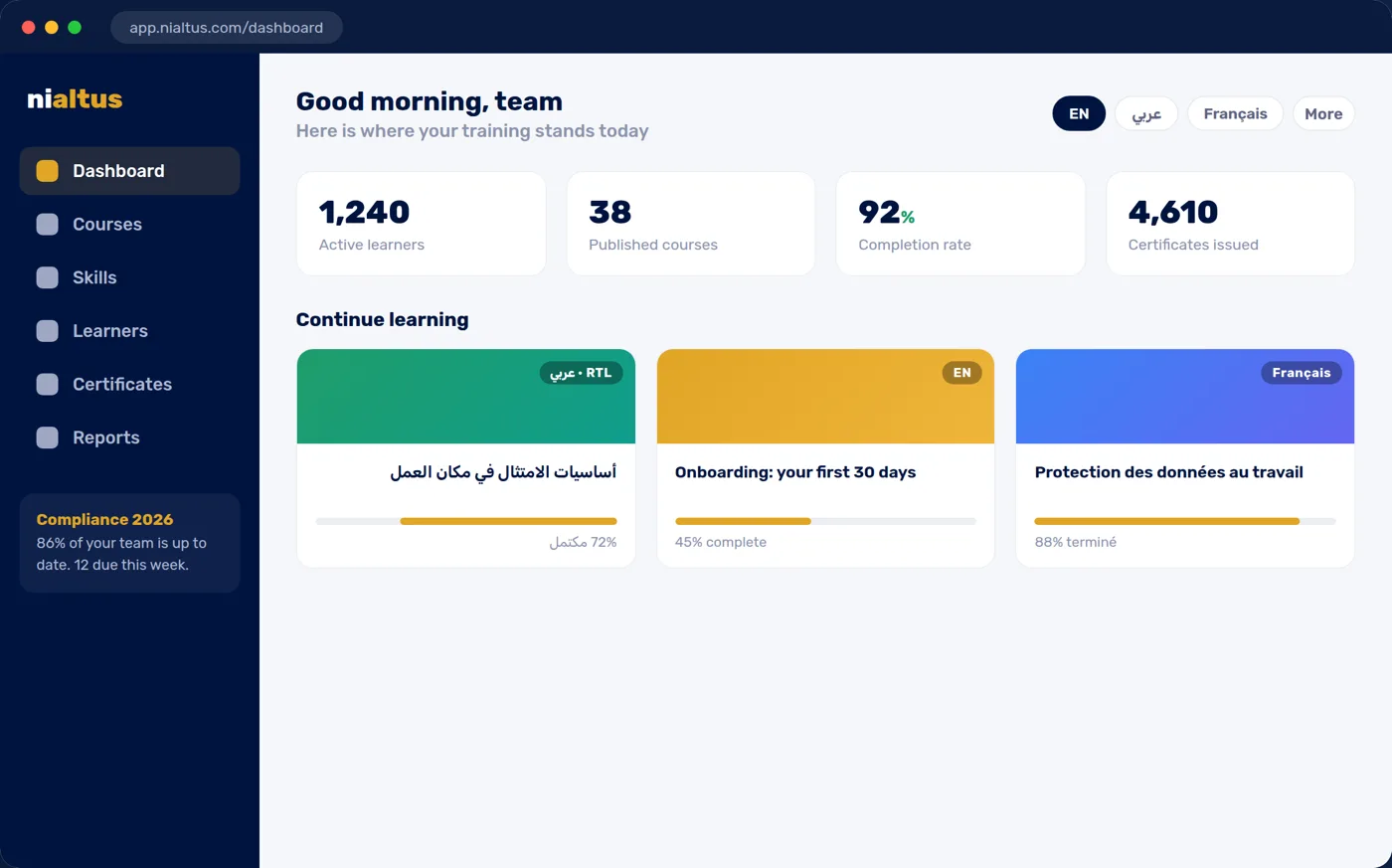
Best for BelgiumNialtus is a modern, affordable multi-tenant LMS built around exactly the problem Belgian employers face: delivering the same training in several languages to different parts of one workforce. It supports unlimited languages with full right-to-left rendering, so Dutch, French, and German sit alongside each other in a single course, and each learner sees their own language automatically. AI-assisted course authoring speeds up building and translating content, while the skills and competency framework, compliance tracking, and certificate tools cover the audit needs common in Belgian sectors. White-label branding, custom domains, multi-currency billing with local tax handling, and SCORM and xAPI support round out a platform that feels enterprise-grade without an enterprise price.
Strengths
- Unlimited languages and full RTL, ideal for a trilingual workforce
- AI course authoring that helps produce and localize content quickly
- EU-ready hosting, compliance tracking, and certificates for audits
- White-label, custom domain, and EUR billing with local tax handling
Watch-outs
- A newer name than the long-established incumbents
- Very large enterprises may want a proof of concept before rollout
360Learning
360Learning is a French-built platform centered on collaborative, peer-led learning, where subject experts inside a company create and refine courses together. That model suits Belgian organizations that want employees to share knowledge rather than rely only on top-down content, and the interface is well localized for French and Dutch speakers. It offers European data hosting and solid analytics, though its pricing model is oriented around active or registered users, which can rise as adoption grows.
Strengths
- Strong collaborative authoring and peer learning
- Well-localized interface with EU data options
- Good engagement and course-quality analytics
Watch-outs
- User-based pricing can climb with scale
- Collaborative model is a bigger fit for some cultures than others
Docebo
Docebo is an established enterprise LMS with deep functionality, broad language support, and a strong track record with large, multinational organizations, of which Belgium and Brussels have many. It handles complex learning operations, extended enterprise scenarios, and sophisticated reporting well, and it offers European hosting. The trade-off is cost and complexity: it is priced and scoped for larger buyers, and smaller Belgian teams may find it more than they need.
Strengths
- Mature, enterprise-grade platform with broad language support
- Handles complex, multi-audience learning operations
- EU hosting and strong reporting
Watch-outs
- Enterprise pricing and setup effort
- Heavier than smaller organizations typically require
aNewSpring
aNewSpring is a Netherlands-based platform popular with training providers and blended-learning designers, which gives it natural strength for the Dutch-speaking part of Belgium. It is good at structured learning journeys, spaced repetition, and combining live and online elements, and it hosts data within the EU. It is less oriented toward broad internal corporate training and administration than some rivals, so it fits course sellers and academies more naturally than large internal L&D teams.
Strengths
- Excellent for blended and provider-led learning
- EU (Netherlands) hosting and multilingual interface
- Strong learning-journey and retention features
Watch-outs
- Less focused on large internal corporate training
- Narrower administrative breadth than enterprise suites
TalentLMS
TalentLMS is a widely used, easy-to-adopt platform that suits small and mid-sized Belgian teams wanting to launch training quickly. It offers a free tier, a clean interface available in many languages, and a straightforward setup, with an EU hosting option for data residency. Its simplicity is its strength and its limit: teams that need deep competency frameworks, heavy customization, or advanced multilingual course structures may outgrow it over time.
Strengths
- Fast to set up with a free entry tier
- Many interface languages and an EU hosting option
- Good fit for small and mid-sized teams
Watch-outs
- Limited depth for complex competency or compliance needs
- Growing teams may need to migrate later
Moodle
Moodle is the best-known open-source LMS, with extensive language packs and complete control over data when self-hosted within the EU, which appeals to budget-conscious and privacy-focused Belgian organizations. It is highly flexible and free to license, but that flexibility comes with responsibility: you need technical resources to host, maintain, secure, and update it, and modern authoring, branding, and billing features often depend on plugins or third-party services.
Strengths
- Open source with extensive language support
- Full data control when self-hosted in the EU
- Highly flexible and free to license
Watch-outs
- Requires technical skill to host and maintain
- Modern features often depend on plugins or add-ons
What separates the best LMS platforms in Belgium in 2026
The market has matured to the point where almost every serious platform can host data in the EU and offer an interface in multiple languages. That baseline no longer sets the leaders apart. What does is how deeply a platform handles genuinely multilingual content, not just a translated menu.
Content-level multilingualism. The gap in 2026 is between platforms that localize the interface and platforms that let one course carry Dutch, French, and German versions that each learner sees automatically. The second group saves real time and avoids the drift that happens when the same course is rebuilt three times.
Compliance that survives an audit. Belgian buyers increasingly ask not just whether data sits in the EU, but whether training records, renewals, and certificates would hold up under scrutiny from the Belgian Data Protection Authority. Platforms with built-in expiry tracking and clean certificate trails now stand out.
Total cost, not headline price. Per-user pricing that looked cheap at pilot scale can become the dominant cost line once training rolls out nationally. The platforms that win in Belgium keep multilingual delivery and compliance inside the core product rather than behind add-on fees.
AI-assisted authoring has also moved from novelty to practical help, especially for producing and translating content across three languages. And multi-currency, local-tax billing matters for Belgian resellers and multinationals that invoice across borders in euros. Taken together, these shifts reward platforms designed for multilingual, compliance-heavy markets rather than retrofitted for them.
How to shortlist the best LMS platforms in Belgium
Use this checklist to test any platform against Belgium’s specific demands before you commit. Tick each item as you confirm it, and treat the multilingual and GDPR points as non-negotiable rather than nice extras.
Your Belgium LMS shortlist
If a platform clears every item, it belongs on your shortlist. If it stumbles on the multilingual or GDPR points, it is unlikely to serve a Belgian workforce well no matter how polished the rest of it looks.
Why genuinely trilingual, GDPR-compliant training is the real Belgium gap
Most LMS platforms can tick a box that says they support multiple languages. Far fewer can deliver a single course that reaches a Dutch-speaking employee in Antwerp, a French-speaking colleague in Namur, and a German-speaking teammate in the east, each in their own language, from one build and one administrative view. That gap between claimed and genuine multilingual delivery is the defining Belgian problem, and it is where most shortlists quietly fall apart.
Layer the GDPR on top and the requirement sharpens further. Belgian employers are accountable to the national Data Protection Authority for how learner data is stored and processed, and Brussels hosts EU institutions and multinationals that hold themselves to a high bar. The platforms that win here are the ones that treat trilingual delivery and European data governance as the foundation of the product rather than features bolted on for a specific deal.
Five questions that reveal the best LMS platforms in Belgium
Before you sign, put every vendor through these five questions. The answers expose fit for Belgium far faster than a generic feature demo does.
- Can one course serve Dutch, French, and German learners from a single build? This is the core Belgian test and separates real multilingual delivery from a translated menu.
- Where is our learner data hosted, and how do you meet GDPR obligations? EU hosting and clear processing terms are the baseline the Belgian Data Protection Authority expects.
- How are certificates, renewals, and expiries tracked for audits? Many Belgian sectors need auditable proof, so compliance features must be built in, not improvised.
- What is the true cost once training rolls out nationally? Per-user models can escalate, so ask for the full picture at real scale, not just pilot pricing.
- Can we brand it, use our own domain, and bill in euros with local tax? These practical details decide whether the platform feels like your own or a rented tool.
A vendor that answers all five convincingly is one of the best LMS platforms in Belgium for your situation. Vague answers on language or data are a clear signal to keep looking.
Frequently asked questions
Why does Belgium need multilingual LMS support more than other countries?
Belgium is officially trilingual, with Dutch (Flemish), French, and German all holding federal status. A national employer often has to train one group of staff in Dutch and another in French, and sometimes a smaller group in German, so genuine multilingual delivery is a core requirement rather than a nice-to-have.
What does GDPR compliance mean for an LMS in Belgium?
Learner records are personal data governed by the General Data Protection Regulation, enforced locally by the Belgian Data Protection Authority. In practice, buyers expect European data hosting, clear processing terms, and controls that would stand up to scrutiny, which is why EU hosting is now a baseline expectation.
Which LMS is best for a trilingual Belgian workforce?
Nialtus is our top pick because it delivers unlimited languages with full right-to-left support from a single course build, so Dutch, French, and German learners each see their own language automatically. That directly solves Belgium’s defining training challenge without separate instances per language.
Do these platforms support SCORM and xAPI content?
Yes. The platforms in this guide support SCORM and xAPI to varying degrees, which lets you import existing courseware and track detailed learning activity. Nialtus supports both, so content built elsewhere can be reused rather than rebuilt.
How should we budget for an LMS in Belgium?
Look beyond the headline price to the total cost at national scale. Per-user models can rise sharply as adoption grows, and features like multilingual delivery or compliance are sometimes charged as add-ons. Nialtus keeps those capabilities in the core product with affordable euro-based billing and local tax handling.
Can we use our own branding and domain?
Several platforms offer white-label branding, and Nialtus adds custom domain support so the learning environment looks and feels like your own. This matters for multinationals and resellers who want a consistent brand experience across languages and regions.
Is open-source Moodle a good option for Belgian organizations?
Moodle can be a strong, low-cost choice if you have the technical resources to host and maintain it within the EU, which gives you full data control. The trade-off is the ongoing effort to secure, update, and extend it, since modern authoring, branding, and billing features often depend on plugins or third-party services.
See the best LMS platform for Belgium in action
If a genuinely trilingual, GDPR-ready platform is what your Belgian workforce needs, Nialtus was built for exactly that. Bring your languages, your compliance requirements, and your branding, and we will show you how one course reaches every learner in their own language.
Book your Belgium demo