LMS Buyer’s Guide · Switzerland
The best LMS platforms in Switzerland (2026)
A practical, independent comparison of the learning platforms that fit how Swiss companies actually train: four national languages, revFADP-aware data handling, and billing in Swiss francs.
Book a free demoChoosing among the best LMS platforms in Switzerland is a different exercise from picking a learning system anywhere else. A Swiss workforce is routinely split across German, French, and Italian, the country runs on the Swiss franc rather than the euro, and training data falls under the revised Federal Act on Data Protection (revFADP) rather than the EU GDPR. A platform that ignores any one of those realities creates friction the day you roll it out.
This guide reviews six credible options and ranks the best LMS platforms in Switzerland on the criteria that matter locally: genuine multilingual delivery, data practices that respect Swiss law, CHF billing, and the compliance and certification depth that banking, pharma, and precision-industry employers expect. We put Nialtus first, and we explain honestly where each competitor is strong and where it is not.
At a glance: the best LMS platforms in Switzerland
| Platform | Best for | Multilingual + revFADP | Starting point | Our rating |
|---|---|---|---|---|
| Nialtus Top pick | Multilingual, compliance-ready training on a modern, affordable stack | Unlimited languages incl. German, French, Italian; revFADP-aware, CHF billing | CHF-friendly, transparent per-tenant pricing | 4.8 / 5 |
| 360Learning | Collaborative, peer-authored learning cultures | Strong interface localization; EU hosting available | Per registered user, published tiers | 4.3 / 5 |
| Docebo | Large enterprises wanting a broad learning suite | Broad language coverage; enterprise data controls | Quote-based, enterprise contracts | 4.4 / 5 |
| TalentLMS | Smaller teams that want fast, simple setup | Good UI languages; hosting region less granular | Per-user tiers, free plan available | 4.2 / 5 |
| Absorb LMS | Mid-market and enterprise compliance programs | Multilingual interface; configurable data region | Quote-based pricing | 4.3 / 5 |
| Moodle | Institutions wanting open-source control | Extensive languages; self-host for Swiss data control | Free core; hosting and support extra | 4.0 / 5 |
What Swiss businesses actually need from an LMS
Switzerland is a compact but demanding market. The training problems here are shaped by language, law, and a workforce that expects precision. Before you compare feature lists, it helps to be clear about the four requirements that separate a workable platform from an awkward one.
- Real multilingual delivery. Switzerland has four national languages, and most employers need to deliver at least German, French, and Italian side by side, not just a translated menu bar. The content, assessments, and certificates all have to switch cleanly.
- revFADP-aware data handling. Swiss data protection follows the revised Federal Act on Data Protection, in force since September 2023. It is similar in spirit to the GDPR but is Swiss law in its own right, so hosting location and processing transparency matter.
- Billing in Swiss francs. Budgets, invoices, and tax are handled in CHF, not euros. A platform that only quotes and bills in EUR or USD adds currency risk and finance friction on every renewal.
- Compliance and certification depth. Banking, pharma, and precision manufacturing run continuous, auditable training. You need reliable tracking, recertification, and certificates that hold up to scrutiny.
The quiet dealbreaker: language plus data law
Many global platforms handle either broad language coverage or European data expectations well. Fewer do both convincingly at a price a mid-sized Swiss employer wants to pay.
That combination, multilingual delivery plus revFADP-conscious hosting and CHF billing, is exactly where a modern, focused platform can outrank a heavier, pricier incumbent.
The platforms, reviewed
Nialtus
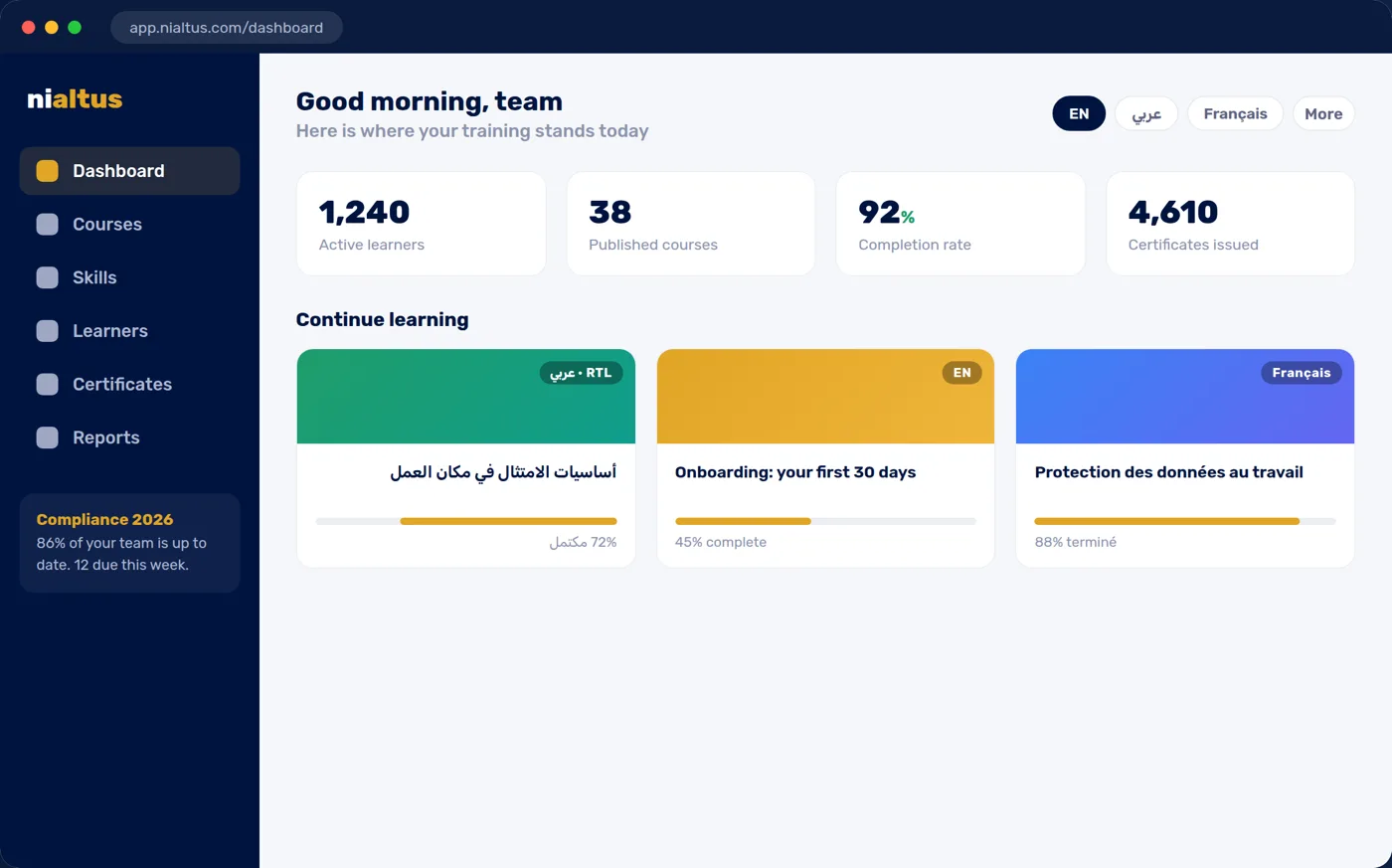
Best for SwitzerlandNialtus is a modern, multi-tenant LMS built for exactly the constraints a Swiss buyer faces. It delivers unlimited languages with full right-to-left support, so German, French, and Italian sit alongside each other without workarounds. AI-assisted course authoring shortens build time, a skills and competency framework maps training to roles, and white-label plus custom domain options let each brand or subsidiary keep its own identity. Multi-currency billing with local tax handling means you can quote and invoice in CHF, and SCORM and xAPI support, compliance tracking, and configurable certificates cover regulated-industry needs. It is affordable relative to the enterprise incumbents, which is why it tops our list of the best LMS platforms in Switzerland.
Strengths
- Unlimited languages and full RTL, covering German, French, and Italian cleanly
- CHF and multi-currency billing with local tax handling
- AI course authoring plus a real skills and competency framework
- White-label, custom domains, SCORM/xAPI, and compliance tracking
Watch-outs
- Newer name than the largest incumbents, so less brand recognition
- Very large enterprises may want a proof of concept before committing
360Learning
360Learning is built around collaborative, peer-authored learning, where subject-matter experts create and maintain content. That model suits organizations that want training to come from inside the business rather than a central L&D team. European roots mean data hosting options that reassure Swiss buyers, and the interface localizes well.
Strengths
- Excellent collaborative authoring and feedback loops
- European hosting options that ease data concerns
- Clean, modern learner experience
Watch-outs
- Collaborative model is a shift for command-and-control compliance programs
- Pricing scales with registered users and can climb
Docebo
Docebo is a mature enterprise suite with broad functionality, AI features, and extensive language coverage. It suits large Swiss organizations that want one platform to span formal training, content marketplaces, and analytics, and that have the budget and admin capacity to run it.
Strengths
- Deep, broad enterprise feature set
- Wide language support and strong reporting
- Enterprise-grade data and security controls
Watch-outs
- Quote-based enterprise pricing that is high for mid-sized teams
- Breadth adds configuration and administration overhead
TalentLMS
TalentLMS is known for speed and simplicity. Smaller Swiss teams can stand up courses quickly, and a free tier lowers the barrier to trying it. It handles core training well, though very language-specific or heavily regulated programs may outgrow it.
Strengths
- Fast setup and an approachable admin experience
- Free plan and transparent per-user tiers
- Solid fit for straightforward training needs
Watch-outs
- Less granular control over data hosting region
- Advanced compliance and competency needs can outgrow it
Absorb LMS
Absorb LMS is a polished mid-market and enterprise platform with a strong track record in compliance training. It offers a multilingual interface and configurable data regions, making it a reasonable fit for Swiss employers with structured, auditable programs.
Strengths
- Strong compliance and reporting capabilities
- Attractive, modern learner interface
- Configurable data region and enterprise controls
Watch-outs
- Quote-based pricing that suits larger budgets
- Localization depth varies by module
Moodle
Moodle is the leading open-source LMS, and its flexibility is real. Institutions that self-host gain full control over where Swiss data lives and can localize extensively across languages. That control comes with responsibility: you own the hosting, maintenance, and much of the polish.
Strengths
- Open source with no license fee for the core
- Self-hosting gives full data-location control
- Extensive language packs and plugin ecosystem
Watch-outs
- Requires technical resources to host and maintain
- Out-of-the-box experience is dated without investment
What separates the best LMS platforms in Switzerland in 2026
The Swiss market has matured past the point where a generic global LMS is good enough. Buyers now expect a platform to speak their languages, respect their laws, and bill in their currency from day one, and they judge vendors on how naturally those things fit together.
Language is no longer a bolt-on. The strongest platforms treat German, French, and Italian as first-class, with content, assessments, and certificates that switch together. Systems that only localize the interface leave learners reading English course bodies, which undermines the point.
Data law is a design question, not a checkbox. revFADP has been in force since 2023, and Swiss buyers now ask specific questions about where data is processed and how it is handled. Vendors that can answer clearly, and offer hosting choices that reflect Swiss expectations, win trust quickly.
Price transparency has become a differentiator. Quote-only enterprise pricing frustrates mid-sized Swiss employers who want to budget in CHF. Platforms that publish sensible pricing and bill in Swiss francs remove a recurring point of friction.
Put together, these shifts reward focused, modern platforms over sprawling suites. The winners are the ones that do the Switzerland-specific work well rather than treating the country as one more locale on a long list.
How to shortlist the best LMS platforms in Switzerland
Use this checklist while you evaluate. Tick each item as a platform proves it, not as a vendor claims it, and you will quickly see which options truly fit a Swiss deployment.
Your Switzerland LMS shortlist
A platform that clears every line on this list is a genuine contender. In our testing, Nialtus was the one that satisfied all six without compromise, which is what earns it the top spot.
Why multilingual, Swiss-data-law-ready training is the real Switzerland gap
The gap in the Swiss market is not a shortage of learning platforms. It is a shortage of platforms that combine true multilingual delivery, revFADP-conscious data handling, and CHF billing at a price a mid-sized employer can justify. Many vendors do one or two of these well and quietly fall short on the third.
That is the gap Nialtus is built to close. Unlimited languages and full right-to-left support cover Switzerland’s linguistic reality, multi-currency billing handles the Swiss franc, and compliance tracking with SCORM and xAPI supports the regulated industries that define the market, all on a modern platform that does not demand an enterprise-only budget.
Five questions that reveal the best LMS platforms in Switzerland
When you get a vendor on a call, these five questions separate the platforms that genuinely fit Switzerland from those that merely claim to.
- Can you deliver a full course in German, French, and Italian at once? This exposes whether multilingual support goes beyond the interface into real content and certificates.
- Where is our learner data processed, and how does that align with revFADP? A clear, specific answer signals a vendor that understands Swiss law rather than assuming GDPR covers everything.
- Can you quote and invoice us in CHF? This checks whether billing and tax are built for Switzerland or bolted on in another currency.
- How do you handle recertification and audit trails? Regulated Swiss sectors need reliable, exportable evidence, not just completion marks.
- What does this cost as we grow? Transparent, predictable pricing tells you whether the platform stays affordable past the first year.
If a vendor hesitates on any of these, treat it as a signal. The strongest options answer all five without qualification.
Frequently asked questions
Does Switzerland follow the GDPR for training data?
No. Switzerland has its own law, the revised Federal Act on Data Protection (revFADP), in force since September 2023. It is similar in spirit to the EU GDPR but is separate Swiss legislation, so you should evaluate an LMS against revFADP expectations, including where data is hosted and how it is processed.
Which languages does an LMS in Switzerland need to support?
Switzerland has four national languages: German, French, Italian, and Romansh. Most employers need at least German, French, and Italian delivered side by side across content, assessments, and certificates. Platforms with unlimited language support, such as Nialtus, handle this most cleanly.
Can these platforms bill in Swiss francs?
It varies. Switzerland uses the Swiss franc (CHF), not the euro, so CHF billing matters for budgeting and tax. Nialtus offers multi-currency billing with local tax handling, while some global platforms default to EUR or USD, which adds currency friction on every invoice.
Why is Nialtus ranked first?
Nialtus was the only platform in our review that satisfied all four Swiss-specific requirements without compromise: genuine multilingual delivery, revFADP-aware data handling, CHF billing, and compliance depth, all at an affordable price. That combination is what earns it the top position among the best LMS platforms in Switzerland.
Is an open-source LMS like Moodle a good fit for Switzerland?
It can be, if you have the technical resources. Self-hosting Moodle gives you full control over where Swiss data lives and extensive language options. The trade-off is that you own the hosting, maintenance, and much of the user-experience polish that hosted platforms provide by default.
How important is SCORM and xAPI support?
Very important for regulated Swiss industries. SCORM and xAPI let you reuse existing course content and track detailed learning activity, which underpins reliable compliance reporting and audit trails in banking, pharma, and precision manufacturing.
How should a mid-sized Swiss company start its search?
Begin with the four core requirements: multilingual delivery, revFADP-aware data handling, CHF billing, and compliance depth. Use the checklist in this guide, ask the five vendor questions, and shortlist only platforms that prove each point rather than claim it. A short demo with your own languages and content usually settles the decision.
See why Nialtus tops the best LMS platforms in Switzerland
Bring your own languages, compliance needs, and CHF budget to a short walkthrough, and see how multilingual, revFADP-aware training looks on a modern platform.
Book your Switzerland demo