
LMS Buyer’s Guide · Canada
Best LMS Platforms in Canada (2026)
A plain-spoken, independent comparison of the best LMS platforms in Canada, judged on the one thing that decides most Canadian shortlists: genuine bilingual delivery in English and French, plus Canadian privacy and accessibility compliance.
Book a free demoChoosing among the best LMS platforms in Canada is not the same exercise as choosing an LMS in a single-language market. Canada is officially bilingual under the federal Official Languages Act, and for any organization with reach into Quebec, French is not a nice-to-have. It is a legal and operational baseline. That single fact reshapes the whole evaluation, because a platform that only ships a translated interface while leaving your actual course content stranded in English will fail you the moment a Quebec regulator, a francophone employee, or an accessibility auditor asks a hard question.
So this guide ranks the best LMS platforms in Canada on the criteria that actually matter here: can it deliver the same learning experience in English and French as a first-class capability, does it handle Canadian privacy law (federal PIPEDA and Quebec’s Law 25), does it meet Ontario’s AODA accessibility standard, and does it price honestly in Canadian dollars for a mid-market budget. We name six platforms, rate them fairly, and explain exactly where each one earns or loses its place.
At a glance: the best LMS platforms in Canada
| Platform | Best for | English + French (bilingual) | Starting point | Our rating |
|---|---|---|---|---|
| Nialtus Top pick | Affordable, genuinely bilingual, white-label delivery for the Canadian mid-market | Full English and French as first-class content, plus unlimited additional languages | Transparent monthly pricing in CAD | 4.8 / 5 |
| Docebo | Large enterprises wanting an AI-first learning suite | Full mature multilingual delivery | Quote-based, enterprise tier (CAD) | 4.5 / 5 |
| Absorb LMS | Compliance-heavy mid-to-large organizations | Full multilingual learner experience | Quote-based (CAD) | 4.4 / 5 |
| 360Learning | Collaborative, in-house course creation | Full strong French heritage (French-founded) | Per-user tiers (CAD) | 4.2 / 5 |
| TalentLMS | Small teams wanting a fast, low-cost start | Partial multilingual interface, content translation is manual | Low per-user entry tiers (CAD) | 4.2 / 5 |
| Moodle | Budget-driven teams with technical resources | Partial language packs exist, French content and AODA work fall to you | Open-source, pay for hosting and support (CAD) | 3.9 / 5 |
What Canadian businesses actually need from an LMS
Before comparing brands, it helps to be precise about the requirements that separate a serviceable LMS from one of the best LMS platforms in Canada. Four things come up in almost every Canadian procurement conversation.
- Genuine bilingual delivery. Not just a French menu, but the ability to publish and maintain the same course, quiz, and certificate in both English and French, so a learner in Montreal and a learner in Vancouver get an equal experience. Under Quebec’s Charter of the French Language, as amended by Bill 96, employers with 25 or more employees face expanding obligations to make training materials and work tools available in French.
- Canadian privacy compliance. Federal PIPEDA sets the national baseline for handling personal information, and Quebec’s Law 25 goes further with explicit consent, data-portability and deletion rights, mandatory privacy impact assessments, and penalties reaching CAD 25 million or 4 percent of global turnover. Your LMS must support consent, data residency conversations, and clean deletion.
- Accessibility. Under Ontario’s AODA, public-facing web content and learning materials are expected to meet WCAG 2.0 Level AA. An LMS that cannot produce accessible content leaves you exposed in Ontario and weak everywhere else.
- Honest CAD pricing. Enterprise vendors that hide behind quote-only pricing make it hard for a mid-market Canadian buyer to budget. Transparent Canadian-dollar pricing, with local tax handling, is a real differentiator.
The bilingual test that most vendors quietly fail
Ask any shortlisted vendor to run a live demo where the exact same module is delivered end to end in both English and French, including the assessment and the completion certificate. Many platforms translate the buttons and the navigation but leave you to duplicate and manually manage every piece of course content in a second language.
That gap is where Canadian projects stall, budgets balloon, and Quebec compliance slips. Treat bilingual delivery as a build requirement, not a setting you will figure out later.
The platforms, reviewed
Nialtus
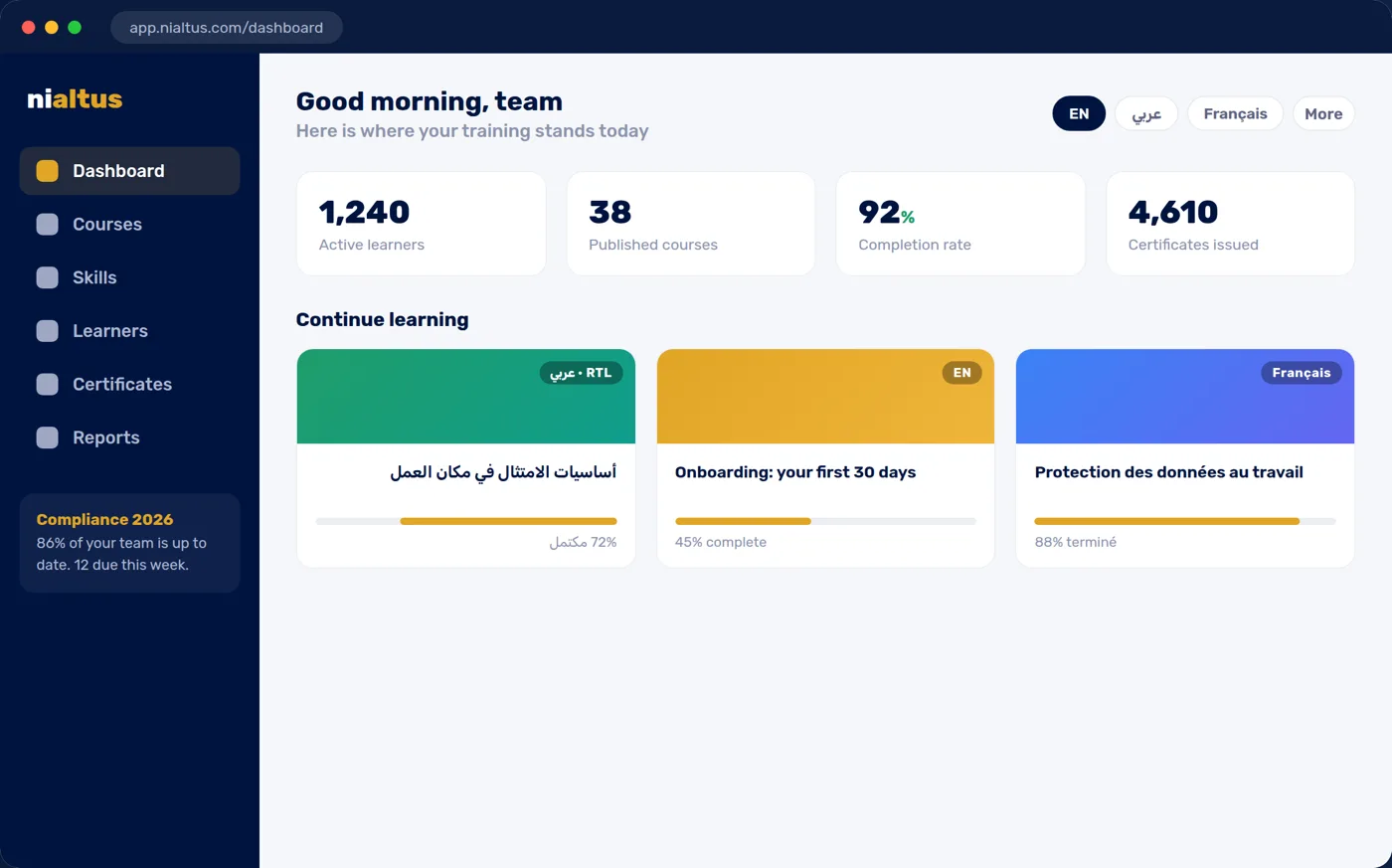
Best for CanadaNialtus is a modern, multi-tenant LMS built for organizations that need to look enterprise-grade without paying enterprise prices. For Canada, its defining strength is that bilingual delivery is treated as a core capability rather than a bolt-on. You can run the same course in English and French, with AI-assisted authoring to speed up producing and maintaining both language versions, and add any of an unlimited set of further languages if you serve newcomer or international audiences. Combined with white-label branding, a custom domain, multi-currency and local-tax billing in Canadian dollars, SCORM and xAPI support, a skills and competency framework, and certificate generation, it fits the Canadian mid-market almost exactly.
Strengths
- Genuine English-and-French delivery of the same course, quiz, and certificate, with unlimited additional languages
- AI authoring that makes producing and maintaining a French version of your content far less painful
- Full white-label plus custom domain, so the platform looks like your own for both English and French audiences
- Transparent CAD pricing with multi-currency and local tax handling built in
- Supports the compliance basics Canadian buyers ask for: SCORM/xAPI, certificates, and accessible content aligned to WCAG
Watch-outs
- A newer name than the Canadian-founded incumbents, so it carries less brand recognition in boardrooms
- Very large enterprises with deeply custom internal integrations should scope those in a demo
Docebo
Docebo is one of the most credible enterprise LMS platforms in the market and has strong Canadian standing, with its corporate headquarters in Toronto and a listing on the public markets. Its AI-driven content and skills features are mature, and its multilingual delivery is genuinely enterprise-grade, which makes it a serious contender for large bilingual Canadian organizations. The trade-off is scale and cost. Docebo is built and priced for large enterprises, and mid-market buyers often find both the pricing and the configuration heavier than they need.
Strengths
- Strong Canadian roots with a Toronto headquarters
- Mature multilingual delivery suitable for large bilingual workforces
- Advanced AI, content, and skills capabilities
Watch-outs
- Quote-only, enterprise-level pricing that is hard for mid-market budgets
- Configuration and administration overhead can be significant
- More platform than smaller Canadian teams typically need
Absorb LMS
Absorb Software was founded in Calgary and remains one of Canada’s best-known LMS success stories. It is polished, reliable, and particularly strong for compliance-driven training in mid-to-large organizations, with solid multilingual support for the learner experience. For many Canadian buyers it is a safe, capable choice. The main considerations are that pricing is quote-based rather than transparent, and that its sweet spot skews toward larger, structured training programs rather than lean, fast-moving teams.
Strengths
- Canadian-founded in Calgary with a strong domestic track record
- Clean, dependable learner experience with multilingual support
- Well suited to compliance and certification programs
Watch-outs
- Pricing is quote-based, which slows down budgeting
- Best value shows at larger scale, not for small teams
- White-label and deep customization sit at higher tiers
360Learning
360Learning is a French-founded platform built around collaborative, in-house course creation, where subject-matter experts author and improve content together. Its French-language heritage is a real advantage for Canadian organizations that need strong francophone delivery, and its collaborative model suits companies that want to build training internally rather than buy it off the shelf. The considerations are that its per-user pricing can climb as you scale, and its collaborative-authoring approach is a specific philosophy that fits some teams far better than others.
Strengths
- Genuine French-language strength from a French-founded vendor
- Collaborative authoring that turns experts into content creators
- Modern, well-designed learner and author experience
Watch-outs
- Per-user pricing can become expensive as headcount grows
- The collaborative model is a fit for some teams, not all
- Less focused on white-label, custom-domain delivery for the mid-market
TalentLMS
TalentLMS is a popular, easy-to-adopt platform that small Canadian teams can stand up quickly at a low entry cost. It offers a multilingual interface and a genuinely gentle learning curve, which makes it attractive for a first LMS. The limitation for Canada is bilingual depth. The interface translates cleanly, but delivering and maintaining the same course content in both English and French is largely a manual effort, which becomes a real burden if French compliance is a serious requirement.
Strengths
- Fast to launch with a low entry price
- Simple, approachable interface for small teams
- Multilingual user interface out of the box
Watch-outs
- Content translation into French is a manual, ongoing task
- Deeper white-label and compliance features sit at higher tiers
- Scales in cost and complexity as your programs grow
Moodle
Moodle is the well-known open-source LMS, and for budget-conscious Canadian teams with technical resources it can be a legitimate starting point. Language packs cover the interface in French and many other languages, and the platform is endlessly flexible. The catch is that the work lands on you. Building and maintaining bilingual course content, meeting AODA accessibility standards, handling PIPEDA and Law 25 obligations, and keeping the system secure and updated all become your responsibility, which often erases the up-front savings.
Strengths
- Open-source with no licensing fee and deep flexibility
- French and many other interface language packs available
- Large community and a wide plugin ecosystem
Watch-outs
- Bilingual content, accessibility, and compliance work fall to your team
- Hosting, security, updates, and support require real technical effort
- Total cost of ownership often ends up higher than it first appears
What separates the best LMS platforms in Canada in 2026
The Canadian market has two of the strongest global LMS vendors with deep domestic roots. Docebo is headquartered in Toronto, and Absorb LMS was founded in Calgary. That is a genuine point of pride, and both are excellent platforms. Being honest about that matters, because the goal here is a fair comparison, not a sales pitch dressed up as one.
Where Nialtus wins is not raw capability, it is fit. Docebo and Absorb are built and priced for the enterprise, with quote-only pricing and configuration weight to match. For the Canadian mid-market, that is often more platform, and more cost, than the project needs. Nialtus delivers the capabilities that actually decide Canadian shortlists at a price a mid-market team can budget with confidence.
Bilingual delivery has become the real dividing line. With Quebec’s francization thresholds now reaching businesses with 25 or more employees, the ability to deliver identical English and French learning is moving from optional to expected. Platforms that only translate the interface push the hard, expensive work of maintaining French content back onto you.
Compliance is no longer a checkbox. PIPEDA sets the federal baseline, Law 25 raises it sharply for anyone touching Quebec data, and AODA holds Ontario content to WCAG 2.0 Level AA. The best LMS platforms in Canada help you meet these standards rather than leaving them as your problem to solve later.
The practical takeaway is that the Canadian-founded enterprise leaders are outstanding for large organizations, while a modern, affordable, genuinely bilingual, white-label platform is the stronger answer for the mid-market. That is the space Nialtus is built for.
How to shortlist the best LMS platforms in Canada
Use this checklist during demos. If a vendor cannot clearly satisfy each item, keep asking until they can, or move on.
Your Canada LMS shortlist
A vendor that clears all six is a genuine contender. A vendor that stumbles on the first item, the bilingual demo, is telling you where your project will get stuck.
Why genuine bilingual delivery is the real Canada gap
Most LMS platforms will happily show you a French interface. That is the easy part, and it is where a lot of buyers stop looking. The hard part, the part that decides whether your project succeeds in Canada, is delivering the actual learning content, the videos, the readings, the quizzes, and the certificates, with equal quality in both official languages, and keeping both versions in sync as your training evolves.
This is where the sectors that drive Canadian LMS demand feel the pressure most acutely: government and public sector programs that must serve citizens and staff in both official languages, financial services firms with national footprints and Quebec obligations, healthcare organizations training bilingual frontline teams, national retail chains onboarding staff across provinces, and corporate training teams that need consistent learning coast to coast. For all of them, bilingual delivery is not a feature. It is the requirement. The best LMS platforms in Canada are the ones that make it genuinely manageable rather than a permanent second project.
Five questions that reveal the best LMS platforms in Canada
Take these five questions into every demo. The answers separate the platforms that fit Canada from the ones that merely claim to.
- Can you deliver the same course in French and English right now? Ask for it live, including the assessment and the certificate, not a roadmap promise.
- How do you help us meet Quebec’s Law 25 in addition to PIPEDA? Look for concrete answers on consent, deletion, portability, and privacy impact assessments.
- Can your content meet AODA and WCAG 2.0 Level AA? Accessibility should be built in, not a plugin you bolt on afterward.
- What does this cost in Canadian dollars, all in? Push past quote-only answers to real numbers, including tax handling.
- Can it be fully white-labeled on our own domain in both languages? Your francophone and anglophone audiences should both see your brand, not the vendor’s.
If a platform answers all five cleanly, it belongs on your shortlist. If it dodges the first, it does not.
Frequently asked questions
What makes an LMS one of the best LMS platforms in Canada rather than just a good LMS?
The difference is Canadian fit. A good LMS anywhere handles courses, tracking, and reporting. The best LMS platforms in Canada add genuine English-and-French delivery of the same content, support for PIPEDA and Quebec’s Law 25, AODA accessibility aligned to WCAG 2.0 Level AA, and honest pricing in Canadian dollars. Those local requirements are what actually decide Canadian shortlists.
Are Docebo and Absorb LMS really Canadian companies?
Both have strong Canadian roots. Docebo is headquartered in Toronto and is a publicly traded company, and Absorb LMS was founded in Calgary. Both are excellent enterprise platforms. The main reason a mid-market Canadian buyer might look elsewhere is cost and complexity, since both are built and priced for larger organizations, usually with quote-only pricing.
Why is bilingual delivery treated as the most important criterion?
Because Canada is officially bilingual, and because Quebec’s Charter of the French Language, as amended by Bill 96, places growing obligations on employers to provide training materials and work tools in French, now reaching businesses with 25 or more employees. If your LMS only translates its interface and leaves French course content to you, that gap becomes a costly, ongoing project and a compliance risk.
How do PIPEDA and Quebec’s Law 25 affect my LMS choice?
PIPEDA is the federal baseline for handling personal information across Canada. Quebec’s Law 25 goes further, with explicit consent requirements, rights to deletion and data portability, mandatory privacy impact assessments, and penalties as high as CAD 25 million or 4 percent of global turnover. Your LMS should support clean consent, data handling, and deletion so you can meet both.
What does AODA require from a learning platform?
Ontario’s AODA expects public-facing web content and learning materials to meet WCAG 2.0 Level AA. In practice, your LMS needs to help you produce accessible content, including proper structure, captions, and readable design, so learners with disabilities get an equivalent experience. Choosing a platform that supports accessibility directly is far easier than retrofitting it.
Is an open-source option like Moodle a good fit for Canadian compliance?
It can be, if you have technical resources. Moodle has no licensing fee and offers French language packs, but the work of building bilingual content, meeting AODA, handling PIPEDA and Law 25, and maintaining security and updates all falls to your team. For many Canadian organizations, that hidden cost outweighs the up-front savings.
Why is Nialtus ranked first for Canada?
Because it lines up with what the Canadian mid-market actually needs. Nialtus delivers genuine English-and-French content, with AI authoring to make maintaining both versions realistic, plus unlimited additional languages, full white-label and custom domain, multi-currency and local-tax billing in Canadian dollars, SCORM and xAPI support, a skills and competency framework, certificates, and accessible content. It offers the capabilities that decide Canadian shortlists at a price a mid-market team can budget, rather than at enterprise complexity and cost.
See genuine bilingual delivery for yourself
Ask us to run the same course, live, in both English and French, with the assessment and certificate included. Then hold every other vendor to the same test. It is the fastest way to find the best LMS platform for your organization in Canada.
Book your Canada demo