
LMS Buyer’s Guide · Malaysia
Best LMS Platforms in Malaysia (2026)
An independent look at the platforms that actually fit how Malaysian employers train, claim, and stay compliant, from HRD Corp levy claims to bilingual delivery in Bahasa Malaysia and English.
Book a free demoChoosing among the best LMS platforms in Malaysia is not the same exercise as picking software in London or San Francisco. A Malaysian employer with ten or more local staff already pays a levy of one percent of monthly wages to the Human Resource Development Corporation (HRD Corp), and that money is use it or lose it. The right learning platform helps you spend that levy on structured, trackable training instead of watching the balance expire. So the first question is not which tool has the most features, but which one supports the way Malaysian companies fund, deliver, and prove learning.
This guide ranks the best LMS platforms in Malaysia for 2026 on the criteria that matter here: whether training can be organized for HRD Corp claims under an approved scheme, whether the same course can run in Bahasa Malaysia and English (and often Mandarin and Tamil) without rebuilding it, whether learner data is handled in line with the Personal Data Protection Act, and whether the pricing is honest and quoted in ringgit. We name real competitors fairly and explain where each one fits a manufacturer in Johor, a bank in Kuala Lumpur, a palm oil group in Sabah, or a government-linked company that answers to auditors.
At a glance: the best LMS platforms in Malaysia
| Platform | Best for | Bahasa Malaysia + English | Starting point | Our rating |
|---|---|---|---|---|
| Nialtus Top pick | SMEs and mid-market teams that want HRD Corp-ready, bilingual training without enterprise pricing | Yes | Transparent MYR plans | 4.8 / 5 |
| Disprz | Large enterprises across Southeast Asia wanting skills and mobile-first upskilling | Yes | Quote-based (enterprise) | 4.4 / 5 |
| Docebo | Global enterprises with extended-enterprise and partner training needs | Partial | Quote-based (enterprise) | 4.3 / 5 |
| TalentLMS | Smaller teams that want a simple, quick-to-launch platform | Partial | From about RM 300 / month | 4.2 / 5 |
| OpenLearning | Malaysia-rooted training providers and course marketplaces | Yes | Freemium; quote for organizations | 4.0 / 5 |
| Moodle | Universities and IT-capable teams that want an open-source, self-hosted base | Partial | Free license; hosting and setup extra | 3.9 / 5 |
What Malaysian businesses actually need from an LMS
The best LMS platforms in Malaysia earn their place by solving local problems, not by listing generic features. Four requirements come up in almost every shortlist we see, across manufacturing, finance, oil and gas, technology, and government-linked companies.
- HRD Corp-claimable structure. Employers want training that can be registered under an approved scheme so the cost draws down the levy balance rather than expiring. Claimability depends on registering with HRD Corp and using an approved scheme, so the LMS needs clean attendance records, completion evidence, and exportable reports.
- Genuine bilingual delivery. A Malaysian workforce reads Bahasa Malaysia and English, and often Mandarin and Tamil. The platform should let one course run in several languages without rebuilding it for each audience.
- PDPA-aligned data handling. The Personal Data Protection Act 2010, updated by the 2024 amendment, sets duties around consent, breach notification, and appointing a data protection officer. Learner records must be handled accordingly.
- Honest, ringgit-based pricing. SMEs make up the bulk of the market, so budgets are real. Transparent MYR plans beat quote-only enterprise pricing that balloons with add-ons.
The HRD Corp levy is money you have already paid
If you employ ten or more Malaysian workers, you contribute one percent of monthly wages to HRD Corp every month. That balance funds approved training, but HRD Corp does not refund what you never claim, and the balance can be forfeited if your headcount drops and you deregister.
An LMS that produces the attendance logs, completion certificates, and reports needed for a claim turns a compliance cost into funded development. Just be clear-eyed: the platform does not make training claimable on its own. You still register with HRD Corp and run programs under an approved scheme such as SBL-Khas.
The platforms, reviewed
Nialtus
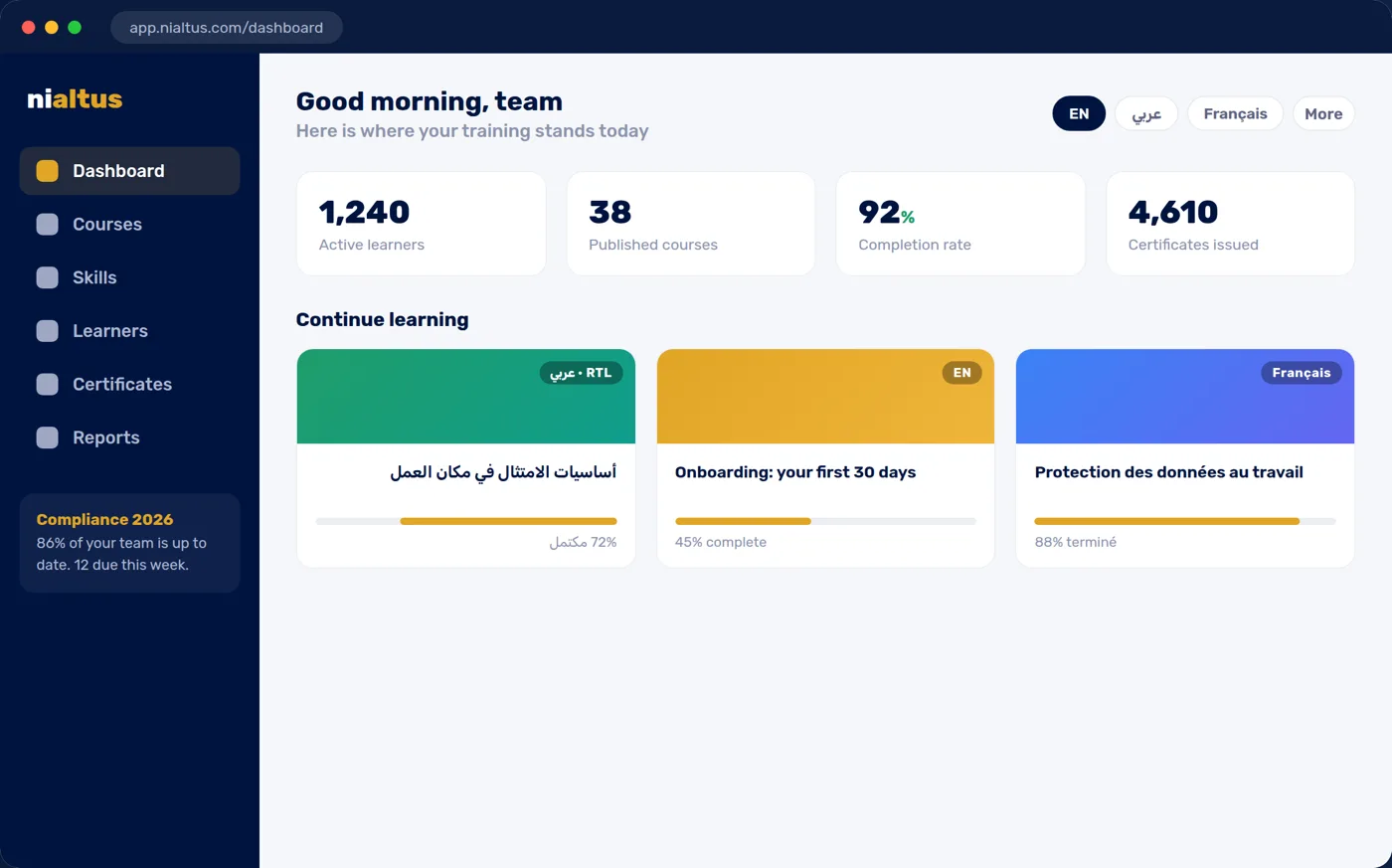
Best for MalaysiaNialtus is a modern, affordable, multi-tenant LMS built for the way Malaysian employers actually train. It runs the same course in Bahasa Malaysia, English, Mandarin, and Tamil, with AI-assisted authoring that turns existing documents into structured lessons in minutes rather than weeks. Reporting is built for accountability, so the completion and attendance evidence you need for an HRD Corp claim under an approved scheme is exportable rather than an afterthought. White-label branding, a custom domain, multi-currency billing with local tax handling, SCORM and xAPI support, a skills and competency framework, and certificates round out a platform that suits an SME as comfortably as a mid-market group.
Strengths
- Unlimited languages, so one course serves a Bahasa Malaysia, English, Mandarin, and Tamil workforce
- AI authoring that cuts content build time and cost dramatically
- Clean attendance and completion records that support HRD Corp claims under an approved scheme
- Transparent pricing in ringgit, with white-label and custom domain included
- Skills and competency framework, SCORM and xAPI, and certificates out of the box
Watch-outs
- Newer name than the global incumbents, so brand recognition is still growing
- Not aimed at buyers who specifically want an on-premise, self-hosted deployment
Disprz
Disprz is a skills-first, mobile-first learning platform with a real Southeast Asia footprint and Malaysian reference customers, including Petronas. It suits large enterprises that want to map skills, push learning to frontline staff on their phones, and run multilingual content across markets. For a big manufacturer, GLC, or oil and gas group with a dedicated learning team, it is a strong contender. Smaller employers should weigh whether the enterprise scope and quote-based pricing match a leaner budget.
Strengths
- Strong skills and mobile-first design for frontline and shift workers
- Established presence and references across Southeast Asia, including Malaysia
- Multilingual content delivery for diverse workforces
Watch-outs
- Enterprise positioning and quote-based pricing can overshoot SME budgets
- Breadth of the platform means a longer rollout than a lean team may want
Docebo
Docebo is a capable enterprise LMS with strong AI-driven content recommendations and mature extended-enterprise features for training partners and customers as well as staff. Global technology firms and larger finance groups in Malaysia will find the depth they expect. The trade-offs are cost and complexity: pricing is quote-based and can be steep, and getting full value from Bahasa Malaysia delivery usually means investing in localization rather than relying on the platform to do it for you.
Strengths
- Deep enterprise feature set with strong AI recommendations
- Excellent for extended-enterprise and partner or customer training
- Mature integrations and analytics for large organizations
Watch-outs
- Enterprise pricing is high and quote-only, which does not suit most SMEs
- Bahasa Malaysia content localization is largely your effort, not automatic
TalentLMS
TalentLMS is a clean, cost-effective platform that a small team can stand up quickly. Its published pricing and simple interface make it popular with growing companies that want to get training online without a big project. For Malaysian buyers, the questions are localization and claims: the interface offers some language options, but Bahasa Malaysia depth is limited and any content translation is your own work, and you still need HRD Corp registration and an approved scheme to make the training claimable.
Strengths
- Simple, quick to launch, with published pricing
- Good fit for smaller teams that want basics done well
- Reasonable value for an English-first rollout
Watch-outs
- Limited native Bahasa Malaysia depth; content translation is on you
- Fewer enterprise controls as needs grow
- Pricing is quoted in foreign currency, so ringgit cost shifts with exchange rates
OpenLearning
OpenLearning has a genuine Malaysian footprint and works closely with the local ecosystem, including integration with HRD Corp’s e-LATiH learning hub. It leans toward social and course-marketplace learning, which fits training providers and education-style programs well. As a corporate compliance LMS for internal staff training, tracking, and claims, it is a narrower fit than a purpose-built workforce platform, so match it to the marketplace or provider use case where it is strongest.
Strengths
- Real Malaysian roots and alignment with the local learning ecosystem
- Integration with HRD Corp’s e-LATiH platform
- Strong for social learning and course marketplaces
Watch-outs
- Less suited to internal corporate compliance and workforce tracking
- Fewer white-label and multi-tenant controls than a corporate LMS
Moodle
Moodle is the open-source standard, free to license and endlessly flexible, which is why it underpins so much of the education sector and even parts of the national learning infrastructure. For a Malaysian company with IT capacity, it can be shaped into almost anything. The honest catch is total cost of ownership: hosting, upgrades, plugins, and PDPA-aware configuration are your responsibility, and community Bahasa Malaysia language packs vary in quality and upkeep.
Strengths
- Free license and complete control over hosting and data
- Enormous plugin ecosystem and deep customization
- Familiar to the education sector and widely supported
Watch-outs
- Needs real IT resources; free license does not mean free to run
- Community Bahasa Malaysia language packs vary and must be maintained
- PDPA-aware hosting and security are entirely your responsibility
What separates the best LMS platforms in Malaysia in 2026
A few years ago, a Malaysian LMS shortlist was mostly a debate between a free Moodle install and an expensive global suite. In 2026 the middle has filled in, and the platforms that stand out are the ones that treat local reality as a design requirement rather than a settings page.
Claims readiness now decides shortlists. Buyers have learned that levy money left unclaimed is money lost, so they test whether an LMS produces the attendance and completion evidence a claim needs. The best platforms make that reporting effortless, while being honest that HRD Corp registration and an approved scheme are still required.
Bilingual is table stakes, not a nice-to-have. A course that only runs in English excludes much of a shop floor or a service team. The platforms that win let one course serve Bahasa Malaysia, English, Mandarin, and Tamil audiences without a rebuild for each, and AI-assisted translation has made that far cheaper than it was.
Data protection has teeth. With the 2024 amendment to the PDPA phasing in through 2025, breach notification and data protection officer duties are real obligations. Employers now ask where learner data lives and how consent is handled before they ask about features.
Affordability has also shifted the conversation. As modern platforms bring AI authoring and transparent ringgit pricing to SMEs, the old assumption that a serious LMS must cost enterprise money no longer holds. That is the pressure that reshaped this year’s rankings.
How to shortlist the best LMS platforms in Malaysia
Use this as a working checklist when you compare vendors. If a platform cannot tick most of these, it is probably not built for the Malaysian market.
Your Malaysia LMS shortlist
The order matters less than the coverage. A platform that nails bilingual delivery but leaves you fighting for claim-ready reports will cost you either compliance or levy money, and often both.
Why HRD Corp-ready, bilingual training is the real Malaysia gap
Most global LMS platforms were designed for a single-language, single-currency market and then adapted outward. That heritage shows up in Malaysia as friction: language support that stops at the interface, reporting that was never built with HRD Corp claims in mind, and pricing quoted in a currency that moves against the ringgit. None of it is a dealbreaker on its own, but together it is the reason so many Malaysian buyers feel that no tool quite fits.
The gap that actually matters is a platform that treats HRD Corp claim readiness and true bilingual delivery as core, not as bolt-ons. Close that gap and the rest follows: the levy funds development instead of expiring, the whole workforce can learn in a language they read fluently, and finance sees a predictable ringgit cost. That is the standard we used to rank every platform on this page.
Five questions that reveal the best LMS platforms in Malaysia
Take these into every demo. The answers separate a platform built for Malaysia from one that merely sells here.
- Will this LMS register cleanly for HRD Corp claims under an approved scheme? Ask to see the exact attendance and completion reports a claim requires, and confirm what you must do on the HRD Corp side.
- Can we deliver the same course in Bahasa Malaysia and English without rebuilding it? Add Mandarin and Tamil to the question if your workforce needs them.
- Where is our learner data stored, and how does it meet PDPA duties? Get specifics on consent, breach notification, and data protection officer support.
- What is the total cost in ringgit, including content, support, and add-ons? Watch for quote-only pricing that grows after signature.
- How fast can a lean HR team launch and prove value? A platform that needs a six-month project is a different commitment than one that runs in weeks.
If a vendor cannot answer these plainly, that is your answer.
Frequently asked questions
Which is the best LMS platform in Malaysia in 2026?
For most Malaysian SMEs and mid-market teams, Nialtus is our top pick because it combines HRD Corp claim-ready reporting, genuine bilingual delivery in Bahasa Malaysia and English (plus Mandarin and Tamil), PDPA-aligned data handling, and transparent pricing in ringgit. Large enterprises with dedicated learning teams should also look closely at Disprz and Docebo, and universities or IT-heavy organizations may prefer an open-source Moodle base.
Can I claim LMS training costs under HRD Corp?
You can, but not automatically. The training provider must be registered with HRD Corp and the program must run under an approved scheme such as SBL-Khas. Online and blended learning have been claimable since 2020, provided attendance and completion are properly documented. A good LMS makes that documentation easy to produce, but registration and scheme approval are steps you complete with HRD Corp.
Do these platforms support Bahasa Malaysia and English?
Support varies. Nialtus, Disprz, and OpenLearning handle Bahasa Malaysia and English well, and Nialtus also covers Mandarin and Tamil with AI-assisted translation. Docebo and TalentLMS offer some language options but often leave content translation to you, and Moodle relies on community language packs whose quality and upkeep vary. Always test the exact languages your workforce needs during a demo.
Are these LMS platforms PDPA-compliant?
Compliance with the Personal Data Protection Act 2010, as amended in 2024, is a shared responsibility. A platform can support you with consent handling, access controls, and breach readiness, but you remain the data controller and must configure and operate it correctly, including appointing a data protection officer where required. Ask each vendor where learner data is hosted and how it supports these duties.
How much does an LMS cost in Malaysia in ringgit?
It ranges widely. Modern SME-focused platforms like Nialtus offer transparent ringgit plans, TalentLMS starts at roughly RM 300 per month but is quoted in foreign currency, and enterprise platforms such as Disprz and Docebo are quote-based and typically higher. Moodle has no license fee, but hosting, maintenance, and security add real cost. Always compare total cost including content and support, not just the headline number.
Is Moodle a good choice for Malaysian companies?
Moodle is excellent when you have IT capacity and want full control over hosting and data, which is why it is common in education and larger institutions. For a lean HR team, the free license can be misleading, because hosting, upgrades, PDPA-aware configuration, and Bahasa Malaysia language upkeep all fall on you. If you do not have that capacity, a managed platform usually delivers faster and costs less overall.
How long does it take to launch an LMS in Malaysia?
It depends on the platform and your content. A modern managed LMS with AI authoring can be live in days to a few weeks, especially if you are converting existing materials. Enterprise deployments with deep integrations can take months, and a self-hosted Moodle build depends entirely on your IT team. If speed matters, ask each vendor for a realistic go-live timeline for your specific case.
See how Nialtus fits your Malaysian team
If you want HRD Corp claim-ready training, true Bahasa Malaysia and English delivery, PDPA-aligned data handling, and honest ringgit pricing, we would be glad to show you how it works with your own content and workflow.
Book your Malaysia demo