LMS Buyer’s Guide · New Zealand
The best LMS platforms in New Zealand (2026)
A practical, honest comparison for New Zealand teams that need bicultural delivery, English and te reo Maori content, Privacy Act 2020 compliance, and NZD billing that just works.
Book a free demoChoosing from the best LMS platforms in New Zealand is different from choosing anywhere else. A New Zealand learning platform has to sit comfortably in a bicultural workplace, respect the way personal information is handled under the Privacy Act 2020, bill cleanly in New Zealand dollars, and help you meet real health and safety duties. This guide ranks six platforms against those local realities rather than a generic global checklist.
We looked at how each system handles English alongside te reo Maori, how it prices for a smaller market than Australia, how it supports compliance and certificates, and how quickly a lean New Zealand team can actually run it. The result is a shortlist of the best LMS platforms in New Zealand that reflects what organisations here need day to day, not what a sales deck promises.
At a glance: the best LMS platforms in New Zealand
| Platform | Best for | English + te reo Maori | Starting point | Our rating |
|---|---|---|---|---|
| Nialtus Top pick | Bicultural teams that want unlimited languages, AI authoring and NZD billing in one place | Yes, unlimited languages | NZD, affordable per-tenant plans | 4.8 / 5 |
| Litmos | Compliance-heavy workforces and fast onboarding | Partial, add your own translations | Per-user, quote based | 4.2 / 5 |
| TalentLMS | Small and mid-size businesses wanting simple setup | Partial, manual content translation | USD tiers, free starter | 4.1 / 5 |
| Docebo | Large enterprises with big L&D budgets | Partial, enterprise localisation | Enterprise, quote based | 4.0 / 5 |
| iQualify | Education-led and NZ-built cohort learning | Partial, some te reo support | NZD, per-learner | 3.9 / 5 |
| Moodle | Institutions with technical teams and tight budgets | Partial, community te reo pack | Open source, hosting cost | 3.7 / 5 |
What New Zealand businesses actually need from an LMS
The best LMS platforms in New Zealand share a short list of local must-haves. Before you compare features, get clear on the things that a smaller, bicultural market makes non-negotiable.
- Genuine bicultural delivery. Treaty of Waitangi obligations mean the public sector and many organisations value the ability to present learning in te reo Maori alongside English, so the platform needs true multi-language content rather than a single fixed interface.
- Privacy Act 2020 alignment. Learner records are personal information, so you need clear control over where data lives, who can see it, and how it is shared, in line with New Zealand privacy principles.
- Health and safety compliance. Under the Health and Safety at Work Act 2015 you must show workers are trained and competent, so certificates, expiry tracking and audit-ready reports matter.
- Fair pricing in NZD. The New Zealand market is smaller than Australia, so per-user pricing in foreign currency adds up quickly and local-currency, per-tenant billing keeps costs predictable.
The bicultural test few vendors pass
Most global platforms translate their menus but leave you stranded on content. In a bicultural workplace, the important thing is being able to author and deliver the actual course material, assessments and certificates in te reo Maori and English, not just switch the button labels.
To be honest about it, no mainstream LMS ships certified te reo Maori courseware. What separates the leaders is whether the platform makes it easy for your own team, or a translation partner, to build and publish that content without limits.
The platforms, reviewed
Nialtus
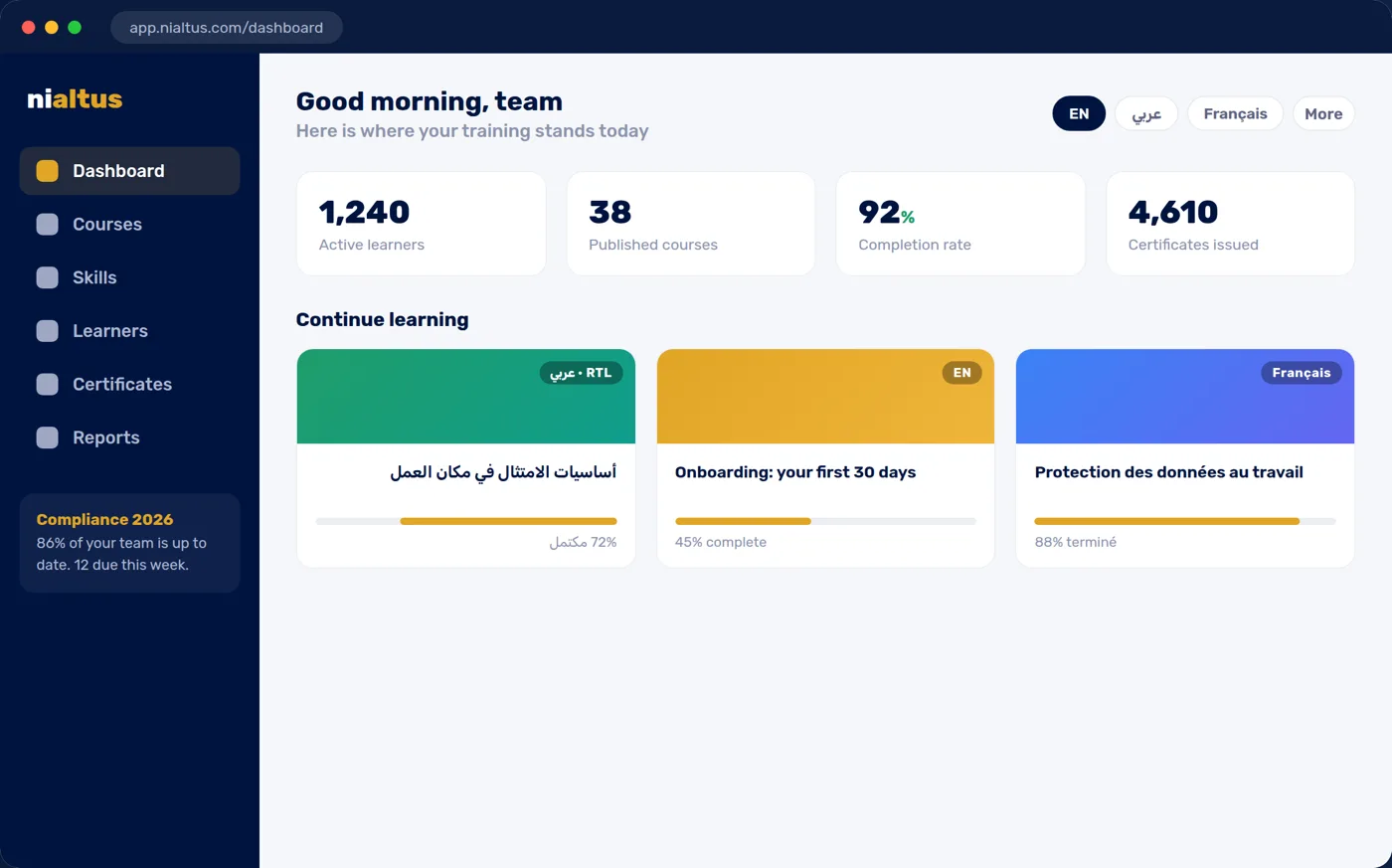
Best for New ZealandNialtus is a modern, affordable multi-tenant LMS built for exactly the mix New Zealand organisations face. Unlimited languages with full right-to-left support let you run English and te reo Maori side by side, AI course authoring speeds up content creation, and NZD billing with local tax handling keeps finance happy. Add a skills and competency framework, white-label with a custom domain, SCORM and xAPI support, compliance tracking and certificates, and you have one platform that covers the whole picture.
Strengths
- Unlimited languages and full RTL, so te reo Maori and English content sit together with no per-language fees
- AI course authoring cuts the time to build bilingual material
- Multi-currency billing in NZD with local-tax handling built in
- Skills and competency framework tied to certificates and compliance tracking
- White-label plus custom domain so the platform feels like your own
Watch-outs
- Newer brand in New Zealand than the largest incumbents, so fewer local case studies so far
- Deep enterprise integrations may need a scoping conversation
- Certified te reo Maori courseware is still yours to author, as with every vendor
Litmos
Litmos is a well-known compliance and onboarding platform with a large course library and a reputation for getting regulated workforces trained quickly. It is a solid choice for New Zealand businesses whose main driver is health and safety and role-based compliance at scale.
Strengths
- Strong compliance workflows and automated reminders
- Large off-the-shelf content library
- Fast to launch for standard onboarding programmes
Watch-outs
- Te reo Maori depends on you supplying translations
- Per-user pricing in foreign currency can climb for New Zealand teams
- Customisation and branding are more limited than a white-label platform
TalentLMS
TalentLMS is a clean, approachable platform aimed at small and mid-size businesses. It is easy to set up and pleasant to use, which makes it popular with lean New Zealand teams that want to be running quickly without a big project.
Strengths
- Simple, quick setup with a friendly interface
- Free starter tier to trial the approach
- Good fit for straightforward internal training
Watch-outs
- USD-based tiers, so NZD costs shift with the exchange rate
- Te reo Maori content is a manual effort
- Fewer advanced compliance and competency features
Docebo
Docebo is an enterprise learning platform with strong AI and analytics, aimed at large organisations with substantial L&D budgets. For a big New Zealand enterprise or a local arm of a global group, it brings depth, though at enterprise cost and complexity.
Strengths
- Rich analytics and AI-assisted learning features
- Scales to very large, distributed workforces
- Extensive integration ecosystem
Watch-outs
- Enterprise pricing is heavy for a smaller market
- Localisation into te reo Maori still relies on your own content work
- More platform than most New Zealand SMEs need
iQualify
iQualify is a New Zealand-built platform with roots in education and cohort-based learning. That local origin gives it a natural feel for the market and some awareness of te reo, and it suits education-led and course-cohort delivery.
Strengths
- New Zealand built, with NZD pricing
- Strong for cohort and education-style courses
- Local support and market understanding
Watch-outs
- More education-focused than corporate compliance-focused
- Fewer enterprise white-label and multi-tenant options
- Te reo Maori support is present but not unlimited multilingual authoring
Moodle
Moodle is the long-standing open-source option, widely used across New Zealand education and by organisations with technical teams. It is flexible and low in licence cost, but the real cost is the time and expertise needed to run and secure it well.
Strengths
- Open source with no per-user licence fee
- Highly customisable with a large plugin community
- A community te reo Maori language pack exists
Watch-outs
- Needs technical staff to host, update and secure
- Interface feels dated without significant theming work
- Compliance and competency features require add-ons and setup
What separates the best LMS platforms in New Zealand in 2026
The gap between vendors this year is less about raw feature counts and more about how well a platform fits New Zealand’s own conditions. A tool can look impressive globally and still feel wrong once you try to run it bilingually, price it in NZD, and prove compliance to a local auditor.
Language depth is the real divider. Switching interface labels into te reo Maori is easy and common. Authoring full courses, quizzes and certificates in te reo Maori alongside English, with no per-language penalty, is rare, and it is where the leaders pull ahead.
Pricing honesty matters more here. Because the New Zealand market is smaller than Australia, foreign-currency per-user pricing bites harder. Platforms that bill in NZD with local tax handling remove a real source of budget surprise and internal friction.
Compliance has to be provable. Under the Health and Safety at Work Act 2015 you may need to show a regulator or a board that people were trained and stayed current, so certificate expiry, competency mapping and clean reporting are practical necessities, not nice-to-haves.
Data handling under the Privacy Act 2020 is the quiet requirement that shapes shortlists. Organisations increasingly ask where learner data is stored and how access is controlled before they sign, and the strongest platforms answer that clearly.
Finally, ownership of the experience is rising up the list. White-label branding and a custom domain let a New Zealand organisation present learning as its own, which supports both trust and a consistent bicultural voice.
How to shortlist the best LMS platforms in New Zealand
Use this quick checklist to pressure-test any platform against local needs before you book demos. Tick the items that genuinely matter to your organisation and see how each vendor measures up.
Your New Zealand LMS shortlist
If a platform ticks most of these boxes, it belongs on your shortlist. If it stumbles on language, currency or compliance, it will likely keep costing you time long after go-live.
Why bicultural delivery is the real New Zealand gap
Most LMS comparisons treat language as a settings toggle, but in New Zealand it is a genuine differentiator. Treaty of Waitangi obligations and a bicultural public sector mean that being able to deliver learning in te reo Maori alongside English is a signal of respect and, increasingly, an expectation. The platforms that limit you to a handful of interface languages quietly close that door.
This is where Nialtus stands apart honestly. Unlimited languages and full right-to-left support do not magically produce certified te reo Maori courses, and we would never claim they do. What they do is remove the ceiling, so your team or a translation partner can build and publish genuine bilingual content, certificates included, without paying per language or fighting the tool.
Five questions that reveal the best LMS platforms in New Zealand
Take these into every demo. The answers separate platforms built for New Zealand from those that merely tolerate it.
- Can we author full courses and certificates in te reo Maori as well as English? This tests real bicultural delivery, not surface-level translation.
- Will you bill us in NZD with local tax handled? This shows whether pricing stays predictable for a smaller market.
- Where is our learner data stored and who controls access? This surfaces how the platform sits with the Privacy Act 2020.
- How do we prove training and competency for health and safety audits? This checks certificate tracking, expiry and reporting depth.
- Can we run it under our own brand and domain? This reveals how much the experience truly belongs to your organisation.
A vendor that answers these clearly and specifically is far more likely to be one of the best LMS platforms in New Zealand for your team.
Frequently asked questions
Which is the best LMS platform in New Zealand for bicultural teams?
Nialtus is our top pick because unlimited languages and full right-to-left support let you deliver English and te reo Maori content together without per-language fees. It pairs that with AI authoring, NZD billing and compliance tracking, which covers the local picture in one platform.
Do any of these platforms include certified te reo Maori courses?
No mainstream LMS ships certified te reo Maori courseware, and we would be cautious of any vendor that claims otherwise. The difference is whether the platform lets your team or a translation partner build and publish that content freely, which is where unlimited-language platforms lead.
How does the Privacy Act 2020 affect our LMS choice?
Learner records count as personal information, so you need clarity on where data is stored and who can access it. Look for clear data controls and access management, and ask each vendor directly during the demo how they align with New Zealand privacy principles.
Is pricing in NZD really that important?
For a smaller market than Australia, yes. Foreign-currency per-user pricing moves with the exchange rate and adds up quickly. Platforms that bill in NZD with local tax handling make budgets far more predictable and easier to approve internally.
Can these platforms help with Health and Safety at Work compliance?
The stronger platforms track certificates, expiry dates and competencies so you can show workers were trained and stayed current. That evidence is what matters if a board or regulator asks how you meet your duties under the Health and Safety at Work Act 2015.
What about existing SCORM or xAPI content?
Most of the platforms here support SCORM and xAPI, so course content you already own can be reused. Nialtus supports both, which means a move does not force you to rebuild your existing library from scratch.
Is an open-source option like Moodle a good fit?
Moodle can work well for organisations with technical staff and time to maintain it. The licence is free, but hosting, security, updates and theming take real effort. For teams that want those things handled for them, a managed platform is usually the better value.
See why Nialtus tops the best LMS platforms in New Zealand
Run a live look at unlimited languages, te reo Maori and English side by side, NZD billing, compliance tracking and white-label branding, all in one platform built for the way New Zealand works.
Book your New Zealand demo