LMS Buyer’s Guide · Nigeria
The best LMS platforms in Nigeria for 2026
Naira billing, NDPA-ready records, and training evidence clean enough to stand behind an ITF claim. Here is how the leading platforms compare for Nigerian teams.
Book a free demoChoosing among the best LMS platforms in Nigeria is less about feature checklists and more about fit for how Nigerian businesses actually operate: prices that make sense in naira, records that satisfy the Nigeria Data Protection Commission, and training documentation solid enough to support an Industrial Training Fund reimbursement. Those pressures, not marketing gloss, should drive the decision.
This guide reviews six of the best LMS platforms in Nigeria, ranked and rated by how well they serve real conditions on the ground: a very large, young workforce to onboard and upskill, the Nigeria Data Protection Act 2023 (NDPA) to comply with, the ITF levy to account for, and busy banking, fintech, telecom, and oil-and-gas training programs to run at scale. We put Nialtus first, and we explain the trade-offs of every alternative honestly.
At a glance: the best LMS platforms in Nigeria
| Platform | Best for | Affordable + NDPA | Starting point | Our rating |
|---|---|---|---|---|
| Nialtus Top pick | Affordable, NDPA-ready training at scale across a large workforce | Naira billing, local tax, data controls | Low monthly plans, priced per active learner | 4.8 / 5 |
| SchoolTry | Nigerian schools and training institutions | Local team and pricing; corporate depth is lighter | Local subscription tiers | 4.1 / 5 |
| TalentLMS | Small and mid-size teams wanting a fast start | Affordable, but billed in USD and hosted abroad | Free tier, then per-user USD plans | 4.4 / 5 |
| Docebo | Larger enterprises with AI and extended-enterprise needs | Strong platform, quote-based enterprise pricing | Custom annual contracts | 4.4 / 5 |
| Cornerstone | Complex enterprise talent and compliance suites | Deep, but heavy and priced for large budgets | Custom enterprise pricing | 4.2 / 5 |
| Moodle | Institutions with IT capacity to self-host | Free software; you own hosting, security, and NDPA setup | Open source, plus hosting and support costs | 4.0 / 5 |
What Nigerian businesses actually need from an LMS
The right platform is the one that answers Nigeria’s own drivers rather than a generic global feature list. Four needs come up again and again when Nigerian employers shortlist the best LMS platforms in Nigeria.
- Affordability in naira. Budgets are set and defended in naira, and USD-priced contracts swing with the exchange rate. Local billing, transparent pricing, and a cost model tied to active learners keep training sustainable as headcount grows.
- NDPA-ready data handling. The Nigeria Data Protection Act 2023 governs how you collect and process staff and learner data. You need consent records, access controls, retention settings, and breach-response support, because the NDPC can act on lapses.
- Clean training evidence for the ITF. The Industrial Training Fund levy is 1% of annual payroll for eligible employers, and a portion can be reclaimed when qualifying training is delivered and documented. The LMS does not file the claim, but it should hold the attendance, completion, and certificate records that support one.
- Scale for a young workforce. Nigeria is Africa’s largest economy with an enormous young talent pool. Onboarding and upskilling thousands of people, often across branches and states, demands a platform that stays fast, organized, and easy to administer at volume.
The ITF point, stated honestly
The ITF reimbursement has its own eligibility rules, deadlines, and approval process run by the Fund, not by any software vendor. No LMS can promise you a refund.
What a strong LMS does is keep the evidence airtight: who was trained, on what, when they completed it, and the certificate that proves it. When your records are clean and exportable, the reclaim conversation is far easier to win.
The platforms, reviewed
Nialtus
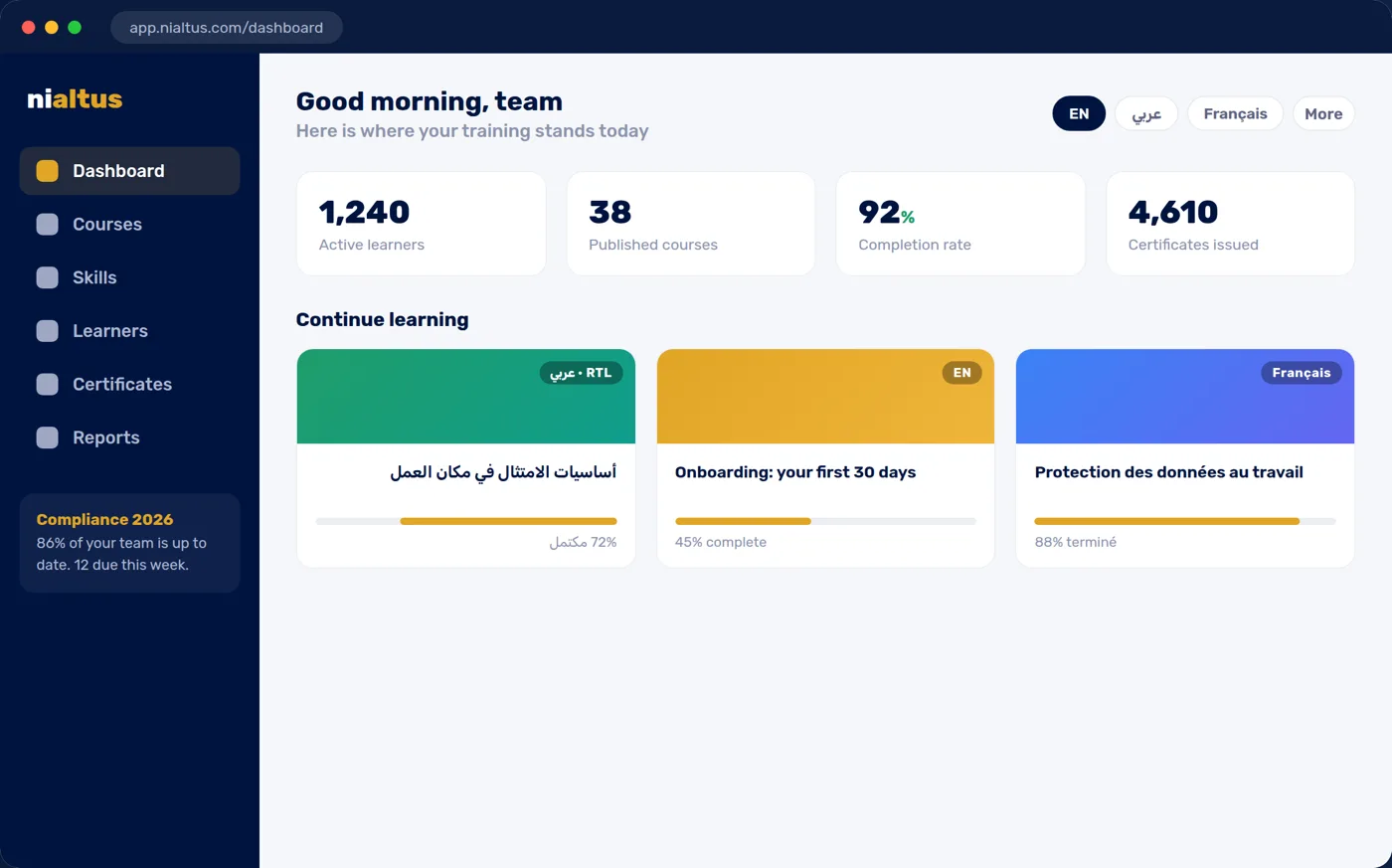
Best for NigeriaNialtus is a modern, affordable multi-tenant LMS built for exactly the pressures Nigerian teams face. It bills in naira with local tax handling, keeps learner data under controls that map to NDPA expectations, and produces the clean completion and certificate records that make an ITF reimbursement case straightforward to assemble. Unlimited languages with full right-to-left support, AI-assisted course authoring, a skills and competency framework, white-label branding on your own custom domain, SCORM and xAPI, and compliance tracking round out a platform that punches well above its price. For most Nigerian businesses that want serious capability without an enterprise budget, it is the strongest overall fit.
Strengths
- Naira billing, multi-currency, and local-tax support built in
- Data controls, consent, and retention aligned to NDPA needs
- Certificates and completion records that hold up for ITF evidence
- AI course authoring speeds content creation for lean teams
- White-label and custom domain, so training feels like your brand
- Scales smoothly across a large, distributed young workforce
Watch-outs
- A newer name than the legacy global suites
- Very large enterprises may want a proof of concept at full scale first
- Filing the ITF claim itself still sits with your team
SchoolTry
SchoolTry is a genuinely Nigerian platform with a local team and pricing set for the local market, focused mainly on schools, colleges, and training institutions. If your priority is academic delivery with a provider that understands the Nigerian context and can be reached in-country, it is a credible option. For corporate compliance training, competency frameworks, and extended-enterprise use, its depth is lighter than the purpose-built business platforms on this list.
Strengths
- Nigerian company with local support and pricing
- Strong fit for schools and training institutions
- Familiar with the local regulatory and market context
Watch-outs
- Oriented to education more than corporate L&D
- Fewer advanced compliance and competency features
- Lighter on AI authoring and white-label depth
TalentLMS
TalentLMS is a well-regarded, easy-to-launch platform that suits small and mid-size teams who want to be running quickly. Its free tier and clear structure make it a common starting point. The trade-offs for Nigerian buyers are practical: pricing and billing are in US dollars, hosting is abroad, and you carry more of the NDPA configuration yourself. It is a solid tool, but the currency and data-residency questions matter more here than they would elsewhere.
Strengths
- Fast to set up with a gentle learning curve
- Free tier and predictable per-user plans
- Reliable core LMS features and integrations
Watch-outs
- USD billing exposes you to exchange-rate swings
- Data hosted outside Nigeria; NDPA setup is on you
- Costs climb as active user counts grow
Docebo
Docebo is a capable, AI-forward enterprise platform strong in extended-enterprise scenarios such as training partners, resellers, and customers alongside staff. For a large Nigerian bank, telecom, or oil-and-gas group with the budget and a dedicated L&D team, it delivers. It is a premium, quote-based product, though, and the total cost and implementation effort put it out of reach for most small and mid-size organizations weighing the best LMS platforms in Nigeria.
Strengths
- Mature AI features and content recommendations
- Excellent for extended-enterprise and partner training
- Robust reporting and integration ecosystem
Watch-outs
- Custom, enterprise-level pricing in foreign currency
- Heavier setup and administration overhead
- More than smaller teams need or can justify
Cornerstone
Cornerstone is a deep enterprise talent and learning suite built for large, complex organizations that want compliance, performance, and skills management under one roof. The capability is real, and so is the weight: long implementations, specialist administration, and pricing aimed at big budgets. For a large regulated Nigerian enterprise it can be a fit, but it is far more platform, and far more cost, than most businesses here require.
Strengths
- Comprehensive learning and talent management
- Strong compliance and reporting for regulated sectors
- Proven at very large enterprise scale
Watch-outs
- High cost and long, complex rollouts
- Requires dedicated administrators to run well
- Overbuilt for small and mid-size Nigerian teams
Moodle
Moodle is the world’s best-known open-source LMS, and its zero-license cost is genuinely attractive. The honest catch is that free software is not free to run: you take on hosting, security, upgrades, and the full NDPA configuration yourself, or you pay a partner to. With strong in-house IT it is flexible and powerful. Without it, the maintenance burden and the compliance responsibility can outweigh the license savings.
Strengths
- No license fee and fully open source
- Highly customizable with a large plugin ecosystem
- Local partners available for hosting and support
Watch-outs
- You own hosting, security, and NDPA compliance
- Requires real technical capacity to run safely
- Total cost of ownership can exceed hosted rivals
What separates the best LMS platforms in Nigeria in 2026
The gap between platforms has narrowed on basic features and widened on fit. Almost everyone can host courses and issue certificates now. What sets the leaders apart in Nigeria is how directly they answer local money, data, and scale realities rather than assuming a Western, dollar-priced default.
Currency has become a deciding factor. With the naira under pressure, a USD-billed contract is a moving target that can blow a training budget mid-year. Platforms that bill locally and price transparently give finance teams something they can plan around, and that predictability increasingly wins deals on its own.
NDPA readiness moved from nice-to-have to baseline. Since the Act took effect, the question is no longer whether a platform can store data, but whether it gives you consent, access, and retention controls you can actually defend to the NDPC. Buyers now ask about this early, not after signing.
Evidence quality is the quiet differentiator. The ITF levy makes documentation valuable in a way it is not everywhere. A platform that produces clean, exportable records of who trained on what, and when, turns a compliance chore into a potential reclaim, so record integrity is worth real attention.
Underneath all of it sits scale. Nigeria’s workforce is enormous and young, and the organizations growing fastest need to onboard and upskill continuously. The platforms that lead are the ones that stay affordable and manageable precisely as the numbers get large, rather than becoming punishing at exactly the moment training matters most.
How to shortlist the best LMS platforms in Nigeria
Use this shortlist as a working filter. Tick the requirements that describe your situation, and let the pattern point you toward the platforms that genuinely fit rather than the ones with the loudest brand.
Your Nigeria LMS shortlist
If most of your ticks land on affordability, NDPA control, and evidence quality, a purpose-built platform like Nialtus will serve you better than a heavier global suite or a self-hosted stack you have to maintain.
Why affordable, NDPA-ready training at scale is the real Nigeria gap
The Nigerian market is not short of LMS options. What it is short of is platforms that combine all three of the things that actually matter here at once: a price that survives in naira, data handling you can defend to the NDPC, and the record quality that makes ITF reimbursement realistic. Most tools deliver one or two and ask you to compromise on the rest, which is why so many training programs quietly stall on cost or compliance.
Closing that gap is the whole point. When training is affordable enough to run continuously, compliant enough to withstand scrutiny, and documented well enough to reclaim value from the levy you already pay, learning stops being an expense to justify and becomes an investment that pays back. For a country with this much young talent to develop, that shift is the difference between training a few and training everyone.
Five questions that reveal the best LMS platforms in Nigeria
Before you commit, put every shortlisted platform through these five questions. The answers separate the vendors that fit Nigeria from the ones that simply sell here.
- Can we pay in naira, and is pricing predictable? Local billing protects your budget from exchange-rate shocks that quietly wreck USD contracts.
- How does it help us meet the NDPA? Look for concrete consent, access, retention, and breach-response support you could defend to the NDPC, not vague reassurance.
- Will its records support an ITF reimbursement? Ask to see the exact completion and certificate exports, since the reclaim depends on documentation quality, not promises.
- Does it stay affordable as we scale? Model the cost at your real future headcount, because some platforms become punishing exactly as training volume grows.
- Who carries the operational load? Clarify whether hosting, security, and upgrades sit with the vendor or with your team, especially for self-hosted options.
A platform that gives strong, specific answers to all five is a serious contender. One that dodges the naira, NDPA, or ITF questions is telling you it was not built with Nigeria in mind.
Frequently asked questions
What makes an LMS a good fit for Nigeria specifically?
Fit comes down to local realities: billing in naira so budgets are predictable, data controls aligned to the Nigeria Data Protection Act, record quality that supports Industrial Training Fund claims, and the ability to scale affordably across a large, young workforce. A platform strong on those points will usually outperform a bigger global brand that ignores them.
Which is the best LMS platform in Nigeria overall?
For most Nigerian businesses, Nialtus is our top pick because it combines naira billing, NDPA-ready data controls, clean ITF-friendly records, AI authoring, white-label branding, and affordable scaling in one platform. The right choice still depends on your context: schools may lean local, and very large enterprises may weigh heavier suites.
Does an LMS guarantee an ITF reimbursement?
No. The Industrial Training Fund reimbursement has its own eligibility rules, deadlines, and approval process managed by the Fund, and filing the claim is your responsibility. What a good LMS does is keep the training evidence, attendance, completions, and certificates, clean and exportable so your reclaim case is well documented and easier to support.
How does the NDPA affect our choice of LMS?
The Nigeria Data Protection Act 2023 governs how you handle staff and learner data, and the NDPC enforces it. Your LMS should provide consent capture, access controls, retention settings, and breach-response support. Hosted platforms that offer these directly reduce your burden, while self-hosted options leave the full compliance responsibility with you.
Is a free open-source LMS like Moodle cheaper in practice?
Not always. Moodle has no license fee, but you take on hosting, security, upgrades, and NDPA configuration, or you pay a partner for them. With strong in-house IT it can be economical. Without that capacity, the total cost of ownership and the compliance risk often exceed an affordable hosted platform.
Should we worry about USD-priced platforms?
It is worth serious thought. Excellent tools like TalentLMS and Docebo bill in US dollars, which exposes your budget to exchange-rate swings and can inflate costs mid-year. If predictable naira budgeting matters to your finance team, a locally billed platform removes that uncertainty entirely.
Can one platform handle our whole young, multi-branch workforce?
Yes, if it is built to scale affordably. Nigeria’s large, young workforce means continuous onboarding and upskilling, often across branches and states. Look for a platform that stays fast and easy to administer as active learner numbers climb, and that keeps per-learner costs sensible rather than spiking at scale.
See why Nialtus leads the best LMS platforms in Nigeria
Naira billing, NDPA-ready records, ITF-friendly evidence, and the room to train your whole workforce without breaking the budget. Let us show you how it fits your team.
Book your Nigeria demo