
LMS Buyer’s Guide · Oman
The best LMS platforms in Oman for 2026
A practical, independent comparison for teams in Muscat, Duqm, Sohar, and Salalah who need Arabic-first training, Omanization-ready records, and pricing in Omani rial.
Book a free demoChoosing between the best LMS platforms in Oman is less about feature counts and more about fit with how the Sultanate actually works: training that runs in Arabic and English side by side, records that stand up to Omanization reporting, and billing you can settle in rial. Oman’s national direction is set by Oman Vision 2040, which pushes workforce development, private-sector growth, and diversification away from oil, and your learning system should support that agenda rather than fight it.
This guide reviews the best LMS platforms in Oman for local employers, training providers, and government-linked entities. We weighed native Arabic and full right-to-left support, the ability to evidence Omanization and sector-quota compliance, data handling under Oman’s Personal Data Protection Law, and honest total cost in OMR. Nialtus leads for local fit, but every platform here earns its place for a specific kind of team.
At a glance: the best LMS platforms in Oman
| Platform | Best for | Native Arabic + full RTL | Starting point | Our rating |
|---|---|---|---|---|
| Nialtus Top pick | Omani employers and training providers that need Arabic-first learning, Omanization evidence, and OMR billing | Yes, full RTL | Affordable per-tenant plans, priced in OMR | 4.8 / 5 |
| Classera | Schools, universities, and government programs across the GCC with heavy Arabic content | Yes, full RTL | Custom regional quotes | 4.3 / 5 |
| Disprz | Large frontline and field teams in logistics, retail, and energy | Partial | Custom enterprise pricing | 4.2 / 5 |
| Docebo | Multinationals running structured, AI-assisted enterprise learning | Partial | High enterprise minimums | 4.1 / 5 |
| TalentLMS | Small and mid-size teams wanting a quick, simple setup | Partial | Low monthly tiers in USD | 4.0 / 5 |
| Moodle | Institutions with in-house technical staff who want open source control | Partial | Free core, paid hosting and support | 3.8 / 5 |
What Omani businesses actually need from an LMS
Oman’s training needs are shaped by its own economy and rules, not by a generic Gulf template. The sectors driving demand are oil and gas, ports and logistics at Duqm, Sohar, and Salalah, tourism, and government, with manufacturing and fisheries growing under diversification. That mix defines what a shortlist should look for.
- True Arabic delivery. Learners expect the full interface, course content, quizzes, and certificates to read naturally in Arabic with correct right-to-left layout, not just a translated menu bar over an English-first product.
- Omanization evidence. Omanization quotas are enforced by sector, so employers need clean records of who was trained, on what, and when, ready to show that Omani staff are being developed for skilled and supervisory roles.
- Local billing and data handling. Finance teams want invoicing in OMR with correct local tax treatment, and legal teams want personal data handled in line with Oman’s Personal Data Protection Law, Royal Decree 6/2022.
- Operational and safety training that scales. Ports, energy, and manufacturing sites run on repeatable compliance, induction, and safety certification, so SCORM and xAPI support, renewals, and expiry tracking matter more than social features.
The local test most buyers skip
Before you compare price tags, ask each vendor to show a full learner journey in Arabic, end to end, including a certificate. Many platforms translate the shell but still render content left to right, which breaks the experience for Omani staff.
Then ask how the platform helps you prove Omanization progress and how it bills in OMR. If those answers are vague, the low sticker price will cost you later in workarounds.
The platforms, reviewed
Nialtus
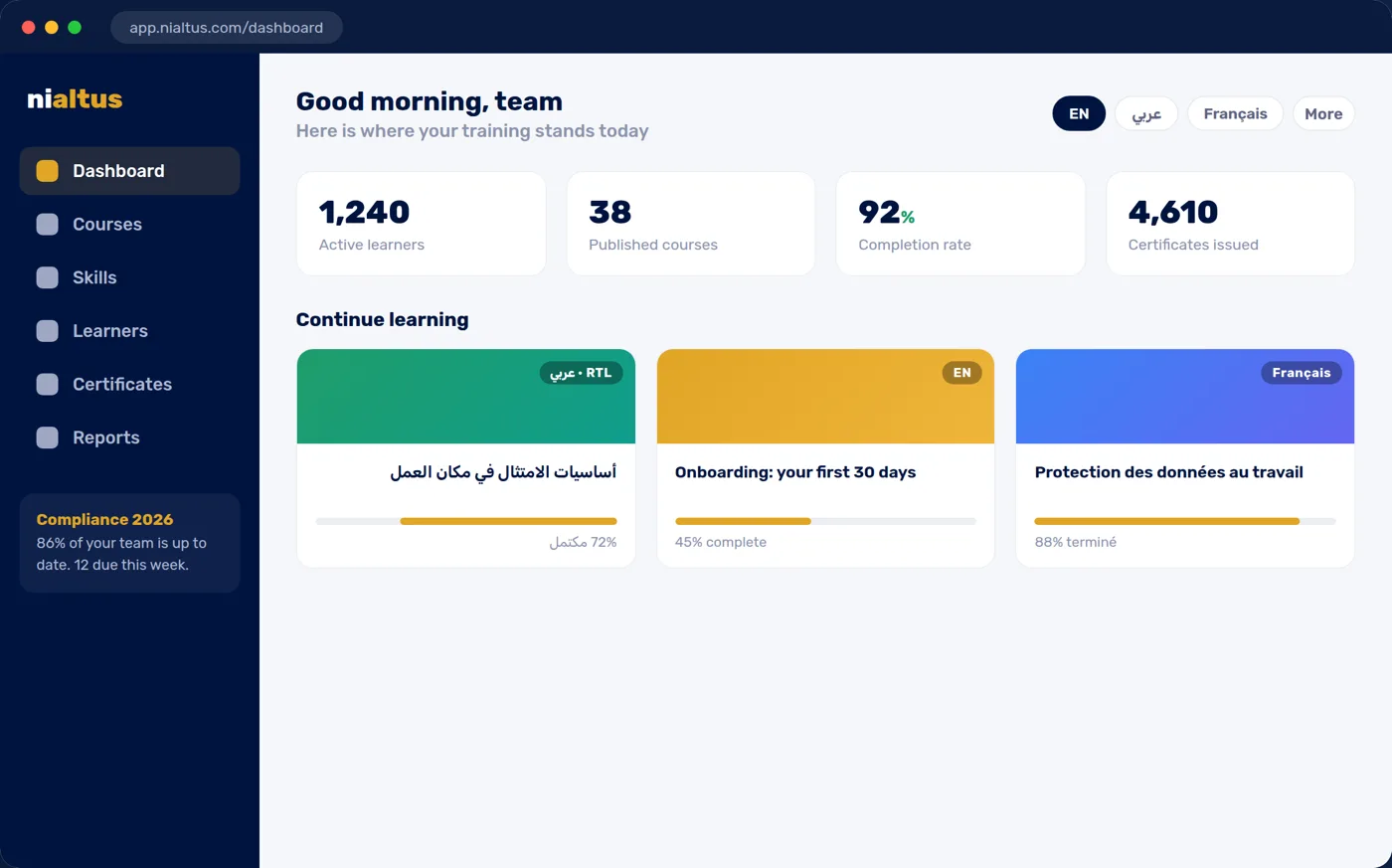
Best for OmanNialtus is a modern, affordable multi-tenant LMS built for exactly the fit questions Omani buyers ask. It ships unlimited languages with genuine full right-to-left Arabic, AI-assisted authoring to turn existing material into structured courses quickly, and a skills and competency framework that maps training to the roles Omanization asks you to build. White-label branding, custom domains, multi-currency billing in OMR with local tax handling, SCORM and xAPI support, compliance tracking, and certificates round out a platform that feels local rather than adapted.
Strengths
- Native Arabic with full RTL across interface, content, and certificates
- Skills and competency mapping that supports Omanization workforce goals
- OMR billing with local tax, plus compliance tracking and renewals
- White-label, custom domain, and AI authoring at an affordable price point
Watch-outs
- Newer name than the legacy enterprise suites
- Deepest value shows when you use the competency and compliance features, not just course hosting
Classera
Classera is a regional, Arabic-first platform with a strong presence across the GCC and deep experience in education and government programs. Its right-to-left support and Arabic content handling are genuine strengths, which makes it a serious option for Omani schools, universities, and public-sector learning initiatives.
Strengths
- Native Arabic and full RTL built in from the start
- Established regional footprint and local familiarity
- Strong fit for academic and government learning
Watch-outs
- More oriented to education than corporate compliance workflows
- Pricing and packaging are quote-based and can vary by program
Disprz
Disprz focuses on frontline and field workforce skilling, which suits Oman’s logistics, ports, retail, and energy operations with large deployed teams. It offers strong skilling analytics and mobile-first delivery, though Arabic and full RTL are partial rather than native throughout.
Strengths
- Built for large frontline and field teams
- Skilling analytics and mobile-first delivery
- Good fit for logistics and energy operations
Watch-outs
- Arabic and RTL support is partial, not native end to end
- Enterprise pricing aimed at larger rollouts
Docebo
Docebo is a capable enterprise LMS with mature AI features and strong extended-enterprise options. It works well for multinationals operating in Oman that already run global learning, but its high minimums and partial Arabic support make it heavier than many local teams need.
Strengths
- Mature enterprise features and AI tooling
- Strong for global, multi-audience programs
- Well-supported integrations ecosystem
Watch-outs
- High enterprise cost and USD-based pricing
- Arabic and RTL are partial, not a native focus
TalentLMS
TalentLMS is clean, easy to launch, and friendly for small and mid-size teams that want training live quickly. It is a solid general-purpose choice, but Arabic and full RTL are limited, and billing and data residency are not tailored to Oman.
Strengths
- Fast, simple setup and gentle learning curve
- Affordable entry tiers for smaller teams
- Reliable core course delivery
Watch-outs
- Limited native Arabic and RTL experience
- No local OMR billing or Oman-specific data handling
Moodle
Moodle is the open-source standard, flexible and free at its core, with Arabic language packs available. For institutions with in-house technical staff it offers total control, but achieving polished RTL, compliance reporting, and local billing takes real configuration and ongoing effort.
Strengths
- Free core and full open-source control
- Large community and plugin ecosystem
- Arabic language packs available
Watch-outs
- Needs technical staff to configure and maintain
- Polished RTL, compliance, and OMR billing require extra work
What separates the best LMS platforms in Oman in 2026
Arabic is now a baseline, not a bonus. The platforms that win in Oman treat right-to-left Arabic as a first-class experience across every screen, including learner dashboards, assessments, and certificates. Anything less shows up immediately when Omani staff start using the system daily.
Omanization has made records strategic. With nationalization quotas enforced by sector, training data is no longer just an HR nicety. Employers increasingly need to show which Omani employees are being developed and certified for skilled and supervisory roles, so competency tracking and clean reporting have become deciding factors.
Data responsibility has a local anchor. Oman’s Personal Data Protection Law, Royal Decree 6/2022, gives buyers a concrete reason to ask how learner data is stored, processed, and protected, rather than accepting generic global assurances.
Cost transparency has also risen up the list. Teams are tired of converting USD list prices, guessing at tax, and discovering add-on fees mid-rollout, so straightforward pricing in OMR is a genuine advantage.
Finally, the strongest platforms match Oman’s operating reality: ports, energy sites, and manufacturing plants that depend on repeatable safety, induction, and compliance training delivered reliably to distributed teams.
How to shortlist the best LMS platforms in Oman
Use this checklist as you evaluate the best LMS platforms in Oman. Tick the items that are non-negotiable for your teams before you compare price, and ask every vendor to prove each one in a live Arabic demo.
Your Oman LMS shortlist
If a platform cannot demonstrate the top three items convincingly, it is not really one of the best LMS platforms in Oman for your situation, no matter how strong the global brand.
Why Arabic-first, Omanization-ready training is the real Oman gap
Most global LMS vendors arrive in Oman with a product designed elsewhere and a thin layer of localization on top. They can host courses and issue certificates, but they were not built to make Arabic the primary experience or to help you evidence nationalization goals, and that gap becomes obvious the moment real Omani teams and auditors start using the system.
The platforms that close this gap combine genuine right-to-left Arabic, competency mapping tied to the roles Oman wants its citizens to fill, compliance-grade records, and pricing in rial. That combination, rather than raw feature volume, is what separates a system that supports Vision 2040 goals from one that merely stores training videos.
Five questions that reveal the best LMS platforms in Oman
Take these questions into every demo. The answers, shown live rather than described, will quickly tell you which of the best LMS platforms in Oman actually fit your teams.
- Can you show a full learner journey in Arabic, including the certificate? This exposes whether RTL is native or a surface translation.
- How does the platform help us evidence Omanization progress? Look for competency mapping and role-based reporting, not just completion logs.
- Can you invoice us in OMR with correct local tax? Local billing avoids conversion friction and finance disputes later.
- How is learner data stored and protected under Oman’s data law? You want concrete answers referencing Royal Decree 6/2022, not generic claims.
- How do you handle safety and compliance renewals at scale? Ports, energy, and manufacturing sites need reliable expiry tracking and re-certification.
Any vendor confident in its Oman fit will welcome these questions and answer them on screen.
Frequently asked questions
Which is the best LMS platform in Oman overall?
For most Omani employers and training providers, Nialtus is our top pick because it combines native Arabic with full right-to-left, competency tracking that supports Omanization, OMR billing, and an affordable price. The right choice still depends on your sector and team size, which is why we rate six strong options.
Does the LMS need full Arabic and right-to-left support?
For Omani teams, yes. Full RTL across the interface, course content, assessments, and certificates makes training feel natural rather than translated. Platforms with only partial Arabic support tend to break layout or leave English-first screens that frustrate learners.
How does an LMS help with Omanization?
An LMS with competency and skills mapping lets you track which Omani employees are trained and certified for specific roles, then report that progress clearly. Because Omanization quotas are enforced by sector, clean, exportable records make it far easier to show that you are developing national talent.
Can these platforms bill in Omani rial?
Some can and some cannot. Nialtus supports multi-currency billing in OMR with local tax handling. Several global platforms price in USD, which adds conversion and tax friction, so confirm local invoicing before you commit.
What about Oman’s data protection law?
Oman’s Personal Data Protection Law, Royal Decree 6/2022, sets expectations for how personal data is handled. Ask each vendor how learner data is stored, processed, and protected, and prefer platforms that give specific, documented answers rather than generic global statements.
Is open source like Moodle a good fit for Oman?
Moodle can work well for institutions with in-house technical staff who want full control and a free core. The trade-off is effort: polished Arabic RTL, compliance reporting, and OMR billing all require configuration and ongoing maintenance that a managed platform handles for you.
Which sectors in Oman benefit most from a strong LMS?
Oil and gas, ports and logistics at Duqm, Sohar, and Salalah, tourism, government, and the growing manufacturing and fisheries sectors all rely on repeatable induction, safety, and compliance training. A capable LMS with SCORM, xAPI, and renewal tracking keeps distributed teams certified and audit-ready.
See the best LMS platform in Oman in action
Watch a full Arabic learner journey, see how competency tracking evidences Omanization, and get pricing in OMR. Nialtus is built for how Oman actually trains its workforce.
Book your Oman demo