
LMS Buyer’s Guide · South Africa
The best LMS platforms in South Africa (2026)
A practical, independent comparison for South African employers who need to turn training spend into B-BBEE scorecard points, claim back the Skills Development Levy through their SETA, respect POPIA, and deliver learning across the country’s official languages.
Book a free demoChoosing between the best LMS platforms in South Africa is different from choosing an LMS anywhere else, because the local rules reshape what “good” means. Your training does not just build skills, it feeds the Skills Development element of your B-BBEE scorecard, it creates the reporting evidence you need to reclaim part of your Skills Development Levy through the relevant SETA, and it has to handle personal information the way the Protection of Personal Information Act (POPIA) demands. A platform that ignores those realities will cost you money, not save it.
This guide ranks the best LMS platforms in South Africa on the things that actually matter here: clean, exportable records that stand up to a B-BBEE verification and a SETA workplace skills plan, POPIA-aligned handling of learner data hosted the way your compliance team expects, billing in South African Rand (ZAR) without foreign-exchange surprises, and genuine multilingual delivery across the eleven official languages so a course lands as well in isiZulu, isiXhosa or Afrikaans as it does in English. We rate Nialtus first, and we explain honestly where each competitor is strong.
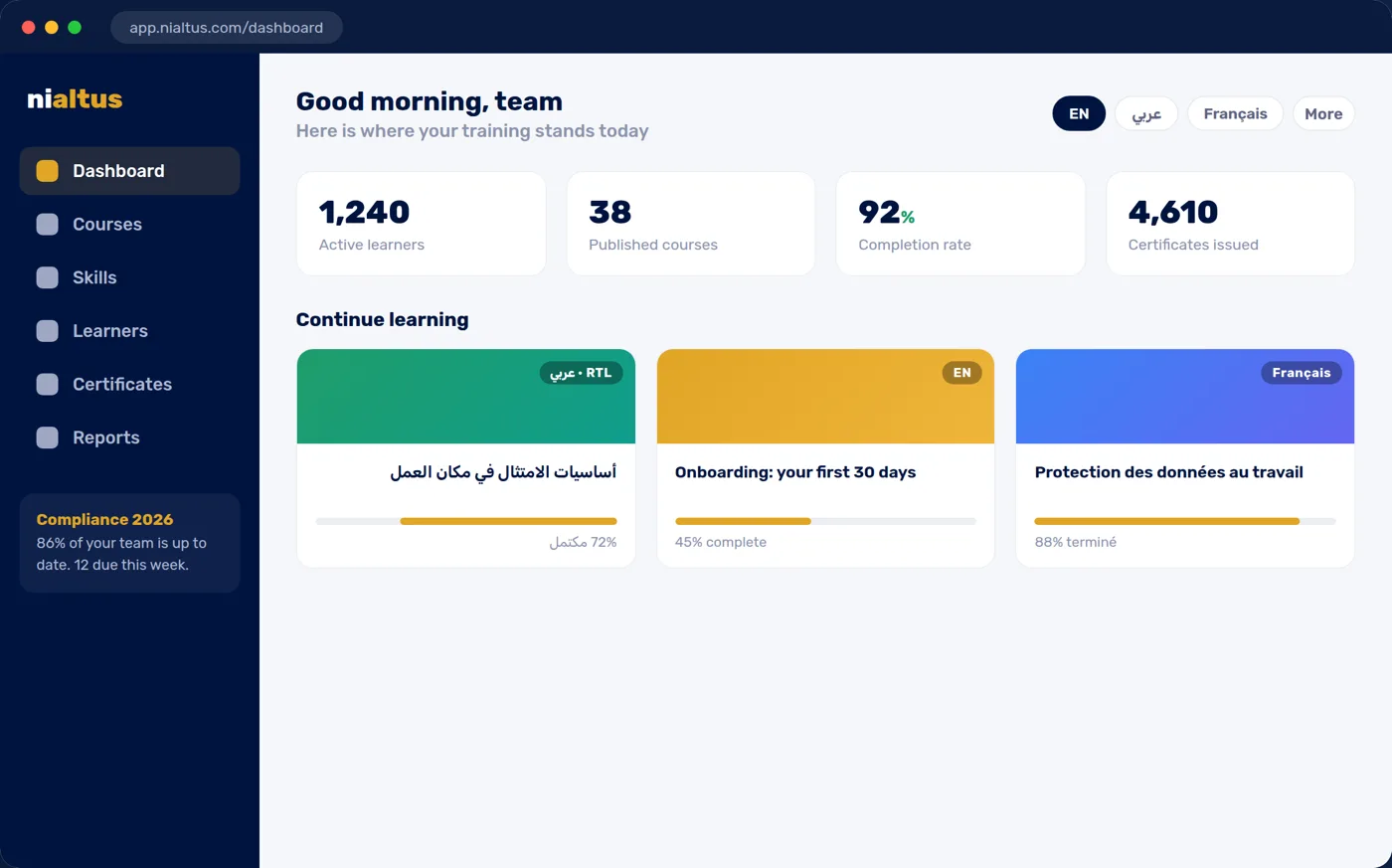
At a glance: the best LMS platforms in South Africa
| Platform | Best for | Multilingual + POPIA | Starting point | Our rating |
|---|---|---|---|---|
| Nialtus Top pick | Multilingual, B-BBEE-ready skills development | All 11 official languages plus full right-to-left, POPIA-ready records | Affordable plans billed in ZAR | 4.8 / 5 |
| TalentLMS | Small and mid-size teams getting started | Multilingual interface, POPIA depends on your setup | Free tier, then paid plans in USD | 4.3 / 5 |
| Docebo | Enterprises wanting AI-driven learning | Many languages, enterprise data controls | Custom quote, USD | 4.2 / 5 |
| Moodle | Open-source flexibility and control | Broad language packs, POPIA is your responsibility | Open source plus hosting and support costs | 4.0 / 5 |
| New Leaf Technologies | Locally supported, SETA-aligned rollouts | Local support and POPIA awareness, platform varies | Custom quote, ZAR | 3.9 / 5 |
| Cornerstone | Large enterprise talent and compliance | Many languages, enterprise controls, heavier to run | Custom quote, USD | 3.9 / 5 |
What South African businesses actually need from an LMS
Before comparing features, it helps to be clear about the local pressures that separate the best LMS platforms in South Africa from a generic global tool. Four needs come up in almost every serious evaluation.
- B-BBEE skills-development evidence. Training spend on designated employees earns points on the Skills Development element of your scorecard, but only if you can prove who was trained, on what, for how long, and at what cost. Your LMS is where that evidence lives, so clean attendance, completion and spend records matter as much as the courses themselves.
- SETA and Skills Development Levy reporting. Employers pay the 1% Skills Development Levy, and part of it is claimable back as grants through the relevant SETA when you train and report properly. The LMS keeps the workplace-skills-plan and annual-training-report evidence in order. It does not grant the funding, but it makes the claim defensible.
- POPIA-aligned data handling. Learner records are personal information. You need consent handling, access controls, sensible retention, and clarity on where data is hosted so your rollout sits comfortably inside POPIA.
- Real multilingual delivery. With eleven official languages, English-only content quietly excludes part of your workforce. The best platforms deliver the interface and the course content in isiZulu, isiXhosa, Afrikaans, Sesotho and more, not just a translated menu bar.
The honest line on funding
No LMS “gets you” B-BBEE points or a SETA refund on its own. Those come from your training decisions, your accredited providers, and your reporting to the right authorities.
What a strong LMS does is keep the proof clean and exportable, so a verification agency or a SETA reviewer can see exactly what was delivered. That is the difference between a claim that holds and one that gets questioned.
The platforms, reviewed
Nialtus
Best for South AfricaNialtus is a modern, affordable, multi-tenant LMS built for exactly the pressures South African employers face. It delivers learning in all eleven official languages with full right-to-left support, bills in ZAR without foreign-currency friction, and keeps POPIA-ready records of who trained on what and when. That last point is what makes it strong for B-BBEE skills development and SETA reporting: the evidence you need to defend a scorecard claim or a mandatory-grant submission is captured cleanly and exports on demand. AI course authoring, a skills and competency framework, white-label branding on your own custom domain, SCORM and xAPI support, compliance tracking, and certificates round out a platform that feels built for this market rather than adapted to it.
Strengths
- All 11 official languages plus full right-to-left, so content lands for the whole workforce
- ZAR billing with multi-currency and local-tax handling, no forex surprises
- Clean, exportable training records that support B-BBEE and SETA evidence
- AI course authoring and a skills framework speed up building compliant content
- White-label on your own custom domain, so it feels like your platform
Watch-outs
- Newer name than the global incumbents, so it may need internal introduction
- Very large enterprises should scope integrations during the demo
TalentLMS
TalentLMS is a clean, approachable platform that suits small and mid-size South African teams getting a training program off the ground. It is quick to set up, has a usable free tier, and supports a multilingual interface. The trade-offs for local buyers are that pricing is in US dollars, and POPIA alignment and SETA-ready reporting depend on how you configure and export data rather than being framed around South African rules.
Strengths
- Fast to launch with a genuinely usable free tier
- Clean interface that non-technical admins pick up quickly
- Good fit for smaller teams and straightforward compliance courses
Watch-outs
- Pricing in USD, so costs move with the exchange rate
- B-BBEE and SETA reporting are not built in, you assemble the evidence yourself
Docebo
Docebo is a capable enterprise platform with strong AI-assisted learning and content features. For a large South African organization with budget and a dedicated learning team, it can do a great deal. The considerations here are cost, complexity, and that its data and reporting are built for a global audience, so you map it onto POPIA, B-BBEE and SETA requirements rather than getting them out of the box.
Strengths
- Mature AI features for content and learner recommendations
- Deep configuration for large, complex training operations
- Broad language support for multinational teams
Watch-outs
- Enterprise pricing in USD, heavier than most local budgets expect
- Local compliance framing is on you, not the platform
Moodle
Moodle is the open-source option many South Africans already know from education, and it is widely used across universities and colleges here. It is flexible, has extensive language packs, and avoids licence fees. The catch is that flexibility is work: hosting, security, POPIA-compliant data handling, upgrades and support all fall to you or a partner, and B-BBEE and SETA reporting have to be built or bolted on.
Strengths
- No licence fees and full control over the platform
- Huge plugin ecosystem and broad language packs
- Familiar to many local educators and administrators
Watch-outs
- You own hosting, security, POPIA and upgrades, which needs skills or a partner
- Compliance and skills-development reporting are not ready made
New Leaf Technologies
New Leaf Technologies is a South African e-learning provider, which gives it a real local-relevance advantage: on-the-ground support, familiarity with SETA-aligned and accredited training, and awareness of local compliance expectations. It often delivers on top of established LMS engines rather than its own platform, so the exact feature set and multilingual depth depend on the underlying tool and package you choose. Worth a conversation if local hand-holding matters to you.
Strengths
- Local South African presence and support in your time zone
- Familiar with SETA-aligned and accredited training needs
- Can quote and contract in ZAR
Watch-outs
- Capabilities depend on the underlying platform they implement
- Confirm multilingual depth and POPIA specifics in writing
Cornerstone
Cornerstone is a large enterprise talent and learning suite that handles compliance training and workforce development at scale. For a big, well-resourced South African employer it is thorough. The trade-offs are that it is expensive, heavier to implement and run, priced in USD, and its compliance model is global, so POPIA, B-BBEE and SETA requirements are things you configure into it rather than native strengths.
Strengths
- Broad talent and compliance capability for large organizations
- Strong reporting and role-based learning at scale
- Many supported languages for multinational operations
Watch-outs
- High cost and implementation effort, priced in USD
- Overkill for most mid-size South African employers
What separates the best LMS platforms in South Africa in 2026
The gap between an average tool and the best LMS platforms in South Africa is no longer about who has the most features. Most serious platforms can host a course and mark it complete. The difference in 2026 is whether the platform is built around the way South Africa actually runs training, funding and compliance, or whether it leaves that work to you.
Evidence beats features. A B-BBEE verification and a SETA grant claim both come down to proof. Clean, timestamped, exportable records of who trained on what, for how long, and at what cost now matter more than a longer feature list, because that is what turns training spend into recognized outcomes.
Language is a compliance and inclusion issue, not a nice-to-have. Delivering the same course across the official languages is what makes training reach the whole workforce, and that reach is part of what makes skills-development spend defensible and meaningful rather than a box-ticking exercise in English only.
Local money and local law reduce friction. Billing in ZAR with the right tax handling, and hosting learner data in a way that fits POPIA, removes the quiet costs and risks that global-first platforms leave on the table. This is where Nialtus deliberately leads.
Cost pressure is also reshaping the market. Many buyers who once defaulted to a global enterprise suite now question paying USD enterprise prices for capability they never fully use, when an affordable, locally-fit platform covers the real requirement better.
Put simply, the winners in 2026 are the platforms that treat South African compliance and language as core design, not as configuration you are left to figure out alone.
How to shortlist the best LMS platforms in South Africa
Use this shortlist to keep an evaluation grounded in what South Africa actually requires. Tick each item as a platform proves it, and be strict, a demo claim is not the same as seeing it work.
Your South Africa LMS shortlist
If a platform ticks all six honestly, it belongs on your shortlist. If it stumbles on the reporting and language items, it may still be a fine LMS somewhere else, but it is not one of the best LMS platforms in South Africa for a compliance-driven, multilingual workforce.
Why B-BBEE-ready, multilingual skills development is the real South Africa gap
Most global LMS platforms treat compliance as a generic checkbox and language as an interface setting. In South Africa that leaves the two most valuable things on the table. Training spend that could earn B-BBEE scorecard points and support a SETA mandatory-grant claim only counts when the evidence is clean and complete, and training only truly develops people when it reaches them in a language they think in. A platform that nails both turns a cost center into recognized skills development.
This is the gap Nialtus is built to close. By combining all eleven official languages with full right-to-left support, POPIA-ready data handling, ZAR billing, and exportable records designed to stand up to verification and SETA reporting, it treats South African reality as the starting point rather than an afterthought. That is why it sits at the top of this list, and why the honest framing matters: the platform keeps the evidence and delivers the learning, while the funding and the points come from doing the training and reporting it correctly.
Five questions that reveal the best LMS platforms in South Africa
When you get a vendor on a call, these five questions separate real local fit from a polished global pitch.
- Can you show me the exact export a B-BBEE verification or SETA review would need? This reveals whether the evidence is clean and ready, or something you would have to assemble by hand.
- Where is our learner data hosted, and how do you handle POPIA consent and retention? Vague answers here are a warning sign, because the responsibility ends up with you.
- Can the same course run across the official languages, content included, not just the menus? This separates genuine multilingual delivery from a translated interface.
- Will we be billed in ZAR with correct local tax, and does the price move with the exchange rate? USD pricing can quietly inflate your budget over a contract year.
- What does it take to launch, and who owns hosting, security and upgrades? This exposes hidden effort, especially with self-managed options.
The best LMS platforms in South Africa answer all five plainly and can show you, not just tell you. Anything less, and you are buying a promise instead of a fit.
Frequently asked questions
Does an LMS give my company B-BBEE points?
No. B-BBEE points on the Skills Development element come from the training you actually deliver to designated employees and the spend behind it, recognized under the codes. An LMS does not grant points. What it does is keep clean, exportable records of who was trained, on what, for how long, and at what cost, so your scorecard claim is properly evidenced and holds up during verification.
Can an LMS help me claim back the Skills Development Levy?
Indirectly, yes. Employers pay the 1% Skills Development Levy, and part of it is claimable back as mandatory grants through the relevant SETA when you train and report properly, including your workplace skills plan and annual training report. The LMS keeps the training evidence organized so those submissions are defensible. It does not grant the funding itself. The claim still depends on you following the SETA process.
What does POPIA mean for choosing an LMS?
POPIA, the Protection of Personal Information Act, governs how you handle learner personal information. For an LMS that means proper consent handling, access controls, sensible data retention, and clarity on where data is hosted. Ask any vendor to explain these directly. Platforms like Nialtus are designed with POPIA-ready records in mind, while some global tools leave the alignment work to you.
How important is multilingual support in South Africa?
Very. South Africa has eleven official languages, so English-only training quietly excludes part of the workforce. The best platforms deliver both the interface and the actual course content in languages such as isiZulu, isiXhosa, Afrikaans and Sesotho, with right-to-left support where relevant. This improves comprehension, completion, and the real value of your skills-development spend.
Why is billing in ZAR a deciding factor?
Many global LMS platforms price in US dollars, so your effective cost drifts with the exchange rate and can be hard to budget across a contract year. A platform that bills in South African Rand with correct local tax, like Nialtus, removes that uncertainty and keeps procurement straightforward. It is a practical, not a cosmetic, difference.
Is an open-source LMS like Moodle a good choice?
It can be, if you have the technical skills or a reliable partner. Moodle is free of licence fees, flexible, and familiar to many local educators. The trade-off is that hosting, security, POPIA-compliant data handling, upgrades and compliance reporting all become your responsibility. For teams that want those things handled and want B-BBEE and SETA evidence ready to export, a managed platform is usually less work overall.
How did you rank the best LMS platforms in South Africa?
We weighted the factors that matter most locally: the quality of exportable evidence for B-BBEE and SETA reporting, POPIA-aligned data handling, genuine multilingual delivery across the official languages, ZAR billing, and core capability such as SCORM and xAPI, certificates, and white-label branding. Nialtus rates first because it is built around these South African realities. Competitors are strong in their own areas, and we have said so plainly.
See the difference a South Africa-first LMS makes
Nialtus delivers multilingual learning across all eleven official languages, POPIA-ready records that support your B-BBEE and SETA reporting, and clear ZAR pricing, all on your own branded domain. Let us show you how it fits your compliance and skills-development goals.
Book your South Africa demo