
LMS Buyer’s Guide · Philippines
Best LMS Platforms in the Philippines (2026)
A practical, independent comparison for Philippine BPO teams, retailers, and service companies that need affordable, bilingual training at real scale.
Book a free demoChoosing among the best LMS platforms in the Philippines comes down to a few local realities: you are almost certainly training in English and Filipino, you are often training thousands of frontline or contact-center staff at once, and you must handle personal data under the Data Privacy Act of 2012 and the National Privacy Commission. The platform that wins is the one that keeps per-user cost low while it does all three well.
This guide reviews six learning platforms through a Philippine lens. We weigh bilingual delivery, price at scale, ease of rollout to large frontline groups, SCORM and xAPI support, compliance tracking, and certificates. Nialtus leads our list, and we explain honestly where each competitor is stronger, so you can shortlist the best LMS platforms in the Philippines for your own team rather than ours.
At a glance: the best LMS platforms in the Philippines
| Platform | Best for | English + Filipino, affordable | Starting point | Our rating |
|---|---|---|---|---|
| Nialtus Top pick | BPO and frontline training at scale, bilingual, low cost per user | Yes, English and Filipino, affordable at scale | Low monthly, transparent per-user pricing | 4.8 / 5 |
| TalentLMS | Small and mid-size teams wanting fast, simple setup | Affordable, English strong, Filipino via manual translation | Free tier, then per-user tiers | 4.3 / 5 |
| Docebo | Large enterprises with big budgets and complex needs | Multilingual, but enterprise pricing is high | Custom enterprise quote | 4.4 / 5 |
| Disprz | Frontline and skilling programs in emerging markets | Frontline focus, pricing on request | Custom quote | 4.1 / 5 |
| Cornerstone | Global corporates needing deep talent and HR suites | Broad language support, premium cost | Custom enterprise quote | 4.0 / 5 |
| Moodle | Institutions and teams with technical staff to self-host | Free software, but hosting and setup cost time | Free core, paid hosting and support | 3.8 / 5 |
What Philippine businesses actually need from an LMS
The Philippine market has a training profile that most global LMS vendors were not built for. A huge share of learners sit in Business Process Outsourcing and contact centers, retail, and services, and they need to be onboarded and re-certified constantly. That shapes what matters when you compare the best LMS platforms in the Philippines.
- Low cost per user at scale. When you train thousands of agents and store associates, a few dollars per seat is the difference between a viable rollout and a stalled one. Affordability is a feature, not a footnote.
- English plus Filipino delivery. English proficiency is a national advantage, but Filipino (Tagalog) makes onboarding and safety content clearer for frontline staff. The platform should serve both without extra tooling.
- Data privacy compliance. Learner records are personal data under the Data Privacy Act of 2012, overseen by the National Privacy Commission. You need clear controls over access, retention, and consent.
- Fast, repeatable rollout. High attrition in BPO and retail means you are always onboarding. SCORM and xAPI support, reusable content, and simple assignment to large groups keep the machine running.
The wedge is affordable, bilingual, at scale
The best LMS platforms in the Philippines are not the ones with the longest feature list. They are the ones that let you train very large, bilingual workforces for a low, predictable cost.
That is the lens we used to rank every vendor below, and it is why an affordable modern platform can outscore far more expensive enterprise suites for Philippine teams.
The platforms, reviewed
Nialtus
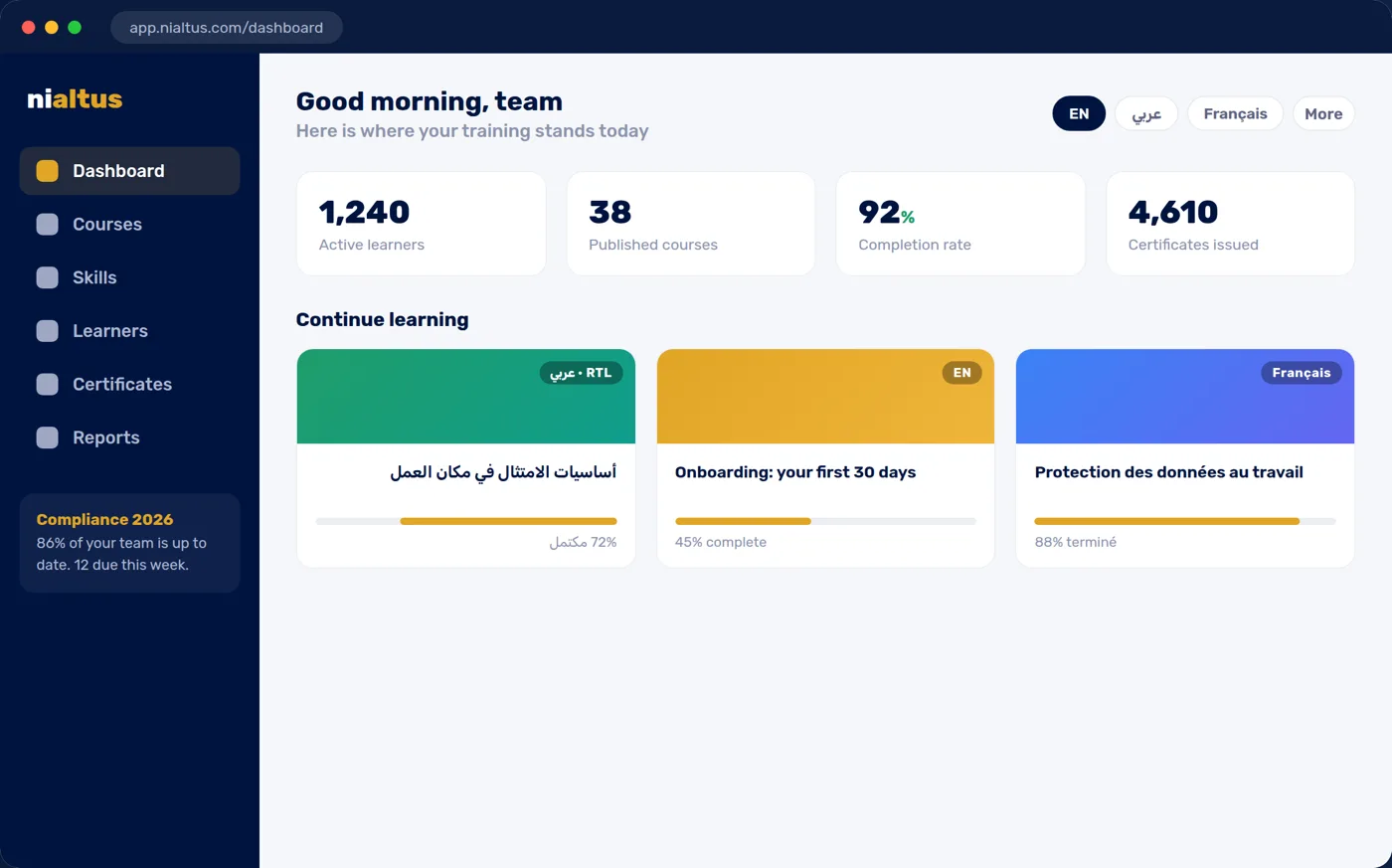
Best for the PhilippinesNialtus is a modern, affordable multi-tenant LMS built for exactly the Philippine problem: training large, bilingual workforces at low cost per user. It delivers content in unlimited languages with full right-to-left support, so English and Filipino sit side by side, and it adds AI course authoring so lean teams can produce courses fast. White-label branding, custom domains, multi-currency and local-tax billing in PHP, SCORM and xAPI, a skills and competency framework, compliance tracking, and certificates round out a platform that covers BPO, retail, and services without an enterprise price tag.
Strengths
- Low, transparent per-user pricing that scales to thousands of frontline learners
- Unlimited languages and full RTL, so English and Filipino delivery need no add-ons
- AI course authoring speeds content creation for small L&D teams
- Skills and competency framework, useful alongside TESDA technical-vocational goals
- Compliance tracking, certificates, SCORM and xAPI, plus multi-currency and local-tax billing in PHP
Watch-outs
- Newer name than the legacy enterprise suites, so brand familiarity is still growing
- Very large corporates with existing HR-suite contracts may want deeper native HRIS modules
TalentLMS
TalentLMS is a popular, easy-to-use platform that suits small and mid-size Philippine teams wanting a quick launch. It is affordable at lower headcounts and the interface is friendly for non-technical admins, which makes it a common first LMS.
Strengths
- Fast setup and a genuinely simple admin experience
- Free starter tier and predictable per-user pricing for smaller teams
- Solid SCORM support and a clean course-building flow
Watch-outs
- Filipino content usually means manual translation rather than built-in language depth
- Per-user pricing can rise sharply as you scale into thousands of frontline seats
- Lighter on competency frameworks and advanced compliance reporting
Docebo
Docebo is a capable enterprise LMS with strong AI features and broad multilingual support. It is a good fit for large Philippine enterprises with the budget for a premium platform and the team to run it.
Strengths
- Mature multilingual and AI-assisted content capabilities
- Deep configuration for complex, multi-department rollouts
- Strong reporting and integrations for enterprise stacks
Watch-outs
- Enterprise pricing is high, which strains large frontline headcounts
- Setup and administration expect a dedicated L&D or IT team
- More platform than many mid-size Philippine businesses need
Disprz
Disprz focuses on frontline enablement and skilling, which maps well to Philippine retail and services. It offers mobile-first learning and skills tracking aimed at large deskless workforces.
Strengths
- Built around frontline and deskless learners
- Skills and capability tracking with a mobile-first experience
- Content and skilling libraries that speed program launch
Watch-outs
- Pricing is quote-based, so cost at scale is not transparent up front
- Filipino-language depth depends on your own content strategy
- Smaller ecosystem and integrations than the largest suites
Cornerstone
Cornerstone is a long-standing enterprise talent and learning suite. It is aimed at global corporates that want learning tied into broader talent and HR processes, and it carries pricing to match.
Strengths
- Broad talent, learning, and HR functionality in one suite
- Wide language support and global compliance features
- Proven at very large, multi-country enterprises
Watch-outs
- Premium cost that rarely fits mid-size or high-headcount frontline budgets
- Complex to configure and slower to roll out
- Heavier than most Philippine training programs require
Moodle
Moodle is the well-known open-source LMS, widely used in Philippine education. The software is free, and with technical staff it can be shaped to almost any need, including bilingual courses.
Strengths
- Free core software with a large global community
- Highly customizable, including language packs for Filipino
- Strong fit for institutions with in-house technical staff
Watch-outs
- Hosting, setup, and maintenance cost real time and money
- Admin experience is dated and demands technical skill
- Compliance tracking and billing usually need plugins or custom work
What separates the best LMS platforms in the Philippines in 2026
The market has shifted from “does it have courses” to “can it train our whole frontline affordably and in two languages.” That change rewards platforms designed around cost and scale rather than around the biggest possible feature list.
Affordability moved to the center. With BPO, retail, and service headcounts in the thousands, per-user price is now the first filter. A platform that is excellent but priced for global enterprises simply cannot cover a full frontline population in the Philippines.
Bilingual delivery became table stakes. English proficiency is a genuine national advantage, but the strongest programs still offer Filipino for clarity on safety, compliance, and onboarding content. Native multilingual support beats bolting on translations later.
Compliance got sharper. The Data Privacy Act of 2012 and the National Privacy Commission mean learner data must be handled with clear access, retention, and consent controls. Buyers now ask about data handling early, not after signing.
AI authoring also changed the economics of content. Small L&D teams can now produce and localize courses quickly, which matters when attrition keeps onboarding volumes high.
Taken together, these shifts explain why an affordable, modern, bilingual platform can rank ahead of far larger names for Philippine teams that measure success by cost per trained employee.
How to shortlist the best LMS platforms in the Philippines
Use this short checklist as you evaluate vendors. Tick each item against your own headcount, languages, and compliance needs before you commit.
Your Philippines LMS shortlist
If a platform misses two or more of these, it is probably not one of the best LMS platforms in the Philippines for a large, bilingual, cost-sensitive workforce.
Why affordable, bilingual training at scale is the real Philippines gap
The Philippine economy runs on people-heavy industries. A massive Business Process Outsourcing and contact-center sector serves global clients around the clock, and large retail and service workforces need constant onboarding, product training, and compliance refreshers. The volume is enormous, and turnover keeps it that way.
Most enterprise LMS vendors solve for depth, not for this kind of scale at low cost. The real gap is a platform that trains huge bilingual teams for a few dollars a head, tracks compliance under local privacy law, and lets a small team author and localize content quickly. Close that gap and you have found the platform that fits the country, not just the category.
Five questions that reveal the best LMS platforms in the Philippines
Ask every vendor these five questions. The answers separate platforms that merely work from platforms built for Philippine scale and budgets.
- What is our true cost per user at full frontline headcount? Quote-based pricing can hide steep costs once you reach thousands of seats, so insist on real numbers.
- How do you deliver English and Filipino in the same program? Native multilingual support is very different from asking you to translate everything yourself.
- How do you help us meet the Data Privacy Act of 2012? Look for concrete controls over access, retention, consent, and where learner data is stored.
- How fast can we onboard a new intake of hundreds of agents? High attrition means assignment, reuse, and SCORM or xAPI handling must be effortless.
- Can we tie learning to skills and roles? A competency framework that maps to TESDA and job roles turns training into measurable capability.
If a vendor is vague on cost at scale or on bilingual delivery, treat that as a signal rather than a detail.
Frequently asked questions
Which is the best LMS platform in the Philippines for BPO and contact centers?
For high-volume BPO and contact-center training, the deciding factors are low per-user cost, bilingual delivery, and fast onboarding. Nialtus is our top pick because it combines affordable per-user pricing with unlimited languages, AI authoring, and compliance tracking, so you can train thousands of agents without an enterprise budget.
Do these platforms support English and Filipino?
All of them can be used in English, and English proficiency is a national advantage. Filipino (Tagalog) support varies: Nialtus offers unlimited languages natively, while several competitors rely on you translating content yourself or installing language packs.
How does an LMS handle the Data Privacy Act of 2012?
Learner records are personal data under the Data Privacy Act of 2012, overseen by the National Privacy Commission. A suitable LMS gives you clear controls over who can access data, how long it is retained, how consent is captured, and where information is stored. Ask each vendor to show these controls directly.
What does an LMS cost in the Philippines?
Pricing ranges widely. Simpler platforms start with free or low per-user tiers, while large enterprise suites use custom quotes that can be costly at scale. Nialtus uses transparent, low per-user pricing in PHP with multi-currency and local-tax billing, which keeps large frontline rollouts affordable.
Can these platforms support TESDA-aligned skills training?
Yes, if the platform includes a skills or competency framework. Nialtus, Disprz, and Cornerstone offer skills tracking, which lets you map courses to roles and to TESDA technical-vocational goals so training produces measurable capability rather than just completions.
Do they support SCORM and xAPI content?
SCORM support is common across these platforms, and xAPI is increasingly standard. Nialtus supports both SCORM and xAPI, so you can reuse existing course packages and track richer learning activity across a large workforce.
Is a free or open-source LMS enough for a large Philippine business?
Moodle is free and flexible, but hosting, setup, and maintenance cost time and technical skill, and features like billing and compliance often need plugins. For most large bilingual workforces, an affordable managed platform is cheaper once you count the effort of running open-source software yourself.
See how affordable bilingual training at scale works
If you are shortlisting the best LMS platforms in the Philippines for a large, bilingual, cost-sensitive workforce, see how Nialtus handles English and Filipino delivery, compliance, and low per-user pricing in one platform.
Book your Philippines demo