
LMS Buyer’s Guide · United Arab Emirates
Best LMS Platforms in the UAE (2026): An Honest Comparison
A practical, no-fluff look at the learning platforms UAE teams actually shortlist, judged on the things that matter here: real Arabic and right-to-left support, Emiratization-ready compliance tracking, AED pricing, and a workforce that speaks a dozen languages.
Book a free demoPicking a learning management system in the UAE is not the same problem as picking one in London or New York. Your workforce is multinational and multilingual. A growing share of your training is not optional, it is mandated. And half the platforms that look great in an English demo quietly fall apart the moment you switch the interface to Arabic.
This guide compares the best LMS platforms in the UAE that businesses shortlist most often, and scores each one on the criteria that actually decide the purchase here, not a generic feature checklist. We name the trade-offs plainly, including where our own platform, Nialtus, is and is not the right fit. If you only have two minutes, start with the comparison table, then read the review of whichever platform matches your situation.
At a glance: the best LMS platforms in the UAE
| Platform | Best for | Native Arabic + full RTL | Starting point | Our rating |
|---|---|---|---|---|
| Nialtus Top pick | Multilingual UAE teams that want Arabic done right without enterprise pricing | Yes, full RTL by design | Affordable, transparent | 4.8 / 5 |
| Docebo | Large enterprises with a big budget and an admin team | Supported, add-on feel | Enterprise ($$$$) | 4.3 / 5 |
| TalentLMS | Small teams that want fast setup in English | Partial | From ~$69/mo | 4.2 / 5 |
| Tadreeb LMS | Buyers who want a locally built, bilingual platform | Yes, bilingual focus | Custom quote | 4.0 / 5 |
| Disprz | Skills and capability programs at scale | Supported | Custom (enterprise) | 4.1 / 5 |
| Moodle | Teams with developers who want full control and no license fee | Yes, but you configure it | Free + hosting/support | 3.9 / 5 |
What UAE businesses actually need from an LMS
Before you compare features, get clear on the four things that separate a platform that works here from one that only works in the demo.
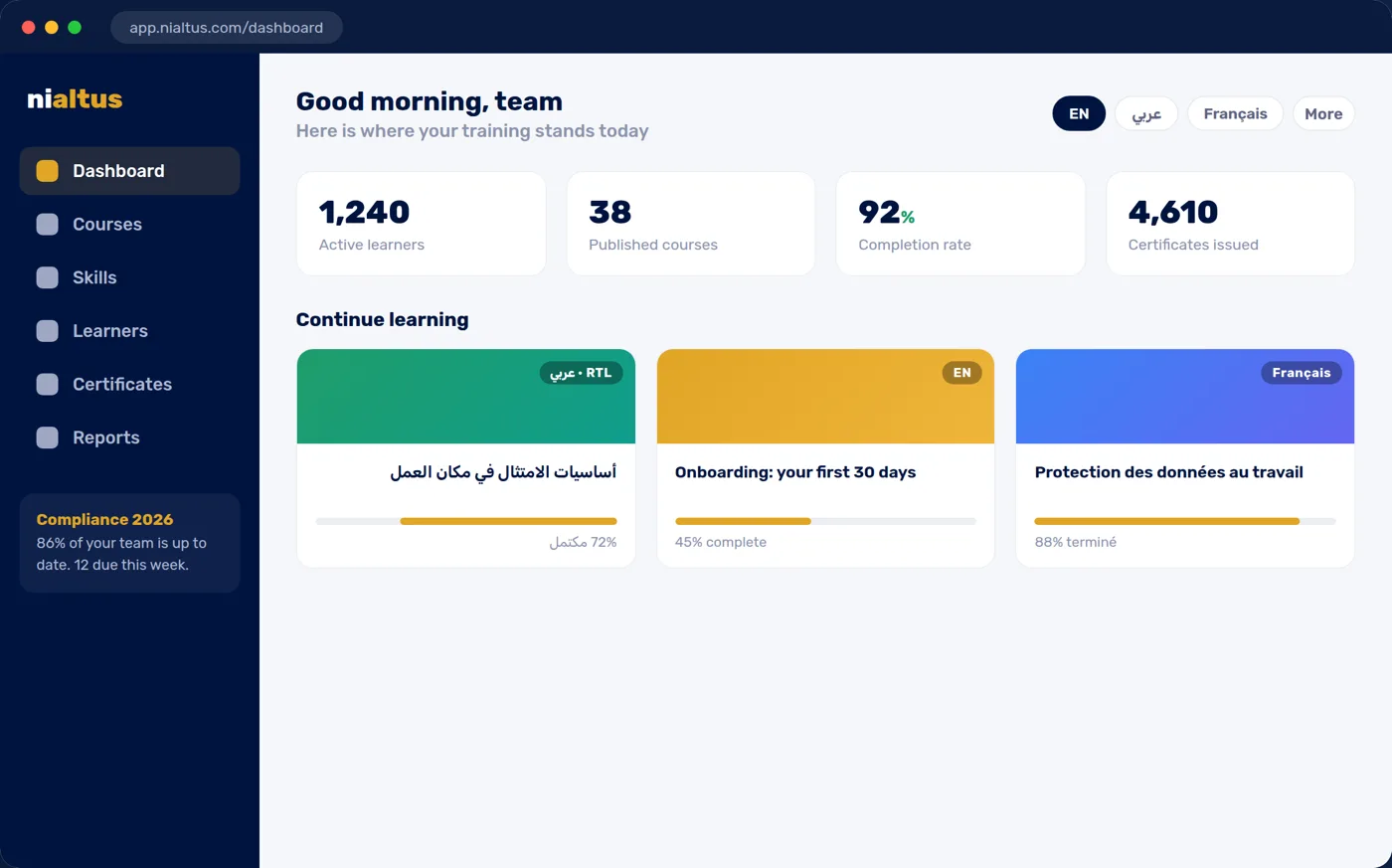
- Arabic that is more than translated text. Real right-to-left support mirrors the entire interface, the navigation, progress bars, buttons, forms, and reports, not just the paragraph text. Many global platforms bolt Arabic on and leave a half-mirrored experience. Always ask for a live Arabic demo before you sign.
- Many languages in one platform. A typical UAE company trains Emirati nationals, and staff from India, the Philippines, Egypt, the UK, and beyond. You need the same course delivered in several languages without buying a separate license for each.
- Compliance you can prove. Emiratization training, health and safety, and sector rules in banking and healthcare all need completion tracking and audit-ready certificates, not just a course library.
- Pricing and billing that fit the region. Budgets are set in AED. Transparent pricing and local-currency billing save you a painful procurement conversation later.
Why training just became non-optional in the UAE
Emiratization is now enforced with real money behind it. Mainland companies with 50 or more skilled employees must raise their Emirati workforce each year, and missing the target carries a fine of AED 108,000 per unfilled Emirati position (2025). At the same time, the government’s NAFIS program funds training and salary support to get nationals into private-sector roles.
The practical effect: you are not just hiring nationals, you have to onboard and upskill them fast, and prove it. An LMS that tracks completion and issues certificates for these programs is no longer a nice-to-have, it is how you stay compliant and claim the support you are entitled to.
The platforms, reviewed
Nialtus
Best for the UAENialtus is a modern, multi-tenant LMS built for teams that need genuine localization without an enterprise price tag. For the UAE specifically, its strongest card is Arabic: full right-to-left is built into the platform by design, so the whole interface flips correctly, not just the course text. It supports unlimited languages, so one course can reach your Emirati, South Asian, Filipino, and European staff from a single setup. Add AI course authoring, a skills and competency framework, white-label with your own domain, multi-currency billing with local tax, SCORM and xAPI support, and audit-ready certificates, and it covers the compliance and multilingual demands that define training here.
Strengths
- Arabic-first, full RTL you can verify in a live demo
- Unlimited languages in one platform
- AI authoring speeds up course building
- Compliance tracking and certificates for Emiratization and safety programs
- Affordable, transparent pricing and AED-friendly billing
- White-label and custom domain to keep it on-brand
Watch-outs
- Newer name than the global incumbents, so fewer brand-recognition points in a boardroom
- Not aimed at the very largest global enterprises that need hundreds of prebuilt integrations
- If you specifically require in-country UAE hosting, confirm the deployment options for your case
Docebo
Docebo is a powerful enterprise platform with deep AI features and a large integration ecosystem, and it has a real presence in the region including a Dubai office. If you are a large enterprise with a dedicated L&D admin team and a matching budget, it is a serious option. The trade-offs for a UAE mid-market buyer are cost and complexity: pricing starts high and is quote-based, the platform takes skilled admins to run well, and Arabic and RTL, while supported, tend to feel like a configured add-on rather than a first-class, polished experience.
Strengths
- Enterprise depth and mature AI features
- Very large integration ecosystem
- Regional presence and enterprise support
Watch-outs
- Premium, quote-only pricing that is heavy for the mid-market
- Needs trained admins to get value
- Arabic and RTL feel bolted on, not native
TalentLMS
TalentLMS is a favorite of small teams because it is genuinely easy and quick to set up, with transparent pricing that starts low. For an English-first UAE team of modest size, it gets you running fast. Where it strains is exactly where the UAE gets demanding: multilingual and Arabic RTL support is partial, and the platform is designed around smaller deployments, so multi-language, white-label, and deeper compliance needs push you toward its higher tiers or past its comfort zone.
Strengths
- Fast, simple setup
- Transparent, low entry pricing
- Good fit for small English-speaking teams
Watch-outs
- Partial Arabic and RTL support
- Thins out on multilingual and white-label needs
- Designed for smaller deployments
Tadreeb LMS
Tadreeb is built for the Middle East with a bilingual Arabic and English focus, which makes it a natural shortlist entry for buyers who want a locally minded platform. If Arabic-first delivery is your single priority and your feature needs are straightforward, it deserves a look. The main questions to ask are around breadth: modern extras like AI authoring, a full competency framework, multi-currency billing, and self-serve pricing transparency are where locally built platforms often trail the modern SaaS options.
Strengths
- Built for the region, bilingual by intent
- Local understanding of buyer needs
Watch-outs
- Narrower modern feature set
- Often high-touch rather than self-serve
- Pricing usually not transparent
Disprz
Disprz is a skills-first platform that shines when your goal is building measurable capability across a large workforce, and it is active across the region. It is a strong choice for enterprises running structured upskilling programs. For a smaller UAE buyer whose first need is simply Arabic-first course delivery at a predictable price, it can be more platform, and more process, than the job requires.
Strengths
- Strong skills and capability focus
- Built for scale
- Regional presence
Watch-outs
- Enterprise-oriented, heavier to adopt
- Custom pricing, less self-serve
- More than a small team usually needs
Moodle
Moodle is the open-source workhorse: no license fee, endlessly customizable, RTL-capable, and trusted worldwide. If you have developers and want total control, it is hard to beat on flexibility. The honest cost is effort. You host it, secure it, update it, and configure Arabic and everything else yourself, and a polished, modern learner experience takes real work. For most UAE companies without an in-house technical team, the total cost of running it well is higher than the free label suggests.
Strengths
- No license fee, fully open source
- Total control and customization
- RTL-capable
Watch-outs
- You host, secure, and maintain it
- Needs technical skill to run well
- Modern experience requires heavy setup
What separates the best LMS platforms in the UAE in 2026
The bar has moved. A few years ago, supporting Arabic and hosting some courses was enough to win a UAE deal. In 2026, buyers expect more, and the platforms that win reflect it.
AI that saves real time. The strongest platforms now use AI to draft courses, build quizzes, and speed up translation, turning weeks of authoring into days. For a lean UAE team juggling Arabic and English, that is the difference between launching this quarter and next year.
Skills, not just courses. Leading buyers want to see capability, not just completion. A competency framework that maps training to the skills your Emiratization and development plans actually need is becoming a baseline expectation, not a premium extra.
Proof on demand. With compliance tied to quotas and funding, pulling an audit-ready report in seconds is now a first-order requirement, not an afterthought.
Weigh any shortlist against these shifts. The best LMS platforms in the UAE are the ones already built for where the market is going, not where it was.
How to shortlist the best LMS platforms in the UAE
Use this checklist when you compare vendors, so a polished demo does not hide a gap you only find after you sign. Tick each item off as you test it.
Your UAE LMS shortlist
Whatever you shortlist, weigh it against these six points rather than a long feature grid. The best LMS platforms in the UAE are the ones that pass all six in a real test, not the ones with the longest brochure.
Why affordable and Arabic-first is the real UAE gap
Look closely at the shortlist and a pattern appears. The platforms with the deepest features are premium and quote-only, and their Arabic feels like an afterthought. The platforms with the best local Arabic focus tend to be narrower or high-touch. And the cheapest, easiest option thins out exactly where UAE compliance and multilingual needs get serious.
That leaves a clear opening for the platform that is genuinely Arabic-first, genuinely multilingual, modern in its feature set, and priced for the mid-market. That gap is the reason Nialtus lands first in this guide for the UAE, not because it beats every rival on every line, but because it fits the specific shape of the problem here better than the alternatives.
Five questions that reveal the best LMS platforms in the UAE
Vendors always demo their strengths. These five questions surface the weaknesses that matter here, and they are worth asking before any contract is signed.
- Can you show me the platform in Arabic, right now? A confident yes, on the spot, tells you the right-to-left experience is real. Hesitation tells you it is a setting someone still has to finish.
- How do learners on older phones and slower connections experience a course? Much of a UAE frontline workforce is mobile-first, and a heavy platform quietly loses them.
- What exactly is included at my price, and what triggers an upgrade? This exposes per-feature fees and the real cost at year two, not just the headline number.
- How do you handle a course that must exist in five languages at once? The answer reveals whether multilingual delivery is built in or billed per language.
- Where is our learner data stored, and who can access it? A clear, specific answer matters for compliance and for any government-adjacent work.
Ask these of every vendor on your shortlist. The best LMS platforms in the UAE answer all five without flinching, while the weaker options change the subject or promise to send details later.
Frequently asked questions
Which LMS has the best Arabic and right-to-left support in the UAE?
Look for full right-to-left by design, where the entire interface mirrors, not just the course text. Nialtus and locally built platforms like Tadreeb lead here, while global platforms such as Docebo and TalentLMS support Arabic but often deliver a partial or add-on experience. Always ask for a live Arabic demo before you decide, because a screenshot never shows a broken RTL flow.
Can an LMS help with Emiratization compliance?
Yes. The right platform tracks who has completed mandatory training, stores audit-ready records, and issues certificates, which is exactly what you need to demonstrate compliance and support your NAFIS-backed hiring. You still design the training content, but the LMS gives you the proof.
Is pricing available in AED, and are the platforms transparent?
It varies. TalentLMS and Nialtus publish transparent pricing, while Docebo, Disprz, and most locally built platforms are quote-only. Nialtus also supports multi-currency billing with local tax, which simplifies procurement for a UAE buyer.
Do we need in-country data hosting?
For most private-sector UAE companies, a reputable cloud platform with clear data handling is sufficient. If you work with government entities or in a regulated sector with strict data-residency rules, ask each vendor directly about hosting regions and residency options before you commit.
What is the best LMS for a mid-size UAE company?
For a multilingual mid-market team that needs real Arabic, compliance tracking, and predictable pricing, Nialtus is our top pick. If you are a very large enterprise with a big budget and an admin team, Docebo is worth evaluating. If you are a small English-first team, TalentLMS will get you started quickly.
How long does it take to launch an LMS in the UAE?
With a modern, self-serve platform you can be live in days, not months. The real work is loading your courses and setting up your Arabic and English content, not fighting the software. Enterprise platforms that need a services team and heavy configuration take far longer, which is worth weighing against your timeline for Emiratization and compliance deadlines.
Can one platform serve both Emirati and expatriate staff?
Yes, and it should. A UAE workforce mixes nationals with staff from across Asia, Europe, and the wider Arab world, so you need one course delivered in several languages, with Arabic first-class rather than an afterthought. That single-course, many-languages model is exactly where a genuinely multilingual platform earns its place over an English-first tool.
See the Arabic-first difference for yourself
The fastest way to judge an LMS for the UAE is to watch it run in Arabic and check whether the whole interface mirrors cleanly. Book a short walkthrough and we will show you full right-to-left, multilingual delivery, and compliance tracking in one place.
Book your UAE demo