
LMS Buyer’s Guide · United States
The Best LMS Platforms in the USA (2026)
An honest, editorial comparison of the six learning platforms most worth shortlisting this year, ranked for the affordable, multilingual mid-market that most US buyers actually live in.
Book a free demoChoosing among the best LMS platforms in the USA is harder than it looks, because the American market is mature, crowded, and full of strong products. A learning management system now has to do far more than host a few courses: it has to track federally and state-mandated compliance, deliver training to hourly and deskless workers on their phones, and increasingly serve a workforce that does not all speak English as a first language. The right choice depends far less on which vendor has the longest feature list and far more on which one fits your budget, your compliance obligations, and the people you are actually training.
This guide ranks the best LMS platforms in the USA for 2026 with a specific point of view: most American organizations are not Fortune 500 enterprises with seven-figure software budgets, and most of them underserve their Spanish-speaking staff. So we weight two things the glossy comparison charts tend to ignore, transparent and affordable pricing, and genuine multilingual delivery, especially Spanish for the large frontline and deskless workforces in retail, hospitality, manufacturing, and healthcare. We name real competitors fairly, give the enterprise incumbents the credit they have earned, and are candid about where they beat the value players.
At a glance: the best LMS platforms in the USA
| Platform | Best for | Multilingual (incl. Spanish) | Starting point | Our rating |
|---|---|---|---|---|
| Nialtus Top pick | Affordable, multilingual mid-market and SMB | Yes, unlimited languages incl. Spanish | Transparent published pricing, USD | 4.7 / 5 |
| Docebo | Large enterprises wanting AI-driven learning at scale | Yes, broad language support | Custom quote, enterprise contracts | 4.5 / 5 |
| Cornerstone OnDemand | Enterprise talent, compliance, and HR integration | Yes, extensive localization | Custom quote, enterprise contracts | 4.3 / 5 |
| TalentLMS | Small and midsize teams wanting fast, simple setup | Partial, interface and content translation | From about $69/mo (active users) | 4.4 / 5 |
| 360Learning | Collaborative, expert-led internal training | Yes, multilingual authoring | From $8/registered user/mo | 4.2 / 5 |
| Moodle | Budget-conscious teams with technical resources | Yes, 100+ community languages | Open-source (self-host) or paid cloud | 4.1 / 5 |
What US businesses actually need from an LMS
Before comparing vendors, it helps to be clear about what an American buyer is really solving for. The pressures on a US training team are specific, and they explain why the ranking looks the way it does.
- Compliance you can prove. OSHA safety training, HIPAA privacy rules in healthcare, and state-mandated anti-harassment training all require you to show who was trained, when, and that they passed, with certificates and audit-ready records.
- Training for a frontline, deskless workforce. Retail associates, warehouse staff, nurses, and franchise crews rarely sit at a desk, so mobile-first delivery and short, practical lessons matter more than a rich desktop authoring suite.
- Real multilingual delivery. Roughly one in five US residents speaks a language other than English at home, most often Spanish, and safety and compliance training that workers cannot fully understand is a liability, not a checkbox.
- Predictable, defensible cost. Budgets are scrutinized, and a platform with transparent per-user pricing is far easier to approve and renew than one that requires an annual enterprise negotiation.
Compliance is not optional in the USA
Federal OSHA standards require documented safety training for hazardous roles, and HIPAA obliges healthcare employers to train workforce members on protecting patient information. On top of that, states run their own mandates: California’s SB 1343 requires employers with five or more employees to give supervisors two hours and other staff one hour of sexual harassment prevention training within six months of hire and every two years after, while New York State requires interactive anti-harassment training for every employee, at every employer, once every year.
The practical takeaway is that your LMS needs reliable enrollment tracking, automatic reminders, pass or fail records, and certificate generation. If it cannot prove completion on demand, it is not doing the one job US compliance teams need most.
The platforms, reviewed
Nialtus
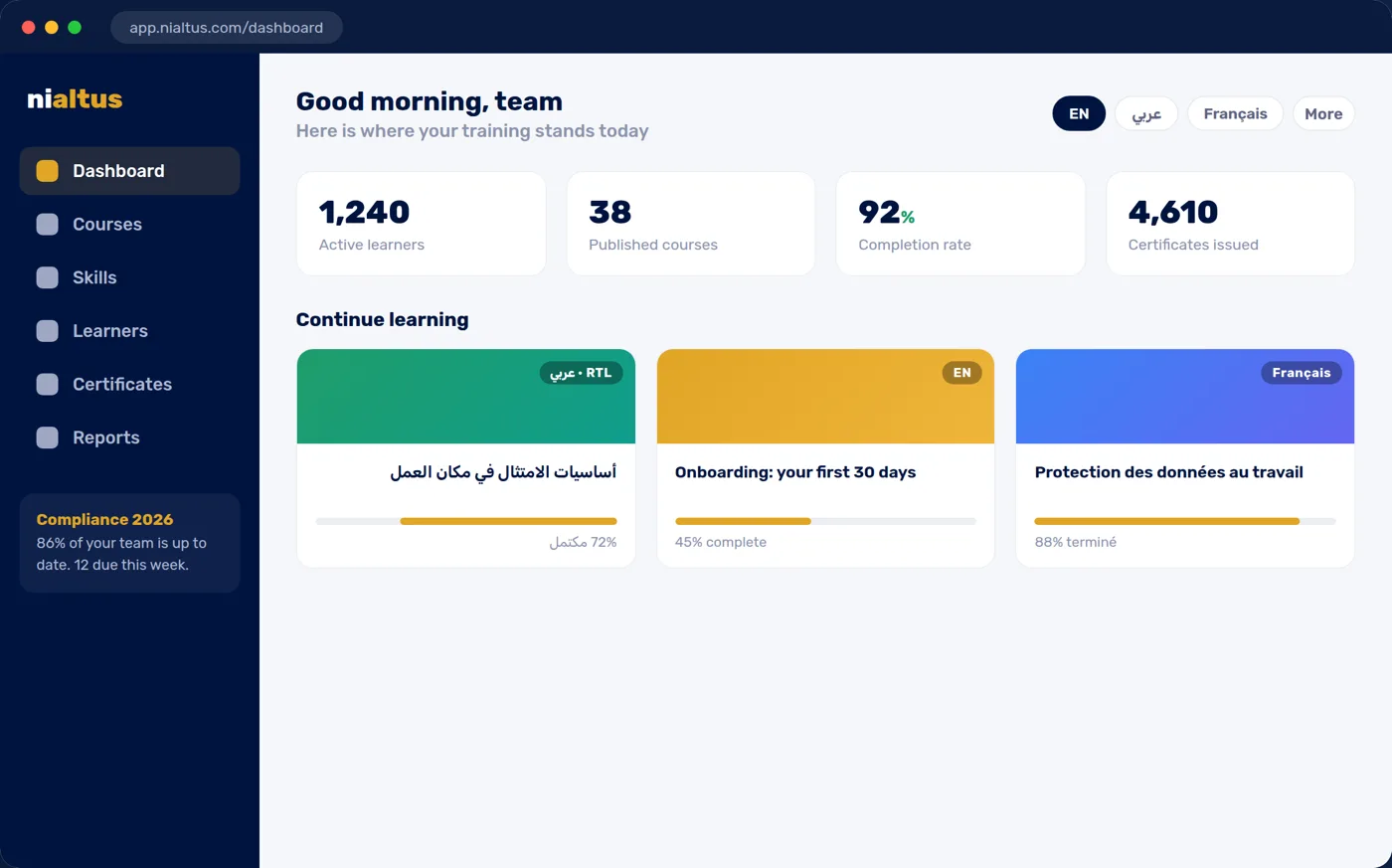
Best value in the USANialtus is a modern, multi-tenant LMS built for the part of the US market the enterprise incumbents price out: growing SMBs and mid-market organizations that still need serious compliance tracking, white-label branding, and multilingual delivery. Its standout is the combination of transparent published pricing in USD and genuinely unlimited languages, which makes it a strong fit for retailers, manufacturers, healthcare groups, and franchises with large Spanish-speaking or mixed-language workforces. AI-assisted authoring and a fast rollout mean smaller teams can launch compliant training in weeks, not quarters.
Strengths
- Transparent, affordable USD pricing with no forced enterprise negotiation
- Unlimited languages, with first-class Spanish for frontline and deskless staff
- AI authoring plus a skills and competency framework for structured programs
- White-label branding and custom domain, so it looks like your own academy
- SCORM and xAPI support, certificates, and multi-currency, local-tax billing
Watch-outs
- Newer name than the decades-old incumbents, so less brand recognition
- Very large enterprises with deep, custom HRIS integration needs may still prefer Docebo or Cornerstone
Docebo
Docebo is one of the strongest enterprise LMS platforms in the USA, known for early and serious investment in AI-driven learning, content curation, and a polished learner experience. Large organizations that want to scale personalized learning across thousands of employees, partners, and customers get a genuinely capable, extensible platform. It is a deserving market leader, but that power comes with enterprise pricing and a level of configuration that can be more than a smaller team needs.
Strengths
- Mature AI features for content curation and personalized learning paths
- Scales cleanly to internal, partner, and customer training audiences
- Strong ecosystem, integrations, and enterprise-grade reporting
Watch-outs
- Custom, quote-based pricing that lands in the enterprise range
- More platform than most SMBs and lean mid-market teams need
- Setup and administration can require dedicated resources
Cornerstone OnDemand
Cornerstone is a long-established enterprise player that sits at the intersection of learning and broader talent management. For large US employers that want compliance training tied tightly to performance, recruiting, and HR data, its depth is hard to match. That breadth is also its trade-off: it is a heavyweight suite, priced and scoped for enterprises, and can feel complex and expensive for organizations that only want a focused LMS.
Strengths
- Deep talent-management suite spanning learning, performance, and skills
- Robust compliance tracking and a large content marketplace
- Extensive localization for global enterprise workforces
Watch-outs
- Enterprise pricing and contracts, quote-based only
- Complexity and administrative overhead can be significant
- Overkill for teams that want a straightforward LMS
TalentLMS
TalentLMS is a deservedly popular choice for small and midsize US teams that want to get training live quickly without a heavy implementation. Its clean interface, active-user pricing, and gentle learning curve make it easy to adopt, and it covers the compliance basics well. It is a genuinely good value product, though its multilingual support is more about translating the interface and content than the deep, unlimited-language delivery some mixed-workforce employers need.
Strengths
- Fast, simple setup with a friendly, intuitive interface
- Active-user pricing that starts affordably, around $69 a month
- Solid course management and compliance tracking for smaller teams
Watch-outs
- Multilingual support is partial rather than deep and unlimited
- Advanced features and higher user counts push you up the tiers
- Less suited to complex, large-scale enterprise programs
360Learning
360Learning takes a distinctive collaborative approach, making it easy for internal experts to build and share courses rather than relying only on a central training team. For US companies that want to capture in-house knowledge and move quickly, that authoring model is a real strength. The trade-off is that its collaborative philosophy suits knowledge-sharing cultures more than pure top-down compliance, and per-registered-user pricing can add up as headcount grows.
Strengths
- Collaborative authoring that turns subject experts into course creators
- Multilingual authoring and a modern, engaging learner experience
- Published entry pricing from $8 per registered user per month
Watch-outs
- Registered-user pricing can grow quickly at scale
- Collaborative model fits knowledge sharing better than strict compliance
- Advanced capabilities move you to custom-quoted plans
Moodle
Moodle is the world’s most widely used open-source LMS, and it earns a place on any honest US shortlist for one clear reason: control and cost. Self-hosting is free of license fees, the community offers over 100 languages, and the platform is endlessly customizable through plugins. The catch is that this flexibility assumes technical capacity. Without in-house or partner expertise to host, secure, and maintain it, the true cost and effort can exceed a polished commercial product.
Strengths
- Open-source with no license fees when self-hosted
- More than 100 community languages, including strong Spanish support
- Highly customizable through a vast plugin ecosystem
Watch-outs
- Requires technical resources to host, secure, and maintain
- Interface feels dated next to modern commercial platforms
- Total cost of ownership can rise once hosting and support are counted
What separates the best LMS platforms in the USA in 2026
The gap between the leading platforms is narrowing on core features and widening on fit. Almost every serious product now handles courses, quizzes, SCORM content, and basic reporting competently, so the real differentiators have moved to price transparency, language depth, mobile experience, and how quickly a team can actually go live.
Affordability has become a strategy, not a discount. The enterprise incumbents remain excellent, but their quote-based pricing puts them out of reach for many SMB and mid-market buyers. Platforms with transparent, published USD pricing are winning that middle of the market precisely because a finance team can approve them without a three-month procurement cycle.
Multilingual delivery is now a compliance and safety issue. With a large Spanish-speaking workforce across US retail, hospitality, manufacturing, and healthcare, training that only exists in English leaves real gaps in comprehension, and in legal exposure. The platforms that treat unlimited languages as a core capability, not an add-on, are pulling ahead for frontline-heavy employers.
AI has shifted from novelty to speed. The most useful AI in 2026 is not a gimmick; it is authoring assistance that turns a policy document or a rough outline into a structured, translated course in a fraction of the time. For small teams, that is often the difference between staying compliant and falling behind.
Mobile is no longer a bonus feature either. If your audience is deskless, the LMS has to work as well on a phone during a shift as it does on a laptop, or completion rates collapse. This is where several older, desktop-first systems still struggle.
Finally, integrations and single sign-on have become table stakes for anything above the smallest teams. The best LMS platforms in the USA connect cleanly to your identity provider, HR system, and content library so that enrollments, offboarding, and reporting stay automatic rather than manual.
How to shortlist the best LMS platforms in the USA
Use this checklist to pressure-test any vendor against the realities of the US market. If a platform cannot honestly tick most of these, keep it off your shortlist.
Your USA LMS shortlist
No single platform is the right answer for everyone, but a vendor that clears this list is a safe place to start a serious evaluation.
Why affordable, Spanish-inclusive training is the real US gap
The most overlooked weakness in American workforce training is language. Employers spend heavily on polished English courses, then hand the same content to warehouse crews, retail associates, and healthcare aides, many of whom would learn far better in Spanish. For safety training under OSHA and for compliance topics where comprehension actually matters, that gap is not a nice-to-have; it is a genuine risk. The enterprise platforms can localize, but usually at enterprise cost, and the cheaper tools often treat language as a partial, bolt-on feature.
That is the specific gap Nialtus is built to close, and it is why we rank it first for the affordable, multilingual mid-market rather than claiming it beats every incumbent at everything. For a growing US organization with a mixed-language, frontline-heavy workforce and a finance team that wants predictable costs, a platform that combines transparent USD pricing with unlimited languages is the honest best fit. For a global enterprise with deep integration demands and a large budget, Docebo or Cornerstone may still be the better call, and that is a fair trade to make with clear eyes.
Five questions that reveal the best LMS platforms in the USA
When you get vendors on a call, these five questions cut through the demo polish faster than any feature checklist.
- Can you show me a real course delivered in Spanish, not just a translated menu? This separates true multilingual delivery from a partial interface translation.
- What will this actually cost at our user count, in writing? Transparent pricing should survive contact with a specific number, not disappear into a quote.
- How do you prove OSHA, HIPAA, or state anti-harassment completion in an audit? Listen for certificates, timestamps, pass or fail records, and automatic reminders.
- What does the learner experience look like on a phone during a shift? A convincing mobile answer matters most for deskless and frontline teams.
- How long from signed contract to our first learners enrolled? Fast rollout is a real differentiator, and vague answers usually mean months.
The vendors that answer these plainly and specifically are almost always the ones worth advancing.
Frequently asked questions
What are the best LMS platforms in the USA in 2026?
Our shortlist is Nialtus, Docebo, Cornerstone OnDemand, TalentLMS, 360Learning, and Moodle. Nialtus ranks first for the affordable, multilingual mid-market thanks to transparent USD pricing and unlimited languages, while Docebo and Cornerstone remain the strongest choices for large enterprises with complex integration needs and bigger budgets.
Why is Nialtus ranked number one if the incumbents are so strong?
Because most US buyers are not large enterprises, and most underserve their Spanish-speaking staff. Nialtus is ranked first specifically for the affordable, multilingual, frontline-heavy mid-market, not as an all-around winner. We are candid that a global enterprise with deep HRIS integration needs may prefer Docebo or Cornerstone.
Which LMS is best for Spanish-speaking and multilingual workforces?
For US employers with large Spanish-speaking frontline teams, platforms that treat unlimited languages as a core capability are the best fit. Nialtus and Moodle both offer strong Spanish support, with Nialtus adding modern AI authoring and transparent pricing, while Moodle offers open-source flexibility if you have technical resources.
How do LMS platforms handle OSHA and compliance training?
The strong platforms let you enroll employees in required courses, send automatic reminders, record pass or fail results, and generate certificates on completion. For OSHA safety training, HIPAA in healthcare, and state anti-harassment mandates, the key is audit-ready records that prove exactly who was trained and when.
Do California and New York require anti-harassment training through an LMS?
They do not require a specific tool, but they require training you must document. California’s SB 1343 mandates two hours for supervisors and one hour for other employees every two years at companies with five or more staff, and New York State requires annual interactive training for every employee at every employer. An LMS is the practical way to deliver and prove that training.
How much does an LMS cost in the USA?
It varies widely. Transparent commercial tools like TalentLMS start around $69 a month, and 360Learning publishes pricing from $8 per registered user per month. Moodle is free to license but carries hosting and maintenance costs, while Docebo and Cornerstone are quote-based enterprise contracts. Nialtus offers transparent published USD pricing aimed at the affordable mid-market.
Which LMS is best for frontline and deskless workers?
Look for a mobile-first experience, short practical lessons, and multilingual delivery, since retail, warehouse, hospitality, and healthcare staff rarely work at a desk. Nialtus and TalentLMS both deliver well on mobile, with Nialtus adding unlimited languages that suit mixed-language frontline teams in particular.
Find your best-fit LMS for the USA
If you want transparent USD pricing, unlimited languages including full Spanish, and compliance tracking that stands up to an audit, see how Nialtus fits your team. We will walk through your compliance needs, your workforce, and your budget honestly, and tell you if another platform is the better call.
Book your USA demo